4.6
183 verified reviews
About
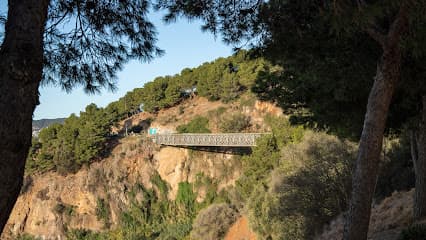
The Pont de Mühlberg isn’t here to be pretty. It’s a steel-and-iron needle stitching together the rugged, sun-baked hills of Horta-Guinardó, and it doesn’t give a damn if you’re afraid of heights. This is the industrial side of Barcelona—the side that doesn’t make it onto the glossy postcards sold on La Rambla. It’s a pedestrian bridge that spans the massive, jagged void of the old Can Baró limestone quarry, a hole in the earth that once provided the literal building blocks for the city sprawling out below your feet.\n\nTo get here, you have to earn it. You’re not just strolling out of a metro station into a plaza; you’re climbing. You’re navigating the steep, narrow streets of a neighborhood where laundry flutters like prayer flags from balconies and old men sit in bars that haven't changed their decor since the eighties. By the time you reach the bridge, you’ll have a light sheen of sweat and a newfound respect for the local grandmothers who do this climb with grocery bags every day. But the moment you step onto those wooden planks—some of them held down by nails that look like they’ve seen better decades—the effort pays off. The wind whips through the iron railings, and suddenly, the city opens up.\n\nFrom the center of the span, you’re looking down into the belly of the old quarry, a reminder of the labor that built the Eixample. Look out, and you’ve got a panoramic shot of the Sagrada Família, the Agbar Tower, and the Mediterranean shimmering in the distance. It’s a view that feels earned, not bought. You’re standing on a piece of 1991 engineering, built just before the Olympics transformed this city into a global playground, and it still retains that sense of functional, unpretentious grit. It’s the gateway to the Bunkers del Carmel, but while the Bunkers have become a bit of a sunset circus for the Instagram crowd, the bridge remains a quieter, more visceral experience.\n\nThere’s a certain honesty to the Pont de Mühlberg. It’s a place where you can feel the scale of Barcelona—not just the architecture, but the geography. You see how the city is hemmed in by the mountains and the sea, a dense, breathing organism of stone and life. You’ll see locals walking their dogs, joggers punishing their knees on the incline, and the occasional traveler who took the wrong bus and ended up somewhere much more interesting than they intended. The bridge is part of the 'Ruta del Carmel,' a path that winds through the history of the Civil War and the post-war shantytowns that once clung to these hills.\n\nDon’t come here if you want a manicured park experience with gravel paths and gift shops. Come here if you want to feel the wind in your face and see the city for what it actually is: a beautiful, messy, sprawling triumph of human will over a difficult landscape. It’s one of the best things to do in Horta-Guinardó if you want to escape the suffocating crowds of the center. Just watch your step on those planks, hold onto your hat, and take a moment to realize that the best views in Barcelona are usually the ones you have to climb for.
Type
Bridge, Tourist attraction
Duration
30-45 minutes
Best Time
Late afternoon for the golden hour light, just before heading to the Bunkers for sunset.
What People Say
bunker(6)nails(5)park(3)bus(3)quarry(2)panoramic view(2)forest(2)history(2)
Features
Bridge
Tourist attraction
Categories
ArchitectureViewpointParkIndustrial Heritage
Ticket Prices
Free Admission
No tickets required
Opening Hours
- MondayOpen 24 hours
- TuesdayOpen 24 hours
- WednesdayOpen 24 hours
- ThursdayOpen 24 hours
- FridayOpen 24 hours
- SaturdayOpen 24 hours
- SundayOpen 24 hours
Must-See Highlights
The view of the Sagrada Família framed by the bridge's iron cables
The sheer drop into the Can Baró quarry directly beneath the span
The weathered wooden planks that give the bridge its tactile, raw character
Visitor Tips
Wear sturdy shoes; the climb up from the bus stop is no joke.
Check the wooden planks for loose nails or uneven surfaces as you walk.
Combine this with a visit to the Bunkers del Carmel, but do the bridge first to avoid the peak sunset crowds.
Good For
PhotographersBudget travelersHikersView seekers
Why Visit
Spans a massive former limestone quarry with dramatic drops
Industrial 1990s architecture offering an unfiltered urban aesthetic
Direct pedestrian link between Parc del Guinardó and the Bunkers del Carmel
Nearby Landmarks
- Bunkers del Carmel (8-minute walk)
- Parc del Guinardó (2-minute walk)
- Park Güell (20-minute walk via hilly terrain)
Accessibility
- The bridge itself is flat and accessible, but the approach roads are very steep and may be difficult for manual wheelchairs.
Location
Carrer de Mühlberg, 94
Municipality of Horta-Guinardó, Barcelona
Nearby Hotels
Nearby Restaurants
In Municipality of Horta-Guinardó
ATTRACTION
メリーゴーランド
Municipality of Horta-Guinardó
A spinning, neon-lit relic of neighborhood childhood, tucked away in the dusty, unvarnished heart of Horta-Guinardó, far from the Gaudi-crazed tourist herds.
0.0(0)
Park
ATTRACTION
SunsetBoatBarcelona
Municipality of Horta-Guinardó
Escape the sweltering, tourist-choked streets for the open Mediterranean, where the city skyline bleeds into the dusk and the Cava actually tastes like freedom.
0.0(0)
Tourist attraction

ATTRACTION
Labyrinth
Municipality of Horta-Guinardó
Barcelona’s oldest garden is a neoclassical middle finger to the city’s chaos, featuring a cypress maze where you can actually lose yourself—and the crowds—for a few euros.
0.0(0)
Tourist attraction
Frequently Asked Questions
Is Pont de Mühlberg worth visiting?
Absolutely, if you want a panoramic view of Barcelona without the crowds of the city center. It offers a unique industrial perspective and is a great stop on the way to the Bunkers del Carmel.
How do I get to Pont de Mühlberg?
Take the V19 or 24 bus to the stop 'Mühlberg - Carretera del Carmel.' From there, it's a short but steep walk to the bridge entrance.
Is there an entrance fee for the bridge?
No, the Pont de Mühlberg is a public pedestrian bridge and is completely free to access 24 hours a day.
Is the bridge safe for people with vertigo?
It can be challenging. The bridge is high and the wooden slats allow you to see through to the quarry below in some spots, so those with a severe fear of heights should be cautious.
Reviews
0 reviews for Pont de Mühlberg
No reviews yet. Be the first to share your experience!