4.3
2,413 verified reviews
About
Barcelona isn’t all flat, sun-drenched boulevards and Gothic gargoyles. If you want to understand how this city actually breathes, you have to head north, away from the sea, until your calves start to burn and the air starts to smell less like diesel and more like Aleppo pine. You end up in Horta-Guinardó, a neighborhood that doesn’t give a damn about your Instagram feed. At the heart of this vertical scramble sits the Plaça del Nen de la Rutlla, a modest, dusty clearing that serves as the staging ground for one of the city’s most honest experiences.
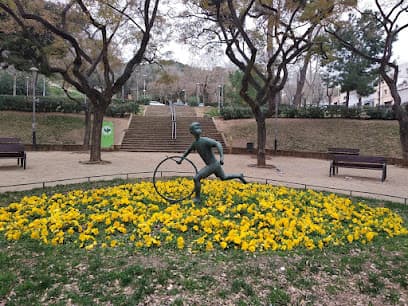
The centerpiece is the statue itself: 'El Nen de la Rutlla,' or the Boy with the Hoop. Cast in bronze by Joaquim Ros i Bofarull in 1961, it’s a snapshot of a Barcelona that’s mostly vanished—a kid frozen in the middle of a game that required nothing more than a metal ring and a stick. He’s lean, focused, and eternally mid-stride. He’s also the unofficial gatekeeper to the Parc del Guinardó. While the tourists are busy elbowing each other at Park Güell, the locals are here, sitting on the benches, letting their dogs run wild, and preparing for the hike up to the Bunkers del Carmel.
This isn't a place for a curated picnic with cava and artisanal cheese. It’s a place for a cheap beer from the corner store and a moment to catch your breath. The plaza feels lived-in. You’ll see old men in flat caps arguing about the state of FC Barcelona, teenagers plotting their night, and a constant stream of joggers who seem to have lungs made of carbon fiber. There’s a grit here that you won’t find in the Eixample. The pavement is worn, the trees are rugged, and the wind carries the sound of the city humming far below.
From this plaza, the city starts to reveal its true scale. You’re at the entrance to one of the best parks in Barcelona, a sprawling, tiered landscape of stone walls and forest paths. If you follow the path upward from the statue, the incline gets serious. This is the gateway to the Turó de la Rovira, home to the famous anti-aircraft fortifications known as the Bunkers. Most people use the Plaça del Nen de la Rutlla as a mere waypoint, a landmark to meet friends before the final ascent for sunset. But if you linger, you see the rhythm of the barrio. It’s a neighborhood park in the truest sense—a communal backyard for people who live in apartments stacked like shoeboxes on the surrounding hills.
Is it 'beautiful' in the traditional sense? Maybe not. It’s functional. It’s a transition zone between the dense urban grid and the wilder, unkempt edges of the Collserola. But there is a specific kind of magic in the way the late afternoon light hits the bronze boy, casting a long shadow across the stones. It’s a reminder that despite the millions of visitors, there are still corners of this city that belong entirely to the people who call it home.
If you’re looking for things to do in Horta-Guinardó, start here. Don’t expect a gift shop or a guided tour. Just bring a sturdy pair of shoes, a bottle of water, and a willingness to sweat. The reward isn't just the view at the top; it's the realization that you’ve stepped out of the bubble and into the real, messy, uphill heart of Barcelona. It’s honest, it’s steep, and it’s exactly what a city park should be.
Type
Park, Tourist attraction
Duration
30-45 minutes (more if hiking)
Best Time
Late afternoon or sunset to catch the light on the statue before heading to the Bunkers.
What People Say
dog(28)game(22)ideal(17)bunkers(11)party(10)bank(10)maintenance(8)sculptures(8)
Features
Park
Tourist attraction
Categories
Public SquareSculptureHikingLocal Life
Ticket Prices
Free Admission
No tickets required
Opening Hours
- MondayOpen 24 hours
- TuesdayOpen 24 hours
- WednesdayOpen 24 hours
- ThursdayOpen 24 hours
- FridayOpen 24 hours
- SaturdayOpen 24 hours
- SundayOpen 24 hours
Must-See Highlights
The 'Nen de la Rutlla' bronze statue
The panoramic views starting just above the plaza
The entrance to the pine forests of Parc del Guinardó
Visitor Tips
Wear comfortable shoes; the walk from the metro is a serious incline.
Stop at a local 'supermercat' nearby for water and snacks before heading further up the hill.
This is a residential area, so keep noise levels down, especially in the evening.
Good For
Dog ownersHikersBudget travelersPhotography enthusiastsLocals
Why Visit
Authentic gateway to the Bunkers del Carmel and Parc del Guinardó
Iconic 1960s bronze sculpture representing traditional Catalan childhood
Unfiltered local atmosphere far from the typical tourist trail
Nearby Landmarks
- Parc del Guinardó (1-minute walk)
- Bunkers del Carmel / Turó de la Rovira (15-minute uphill walk)
- Hospital de Sant Pau (12-minute walk)
- Parc de les Aigües (10-minute walk)
Accessibility
- Outdoor public space
- Steep surrounding terrain
- Paved areas but significant inclines in the neighborhood
Location
Municipality of Horta-Guinardó, Barcelona
Nearby Hotels
Nearby Restaurants
In Municipality of Horta-Guinardó
ATTRACTION
メリーゴーランド
Municipality of Horta-Guinardó
A spinning, neon-lit relic of neighborhood childhood, tucked away in the dusty, unvarnished heart of Horta-Guinardó, far from the Gaudi-crazed tourist herds.
0.0(0)
Park
ATTRACTION
SunsetBoatBarcelona
Municipality of Horta-Guinardó
Escape the sweltering, tourist-choked streets for the open Mediterranean, where the city skyline bleeds into the dusk and the Cava actually tastes like freedom.
0.0(0)
Tourist attraction

ATTRACTION
Labyrinth
Municipality of Horta-Guinardó
Barcelona’s oldest garden is a neoclassical middle finger to the city’s chaos, featuring a cypress maze where you can actually lose yourself—and the crowds—for a few euros.
0.0(0)
Tourist attraction
Frequently Asked Questions
Is Plaça del Nen de la Rutlla worth visiting?
Yes, if you want to experience an authentic local neighborhood and are planning to hike up to the Bunkers del Carmel or explore Parc del Guinardó. It offers a raw look at Barcelona life away from the main tourist hubs.
How do I get to Plaça del Nen de la Rutlla?
The easiest way is to take the Metro L4 (Yellow Line) to Alfons X or Guinardó | Hospital de Sant Pau and walk uphill. Several buses, including the V23 and D40, also stop nearby.
What is the statue in the plaza?
The statue is 'El Nen de la Rutlla' (The Boy with the Hoop), a bronze work by Joaquim Ros i Bofarull installed in 1961, depicting a traditional children's game.
Is it a good spot for kids and dogs?
Absolutely. It's a very popular spot for local dog owners and has space for children to play, though be mindful that the surrounding area is quite steep.
Reviews
0 reviews for Plaça del Nen de la Rutlla
No reviews yet. Be the first to share your experience!