4.1
681 verified reviews
About
If you’re looking for the gingerbread houses of Park Güell or the manicured rose gardens of the Ciutadella, do yourself a favor and get off the metro somewhere else. Plaça de la Vall d'Hebron isn't interested in your vacation photos. It’s a sprawling, concrete-heavy, unapologetically urban space that serves as a reminder of what Barcelona actually is when the cameras aren't rolling: a living, breathing city that had to reinvent itself in 1992 and never quite looked back.
The first thing that hits you—the gut punch—is the 'Mistos.' It’s a massive sculpture of a matchbook by Claes Oldenburg and Coosje van Bruggen. Five giant matches, some burnt, some scattered, rising out of the pavement like a surrealist fever dream. It’s pop art on a scale that makes you feel like an ant in a giant’s kitchen. In a neighborhood dominated by the massive, looming presence of the Vall d'Hebron Hospital, this burst of primary colors and absurd scale is exactly the kind of weirdness this city does best. It’s not 'pretty' in the traditional sense; it’s bold, it’s slightly aggressive, and it’s undeniably cool.
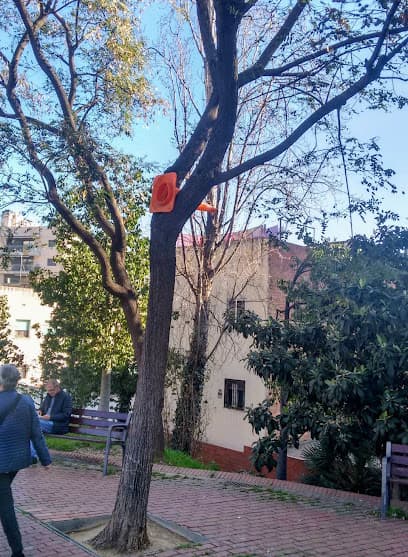
This isn't a place for tourists to congregate; it’s a place for the people of Horta-Guinardó. You’ll see old men occupying the benches (the 'banks' mentioned in every local review) with the kind of permanence that suggests they were installed with the concrete. You’ll see kids screaming across the playground, oblivious to the fact that they’re playing in the shadow of world-class contemporary art. There’s a specific kind of melancholy here, too—the park sits right across from one of the largest hospitals in Catalonia. People come here to pace, to smoke, to wait for news, or to just breathe in the shadow of the trees. It gives the place a weight, a human gravity that you don't find at the Sagrada Família.
Historically, this area was the heart of the 1992 Olympic transformation. Before the games, this was the edge of the world, a neglected fringe. The Olympics brought the Pavelló de la Vall d'Hebron and the archery ranges, turning this into a hub of international sport. Today, that energy has settled into a quiet, functional dignity. The park offers plenty of shadow—a commodity more valuable than gold in a Barcelona July—thanks to a decent canopy of trees that softens the hard edges of the surrounding apartment blocks and transit arteries.
Is it worth the trek up the L3 green line? If you give a damn about the 1992 Olympic legacy or you want to see one of the most iconic pieces of public art in Europe without a thousand selfie sticks in your peripheral vision, then yes. It’s a window into the real Horta-Guinardó, a neighborhood that feels like a village swallowed by a metropolis. It’s steep, it’s breezy, and it’s honest. Come here to see the matches, stay to watch the sun hit the hills of Collserola, and appreciate a part of Barcelona that doesn't care if you like it or not. That’s the real magic of this city—the parts that belong to the locals, where the coffee is cheap, the service is brisk, and the art is big enough to crush you.
Type
Park
Duration
45-60 minutes
Best Time
Late afternoon when the sun hits the 'Mistos' sculpture and the neighborhood comes alive with locals.
What People Say
kids(10)shadow(7)bank(6)trees(6)sit(5)game(5)hospital(4)breath(4)
Features
Park
Categories
Public ArtOlympic HistoryArchitectureFamily Friendly
Ticket Prices
Free Admission
No tickets required
Opening Hours
- MondayOpen 24 hours
- TuesdayOpen 24 hours
- WednesdayOpen 24 hours
- ThursdayOpen 24 hours
- FridayOpen 24 hours
- SaturdayOpen 24 hours
- SundayOpen 24 hours
Must-See Highlights
The 'Mistos' (Matches) sculpture
The views of the Collserola hills
The Olympic-era Pavelló de la Vall d'Hebron
Visitor Tips
Bring a camera for the sculpture; the scale is incredible.
Combine this with a visit to the nearby Horta Labyrinth Park for a full afternoon.
There are several local bakeries nearby on Passeig de la Vall d'Hebron for a cheap snack.
Good For
Art loversFamilies with kidsPhotography enthusiastsBudget travelers
Why Visit
The iconic 'Mistos' sculpture by Claes Oldenburg
Authentic local atmosphere far from the tourist center
Significant 1992 Olympic Games heritage site
Nearby Landmarks
- Hospital de la Vall d'Hebron (2-minute walk)
- Metro Vall d'Hebron L3/L5 (1-minute walk)
- Velòdrom d'Horta (10-minute walk)
- Laberint d'Horta (15-minute walk)
Accessibility
- Fully wheelchair accessible
- Flat paved surfaces
- Elevator access from Metro
Location
Carrer de la Vall d'Hebron, 6
Municipality of Horta-Guinardó, Barcelona
Nearby Hotels
Nearby Restaurants
In Municipality of Horta-Guinardó
ATTRACTION
メリーゴーランド
Municipality of Horta-Guinardó
A spinning, neon-lit relic of neighborhood childhood, tucked away in the dusty, unvarnished heart of Horta-Guinardó, far from the Gaudi-crazed tourist herds.
0.0(0)
Park
ATTRACTION
SunsetBoatBarcelona
Municipality of Horta-Guinardó
Escape the sweltering, tourist-choked streets for the open Mediterranean, where the city skyline bleeds into the dusk and the Cava actually tastes like freedom.
0.0(0)
Tourist attraction

ATTRACTION
Labyrinth
Municipality of Horta-Guinardó
Barcelona’s oldest garden is a neoclassical middle finger to the city’s chaos, featuring a cypress maze where you can actually lose yourself—and the crowds—for a few euros.
0.0(0)
Tourist attraction
Frequently Asked Questions
Is Plaça de la Vall d'Hebron worth visiting?
Yes, especially for fans of contemporary art and Olympic history. The 'Mistos' sculpture is a world-class piece of pop art that you can enjoy without the typical Barcelona crowds.
What is the giant matchstick sculpture in Barcelona?
It is called 'Mistos' (Matches), created by artists Claes Oldenburg and Coosje van Bruggen for the 1992 Olympic Games. It features a giant matchbook with several scattered matches.
How do I get to Plaça de la Vall d'Hebron?
Take the L3 (Green Line) or L5 (Blue Line) of the Barcelona Metro to the Vall d'Hebron station. The park is located directly outside the station exits.
Is there anything else to see nearby?
Yes, you are close to the Laberint d'Horta (Horta Labyrinth Park) and the Velòdrom d'Horta, both of which are within a 15-minute walk or a short bus ride.
Reviews
0 reviews for Plaça de la Vall d'Hebron
No reviews yet. Be the first to share your experience!