4.1
988 verified reviews
About
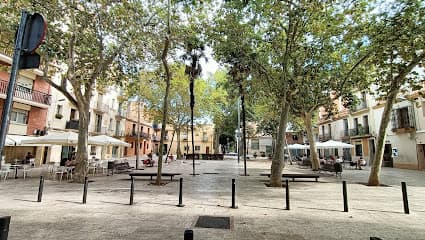
Most tourists in Barcelona are busy elbowing each other for a photo of a building that looks like a melting candle. They stay in the center, trapped in a loop of overpriced paella and sangria that tastes like cough syrup. Their loss. If you want to see where the city actually breathes, you get on the L5 metro and head north to Horta. You get off at the stop that feels like a different century and walk until you hit Plaça de Bacardí.\n\nThis isn’t a 'park' in the way an American suburbanite thinks of one. It’s a social lung. It’s a dusty, sun-dappled rectangle of gravel and stone surrounded by 19th-century houses that have seen better days and don't care. The first thing you’ll hear isn't a tour guide’s drone; it’s the rhythmic, hollow thwack-thwack of a plastic ball hitting a concrete ping pong table. It’s the soundtrack of the neighborhood. Old men who have lived here since the transition to democracy sit on benches, watching the world go by with the kind of practiced indifference you can only earn through decades of observation. Kids scream, chasing each other through the legs of parents who are more interested in their third glass of vermut than in helicopter parenting.\n\nThere’s a history here, too, though it doesn't shout at you. The name Bacardí? Yeah, that Bacardí. Before the family became the kings of Caribbean rum, they were here. Facundo Bacardí Massó was born down the road in Sitges, but the family owned the land this square sits on—part of what was once the 'Eixample de Horta.' It was an ambitious expansion for a village that didn't want to be part of the big city. Today, the rum empire is long gone, but the name remains etched into the identity of this corner of the Horta-Guinardó district.\n\nThe square is lined with bars that don't have menus in six languages. They have terraces that spill out onto the pavement, where the beer is cold, the olives are salty, and the service is exactly as brusque as it needs to be. You sit at a place like L'Eivissenc or one of the nameless little holes-in-the-wall, and you watch the light change. The orange trees provide a bit of shade, and the surrounding architecture—low-slung, colorful, and slightly crumbling—reminds you that Barcelona was once a collection of fiercely independent villages before it became a global brand.\n\nIs it 'beautiful'? Not in a postcard way. It’s better than that. It’s honest. There are no gift shops selling plastic bulls. There are no human statues waiting for a coin. There’s just the smell of frying garlic, the sound of the wind in the trees, and the feeling that you’ve finally found a place where the city isn't trying to sell you anything. It’s a place to exist, to drink, and to realize that the best parts of travel aren't the monuments—they’re the spaces in between them where life actually happens. If you want to know what Horta is actually about, sitting here for two hours with a cold drink and zero plans is the only item on the agenda.
Type
Park
Duration
1-2 hours
Best Time
Late afternoon or early evening when the terraces are full and the neighborhood comes alive.
What People Say
square(92)children(49)sidewalk cafe(35)ping pong table(20)games(18)tapas(12)menu(8)bank(5)
Features
Park
Categories
Public SquareLocal CultureHistoryUrban Space
Ticket Prices
Free Admission
No tickets required
Opening Hours
- MondayOpen 24 hours
- TuesdayOpen 24 hours
- WednesdayOpen 24 hours
- ThursdayOpen 24 hours
- FridayOpen 24 hours
- SaturdayOpen 24 hours
- SundayOpen 24 hours
Must-See Highlights
The 19th-century residential architecture surrounding the square
The public ping pong tables where locals play intensely
The orange trees that provide shade to the cafe terraces
The nearby Carrer de Campoamor with its stunning villas
Visitor Tips
Don't expect English menus; brush up on basic Spanish or Catalan food terms.
Bring your own ping pong paddles if you want to join the local games.
Combine this with a visit to the nearby Labyrinth Park (Parc del Laberint d'Horta).
Sunday mornings are particularly lively with families and 'vermut time'.
Good For
Families with childrenBudget travelersSolo travelers looking for local vibesHistory buffs
Why Visit
Authentic local atmosphere far from the tourist trail
Historical connection to the famous Bacardí rum family
Active neighborhood social hub with public ping pong tables
Nearby Landmarks
- 5-minute walk from Horta Metro (L5)
- 10-minute walk from Carrer de Campoamor (Modernist houses)
- 15-minute walk from Parc del Laberint d'Horta
Accessibility
- Flat paved surfaces
- Wheelchair accessible square
- Accessible by public transport
Location
Plaça de Bacardí, 9999
Municipality of Horta-Guinardó, Barcelona
Nearby Hotels
Nearby Restaurants
In Municipality of Horta-Guinardó
ATTRACTION
メリーゴーランド
Municipality of Horta-Guinardó
A spinning, neon-lit relic of neighborhood childhood, tucked away in the dusty, unvarnished heart of Horta-Guinardó, far from the Gaudi-crazed tourist herds.
0.0(0)
Park
ATTRACTION
SunsetBoatBarcelona
Municipality of Horta-Guinardó
Escape the sweltering, tourist-choked streets for the open Mediterranean, where the city skyline bleeds into the dusk and the Cava actually tastes like freedom.
0.0(0)
Tourist attraction

ATTRACTION
Labyrinth
Municipality of Horta-Guinardó
Barcelona’s oldest garden is a neoclassical middle finger to the city’s chaos, featuring a cypress maze where you can actually lose yourself—and the crowds—for a few euros.
0.0(0)
Tourist attraction
Frequently Asked Questions
Is Plaça de Bacardí worth visiting?
Yes, if you want to escape the tourist crowds and see an authentic, residential side of Barcelona. It’s a prime spot for a slow afternoon of people-watching and drinking vermut at a local terrace.
How do I get to Plaça de Bacardí?
Take the L5 (Blue Line) Metro to the Horta station. From there, it’s a short 5-minute walk through the narrow, charming streets of the old Horta village center.
What is the history of the square?
The square is named after the Bacardí family, who owned the land in the 19th century. It was the centerpiece of the 'Eixample de Horta,' a planned expansion of the then-independent village.
Are there places to eat in Plaça de Bacardí?
The square is ringed with local bars and cafes like L'Eivissenc that offer traditional tapas, sandwiches, and drinks at much lower prices than the city center.
Reviews
0 reviews for Plaça de Bacardí
No reviews yet. Be the first to share your experience!