4.5
8,491 verified reviews
About
Barcelona is a city that demands you look up, but Parc del Guinardó demands you climb. If you’re tired of the elbow-to-elbow shuffle of the Gothic Quarter or the overpriced, ticketed madness of Park Güell, this is where you go to breathe. It is the city’s literal lung, a massive, vertical expanse of green that doesn’t give a damn about your comfort. You’re going to sweat, your calves are going to burn, and that’s exactly the price of admission for one of the best views in Barcelona.
Located in the rugged Municipality of Horta-Guinardó, this isn't just one park; it’s a three-act play in landscape architecture. At the bottom, you have the urban park—a civilized space where local kids kick footballs and old men argue on benches. Move higher, and you hit the historical gardens, designed in the 1920s by Jean-Claude Nicolas Forestier and Nicolau Maria Rubió i Tudurí. This is the sophisticated middle child, full of terraced walls, stone stairs, and the iconic 'Nen de la rutlla' statue—a bronze boy rolling a hoop that has become the symbol of the neighborhood. It’s elegant, slightly weathered, and smells of damp earth and rosemary.
But keep going. The landscape transforms in the third act: the forest. As you ascend the slopes of Turó de la Rovira, the paved paths give way to gravel and dirt. The air changes. The humidity of the Mediterranean coast is filtered through dense stands of Aleppo pines. This is one of the best hiking spots in Barcelona without actually leaving the city limits. It’s wild, unpretentious, and largely ignored by the tour bus crowds who are too busy queuing for Gaudí’s gingerbread houses a few hills over.
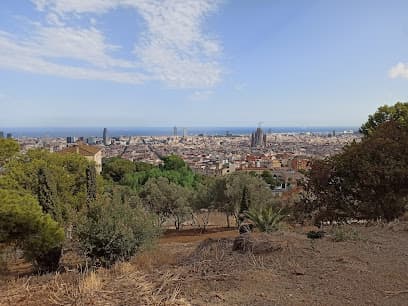
When you reach the Mitja Lluna (Half Moon) square, stop. Turn around. The city unfolds beneath you like a map. You can see the Sagrada Família rising like a giant termite mound, the blue smudge of the sea, and the grid of the Eixample. It’s a panoramic photography dream, but without the Instagram influencers blocking your shot. You’ll share this space with serious runners, locals walking their dogs, and the occasional couple sharing a cheap bottle of wine while the sun dips behind Tibidabo.
Is Parc del Guinardó worth visiting? Only if you value authenticity over convenience. The park is steep, the signage is occasionally cryptic, and there isn't a gift shop in sight. It’s a place of transition—where the city’s rigid geometry dissolves into the chaos of nature. It’s honest. It’s a reminder that Barcelona isn't just a museum of Modernism; it’s a living, breathing, topographical challenge.
If you’re looking for things to do in Horta-Guinardó, this is the anchor. It’s the gateway to the Bunkers del Carmel, which sit just above the park’s northern edge. While the Bunkers have become a victim of their own fame, Parc del Guinardó remains a sanctuary. It’s the kind of place where you can actually hear yourself think, provided you aren't huffing too hard from the incline. Bring water, wear shoes with actual grip, and leave the selfie stick at the hotel. This is a place for looking, not for posing.
Type
Park, Tourist attraction
Duration
2-3 hours
Best Time
Late afternoon for the golden hour views over the city and cooler temperatures for the climb.
What People Say
dog(119)lung(79)mountain(78)bunkers(71)panoramic photography(22)barcelona(16)spanish civil war(15)air defense(14)
Features
Park
Tourist attraction
Categories
NatureHikingPhotographyGardens
Ticket Prices
Free Admission
No tickets required
Opening Hours
- Monday7 AM to 8 PM
- Tuesday7 AM to 8 PM
- Wednesday7 AM to 8 PM
- Thursday7 AM to 8 PM
- Friday7 AM to 8 PM
- Saturday7 AM to 8 PM
- Sunday7 AM to 8 PM
Must-See Highlights
The 'Nen de la rutlla' bronze statue
The Mitja Lluna (Half Moon) viewpoint
The historic terraced gardens designed by Forestier
The Font del Cuento, a historic natural spring
Visitor Tips
Wear sturdy walking shoes; the gravel paths can be slippery on the descent.
Bring your own water and snacks as there are very few kiosks once you start the climb.
Combine this with a visit to the Bunkers del Carmel for sunset, but use the park for a quieter experience beforehand.
Good For
HikersDog ownersPhotographersBudget travelersNature lovers
Why Visit
Three distinct landscape zones ranging from manicured 1920s gardens to wild Mediterranean pine forest
Unobstructed 360-degree views of the Barcelona skyline and the Mediterranean Sea
Home to the iconic 'Nen de la rutlla' statue and historic stone terraces designed by Forestier
Nearby Landmarks
- Hospital de Sant Pau (15-minute walk)
- Bunkers del Carmel (10-minute walk from the upper edge)
- Park Güell (25-minute walk or short bus ride)
Accessibility
- Partial accessibility in the lower urban zone
- Steep inclines and stairs make the upper forest zone difficult for wheelchairs
Location
Municipality of Horta-Guinardó, Barcelona
Nearby Hotels
Nearby Restaurants
In Municipality of Horta-Guinardó
ATTRACTION
メリーゴーランド
Municipality of Horta-Guinardó
A spinning, neon-lit relic of neighborhood childhood, tucked away in the dusty, unvarnished heart of Horta-Guinardó, far from the Gaudi-crazed tourist herds.
0.0(0)
Park
ATTRACTION
SunsetBoatBarcelona
Municipality of Horta-Guinardó
Escape the sweltering, tourist-choked streets for the open Mediterranean, where the city skyline bleeds into the dusk and the Cava actually tastes like freedom.
0.0(0)
Tourist attraction

ATTRACTION
Labyrinth
Municipality of Horta-Guinardó
Barcelona’s oldest garden is a neoclassical middle finger to the city’s chaos, featuring a cypress maze where you can actually lose yourself—and the crowds—for a few euros.
0.0(0)
Tourist attraction
Frequently Asked Questions
Is Parc del Guinardó worth visiting?
Yes, if you want the best panoramic views of Barcelona without the crowds of Park Güell. It’s a steep climb, but the mix of historic gardens and wild pine forest offers a much more authentic local experience.
How do I get to Parc del Guinardó?
The easiest way is taking the Metro L4 (Yellow Line) to the Guinardó | Hospital de Sant Pau station. From there, it’s a 10-minute walk uphill to the park entrance.
Is Parc del Guinardó free?
Yes, admission to the park is completely free and it is open 24 hours a day, though it is best visited during daylight hours for safety and the views.
Is it difficult to walk through the park?
The park is very steep with many stairs and inclined gravel paths. It is not recommended for those with mobility issues, but there are elevators and escalators on some of the surrounding streets to help with the initial ascent.
Reviews
0 reviews for Parc del Guinardó
No reviews yet. Be the first to share your experience!