4.2
116 verified reviews
About
If you’re looking for the Barcelona of the postcards—the one with the polished marble, the overpriced sangria, and the slow-moving herds of selfie-stick-wielding tourists—you’ve come to the wrong neighborhood. Parc del Cargol isn’t interested in your vacation photos. Tucked away in the Horta-Guinardó district, sitting right in the shadow of the massive Vall d'Hebron hospital complex, this is a park for the people who actually live, work, and occasionally suffer in this city. It’s raw, it’s unvarnished, and it’s exactly the kind of place you go when you want to see the city’s ribs.
The name 'Cargol' means snail, and you’ll understand why the second you arrive. The park is defined by a long, winding spiral path that snakes its way up the hillside. It’s a piece of late-20th-century urbanism that hasn’t necessarily aged with grace, but it possesses a certain brutalist honesty. There are no trencadís mosaics here, no whimsical Gaudí dragons. Just concrete, dirt, and the kind of hardy Mediterranean scrub that manages to survive despite the constant hum of the Ronda de Dalt highway nearby. It’s a place where the air smells of dry pine needles and car exhaust, a sensory cocktail that is uniquely, undeniably Barcelona.
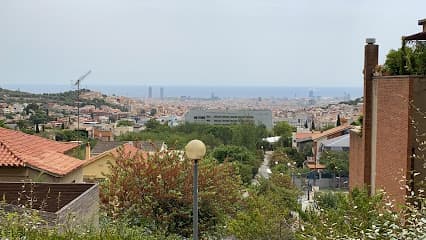
Why would you come here? For the view, mostly. Because this park is perched on the edge of the Collserola foothills, it offers a perspective of the city that most visitors never see. From the top of the snail’s coil, the city unfolds beneath you like a sprawling, chaotic map. You can see the Sagrada Família poking its spires through the haze, the Agbar Tower gleaming in the distance, and the Mediterranean shimmering on the horizon. But you’re seeing it from the outside looking in. You’re seeing the scale of the thing, the density of the Eixample grid, and the way the city eventually gives up and crashes into the sea. It’s one of the best views in Barcelona, and unlike the bunkers at Carmel, you won’t have to fight a thousand influencers for a square inch of space.
The human element here is what makes it real. This isn't a 'destination.' It’s a transit point and a sanctuary. You’ll see doctors in scrubs taking a frantic ten-minute break, families waiting for news from the hospital sitting silently at the picnic tables, and local kids who don't realize they have a world-class view while they kick a deflated football against a concrete wall. There’s a melancholy to the place, sure, but there’s also a profound sense of life happening in real-time. It’s a park for waiting, for thinking, and for breathing in a city that often feels like it’s holding its breath for the next tourist season.
Is Parc del Cargol worth it? If you’re on a three-day sprint to see the 'must-visit' landmarks, probably not. But if you’re the kind of traveler who finds beauty in the cracks of the sidewalk, who prefers a quiet bench and a cheap beer from a corner store over a crowded terrace, then yes. It’s a reminder that Barcelona is more than just a museum of Modernisme; it’s a living, breathing, sometimes exhausted metropolis. Come here at sunset, watch the lights of the city flicker on, and listen to the distant roar of the traffic. It’s not a fairy tale, but it’s the truth, and in this city, the truth is getting harder to find.
Type
Park, Tourist attraction
Duration
45-60 minutes
Best Time
Sunset, when the city lights begin to glow and the heat of the day has faded.
What People Say
hospital(2)table(2)
Features
Park
Tourist attraction
Categories
Urban ParkViewpointLocal Life
Ticket Prices
Free Admission
No tickets required
Opening Hours
- MondayOpen 24 hours
- TuesdayOpen 24 hours
- WednesdayOpen 24 hours
- ThursdayOpen 24 hours
- FridayOpen 24 hours
- SaturdayOpen 24 hours
- SundayOpen 24 hours
Must-See Highlights
The spiral path (The Snail) that gives the park its name
The picnic area near the top for a quiet lunch with a view
The overlook facing the Mediterranean Sea
Visitor Tips
Bring your own water and snacks as there are no kiosks inside the park.
Wear comfortable shoes; the spiral path is longer than it looks.
Combine this with a visit to the nearby Horta Labyrinth for a full afternoon in the district.
Good For
Budget travelersPhotography enthusiastsLocalsSolo travelers
Why Visit
Spiral 'Snail' architecture offering a unique uphill walking path
Unobstructed panoramic views of the Barcelona skyline and sea
Zero tourist crowds compared to city center parks
Nearby Landmarks
- Hospital de la Vall d'Hebron (3-minute walk)
- Metro Vall d'Hebron L3/L5 (7-minute walk)
- Parc de la Vall d'Hebron (10-minute walk)
- Laberint d'Horta (18-minute walk)
Accessibility
- Paved spiral paths
- Steep inclines may be challenging for manual wheelchairs
- Benches available for resting
Location
Carrer de Natzaret
Municipality of Horta-Guinardó, Barcelona
Nearby Hotels
Nearby Restaurants
In Municipality of Horta-Guinardó
ATTRACTION
メリーゴーランド
Municipality of Horta-Guinardó
A spinning, neon-lit relic of neighborhood childhood, tucked away in the dusty, unvarnished heart of Horta-Guinardó, far from the Gaudi-crazed tourist herds.
0.0(0)
Park
ATTRACTION
SunsetBoatBarcelona
Municipality of Horta-Guinardó
Escape the sweltering, tourist-choked streets for the open Mediterranean, where the city skyline bleeds into the dusk and the Cava actually tastes like freedom.
0.0(0)
Tourist attraction

ATTRACTION
Labyrinth
Municipality of Horta-Guinardó
Barcelona’s oldest garden is a neoclassical middle finger to the city’s chaos, featuring a cypress maze where you can actually lose yourself—and the crowds—for a few euros.
0.0(0)
Tourist attraction
Frequently Asked Questions
Is Parc del Cargol worth visiting?
It is worth it if you want a quiet, non-touristy spot with panoramic views of the city. It is not a traditional 'beauty spot,' but it offers an authentic look at Barcelona's urban landscape.
How do I get to Parc del Cargol?
The easiest way is to take the L3 Metro (Green Line) to the Vall d'Hebron station. From there, it is a short but uphill walk toward Carrer de Natzaret.
What is near Parc del Cargol?
The park is adjacent to the Hospital de la Vall d'Hebron. The famous Laberint d'Horta (Horta Labyrinth Park) is also about a 15-20 minute walk or a short bus ride away.
Reviews
0 reviews for Parc del Cargol
No reviews yet. Be the first to share your experience!