4.6
17,196 verified reviews
About
If you want the postcard version of Barcelona—the one with the polished marble and the overpriced sangria—stay down in the Gothic Quarter with the rest of the sheep. But if you want to see the city’s scars, if you want to feel the wind whip off the Mediterranean and realize just how small you are, you have to climb. You head north, past the Gaudí-saturated crowds of Park Güell, until the pavement gets steeper and the air gets thinner. You’re looking for the Turó de la Rovira, known to the locals simply as 'The Bunkers.'
This isn't some manicured park. It’s a jagged, concrete crown sitting atop a hill in the Horta-Guinardó district. In 1937, during the height of the Spanish Civil War, this was a place of desperation. These were anti-aircraft batteries, built to swat Italian bombers out of the sky as they rained hell on the city below. You can still feel the ghosts of the gunners here, standing over their Vickers cannons, peering through the haze for the next wave of destruction. It’s visceral. It’s heavy. It’s the kind of history that doesn't need a plaque to tell you it was important.
After the war, the guns were removed, but the concrete stayed. And because humans are nothing if not resilient, the site transformed. For decades, it was a shantytown—the 'Barraquisme'—where thousands of migrants from southern Spain built lives out of scavenged brick and hope. They called it 'Els Canons.' They lived in the very pits where the guns once sat, overlooking a city that largely ignored them until the 1992 Olympics forced a 'cleanup.' What’s left now is a hybrid: a museum of history (MUHBA) and a public square that offers the most honest 360-degree view of Barcelona you’ll ever find.
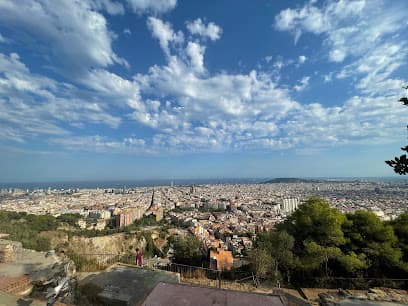
From up here, the Sagrada Família looks like a sandcastle left too close to the tide. The Eixample grid is a perfect, obsessive-compulsive dream. You see the Agbar Tower glowing like a neon cigar and the sea stretching out toward Italy. It’s a protein rush for the eyes. But let’s be real: the secret is out. What used to be a quiet spot for neighborhood kids to drink cheap Estrella and watch the sunset has become a magnet for the Instagram-obsessed. You’ll see them, posing on the edge of the concrete, more interested in their filters than the fact that people once huddled here for their lives.
Because of the overtourism and the late-night parties, the city finally put up fences. They close the site at night now to give the long-suffering neighbors a break from the noise. It’s a shame, but it’s the price of fame in a city that’s being loved to death. If you’re smart, you’ll come at sunrise. The light hits the city from the sea, turning the stone to gold, and you’ll have the place mostly to yourself. You can sit on the cold concrete, feel the grit under your fingernails, and appreciate the fact that Barcelona is a city that has survived bombs, poverty, and now, us. It’s a place of survival. It’s raw, it’s beautiful, and it’s the best free show in town. Just don't leave your trash behind. The ghosts don't like it.
Type
Local history museum, Historical landmark
Duration
1-2 hours
Best Time
Sunrise to avoid crowds and see the best light over the Mediterranean.
Guided Tours
Available
What People Say
bunkers(217)sunrise(118)panoramic view(118)disfrutar(110)spanish civil war(109)nightscape(102)hill(47)metro(44)
Features
Local history museum
Historical landmark
Categories
HistoryMilitaryViewpointSpanish Civil War
Ticket Prices
Free Admission
No tickets required
Opening Hours
- MondayClosed
- TuesdayClosed
- Wednesday10 AM to 2 PM
- ThursdayClosed
- FridayClosed
- Saturday10 AM to 2:30 PM
- Sunday10 AM to 3 PM
Must-See Highlights
The 360-degree panoramic view from the top of the batteries
The 'Officer's Pavilion' museum space detailing the shantytown history
The circular concrete gun emplacements
The original tile floors from the 1940s-1980s shantytown homes
Visitor Tips
Bring water and snacks as there are no services at the top
Wear sturdy shoes for the steep, rocky climb
Check the official closing times as the site is now strictly fenced and cleared by police at dusk
Be respectful of the local residents who live on the access roads
Good For
History buffsPhotographersBudget travelersHikers
Why Visit
Unobstructed 360-degree views of the entire Barcelona skyline and sea
Authentic Spanish Civil War anti-aircraft battery ruins
Preserved remnants of the mid-20th century 'Barraquisme' shantytown dwellings
Nearby Landmarks
- Park Güell (20-minute walk)
- Recinte Modernista de Sant Pau (25-minute walk)
- Parc del Guinardó (5-minute walk)
Accessibility
- Limited accessibility
- Steep inclines
- Uneven historical surfaces
- Not recommended for those with mobility issues
Location
Carrer de Marià Labèrnia, s/n
Municipality of Horta-Guinardó, Barcelona
Nearby Hotels
Nearby Restaurants
In Municipality of Horta-Guinardó
ATTRACTION
メリーゴーランド
Municipality of Horta-Guinardó
A spinning, neon-lit relic of neighborhood childhood, tucked away in the dusty, unvarnished heart of Horta-Guinardó, far from the Gaudi-crazed tourist herds.
0.0(0)
Park
ATTRACTION
SunsetBoatBarcelona
Municipality of Horta-Guinardó
Escape the sweltering, tourist-choked streets for the open Mediterranean, where the city skyline bleeds into the dusk and the Cava actually tastes like freedom.
0.0(0)
Tourist attraction

ATTRACTION
Labyrinth
Municipality of Horta-Guinardó
Barcelona’s oldest garden is a neoclassical middle finger to the city’s chaos, featuring a cypress maze where you can actually lose yourself—and the crowds—for a few euros.
0.0(0)
Tourist attraction
Frequently Asked Questions
Is MUHBA Turó de la Rovira worth visiting?
Absolutely. It offers the only true 360-degree panoramic view of Barcelona and provides a haunting, unvarnished look at the city's Civil War history and post-war shantytowns.
How do I get to the Bunkers del Carmel?
Take the V19 or 24 bus from the city center to the 'Muntanya' stop, then follow the signs for a steep 10-minute uphill walk. Alternatively, take Metro L4 to Alfons X and prepare for a 20-25 minute hike.
What is the best time to visit?
Sunrise is the best time to avoid the massive crowds and enjoy the light coming off the Mediterranean. Note that the site is now fenced and typically closes at 5:30 PM in winter and 7:30 PM in summer.
Is there an entrance fee?
No, access to the viewpoint and the outdoor historical site is free. There are small indoor museum spaces with specific hours, but the main draw is the open-air battery remains.
Reviews
0 reviews for MUHBA Turó de la Rovira
No reviews yet. Be the first to share your experience!