4.6
246 verified reviews
About
Forget the Bunkers del Carmel. Seriously. If you want to stand shoulder-to-shoulder with three hundred people holding selfie sticks and lukewarm cans of Estrella, go right ahead. But if you actually want to see Barcelona—the real, breathing, slightly scarred version of it—you keep walking. You head into the Horta-Guinardó district, a neighborhood that doesn't give a damn about your vacation photos or your curated itinerary. You find the Mirador del Nen de la Rutlla, and you earn the view with a climb that will make your calves scream.
This isn't a place for the lazy. To get here, you’re navigating the steep, gravity-defying streets of Guinardó, where the laundry hangs over the balconies like flags of surrender and the air starts to thin out as you leave the tourist-clogged center behind. The reward is a small, paved terrace anchored by a bronze statue of a boy playing with a hoop—the 'Nen de la Rutlla.' It was placed here in 1961, a work by Joaquim Ros i Bofarull, and there’s something hauntingly simple about it. In a city obsessed with grand cathedrals and modernist ego-trips, here is just a kid, frozen in a moment of play, looking out over a metropolis that has grown exponentially more complicated since he was cast in metal.
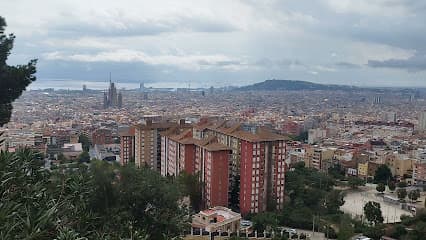
From this vantage point, Barcelona looks like a massive, intricate circuit board. You see the Eixample grid laid out with mathematical precision, the Sagrada Família rising up like a melting sandcastle in the middle of it all, and the Agbar Tower glowing like a neon thumb. On a clear day, the Mediterranean sits on the horizon, a flat sheet of blue that puts the whole chaotic mess into perspective. It is, quite simply, one of the best viewpoints in Barcelona, and yet, half the time, you’ll have it almost entirely to yourself, save for a few local joggers and the occasional stray cat.
The atmosphere here is heavy with the scent of dry pine needles and the distant, muffled roar of the city below. It’s a place for reflection, or for a quiet beer at sunset when the light hits the stone of the Sagrada Família and turns the whole city into a hazy, golden dream. There are no kiosks here selling overpriced magnets. There are no tour buses. It’s just you, the boy with his hoop, and the realization that Barcelona is much bigger and much older than the three blocks around La Rambla would have you believe.
Is it worth the hike? If you value silence and a perspective that hasn't been filtered through a thousand Instagram presets, then yes. It’s a reminder that the best things in this city—and in life—usually require a bit of sweat and a willingness to go where the crowds aren't. It’s raw, it’s honest, and it’s exactly what a viewpoint should be: a place to feel small in the face of something vast. Just bring decent shoes and leave the flip-flops at the hotel. This is a neighborhood that demands respect, and the hill doesn't care about your fashion choices.
When you finally head back down, descending into the labyrinth of Horta-Guinardó, you’ll feel like you’ve seen something the rest of the city missed. You’ve looked at the heart of Barcelona from the outside in, and that’s a perspective you can’t buy with a skip-the-line ticket.
Type
Scenic spot, Observation deck
Duration
45-60 minutes
Best Time
Sunrise for photography or late afternoon for a quiet sunset experience.
What People Say
park(8)sagrada familia(5)sunrise(3)photography(3)hikes(3)lighting(2)state(2)people(2)
Features
Scenic spot
Observation deck
Categories
Observation DeckParkHikingPhotography
Ticket Prices
Free Admission
No tickets required
Opening Hours
- MondayOpen 24 hours
- TuesdayOpen 24 hours
- WednesdayOpen 24 hours
- ThursdayOpen 24 hours
- FridayOpen 24 hours
- SaturdayOpen 24 hours
- SundayOpen 24 hours
Must-See Highlights
The 'Nen de la Rutlla' bronze statue
Panoramic view of the Eixample district grid
The pine-shaded trails of Parc del Guinardó leading to the summit
Visitor Tips
Bring water as there are few facilities once you start the climb
Wear sturdy sneakers; the incline on Carrer de Sant Joan de les Abadesses is no joke
Combine this with a walk through the rest of Parc del Guinardó to see the old water works
Good For
PhotographersHikersBudget travelersSolo travelers seeking peace
Why Visit
Unobstructed views of the Sagrada Família from a unique northern angle
Significantly less crowded than the nearby Bunkers del Carmel
Features the iconic 1961 bronze sculpture by Joaquim Ros i Bofarull
Nearby Landmarks
- 15-minute walk from Bunkers del Carmel
- 5-minute walk from Parc del Guinardó upper trails
- 20-minute walk down to Hospital de Sant Pau
Accessibility
- Steep terrain
- Paved paths available but very inclined
- Not recommended for those with limited mobility
Location
Carrer de Sant Joan de les Abadesses
Municipality of Horta-Guinardó, Barcelona
Nearby Hotels
Nearby Restaurants
In Municipality of Horta-Guinardó
ATTRACTION
メリーゴーランド
Municipality of Horta-Guinardó
A spinning, neon-lit relic of neighborhood childhood, tucked away in the dusty, unvarnished heart of Horta-Guinardó, far from the Gaudi-crazed tourist herds.
0.0(0)
Park
ATTRACTION
SunsetBoatBarcelona
Municipality of Horta-Guinardó
Escape the sweltering, tourist-choked streets for the open Mediterranean, where the city skyline bleeds into the dusk and the Cava actually tastes like freedom.
0.0(0)
Tourist attraction

ATTRACTION
Labyrinth
Municipality of Horta-Guinardó
Barcelona’s oldest garden is a neoclassical middle finger to the city’s chaos, featuring a cypress maze where you can actually lose yourself—and the crowds—for a few euros.
0.0(0)
Tourist attraction
Frequently Asked Questions
Is Mirador del Nen de la Rutlla worth visiting?
Absolutely, if you want panoramic views of the Sagrada Família and the Mediterranean without the massive crowds found at the Bunkers del Carmel. It requires a steep walk, but the peace and perspective are unmatched.
How do I get to Mirador del Nen de la Rutlla?
Take the L4 Metro to Alfons X and prepare for a 15-20 minute uphill hike, or use the V23 bus which drops you closer to the park entrance. The climb is steep, so wear comfortable shoes.
What is the best time to visit?
Sunrise is spectacular and nearly empty, offering a clear view of the sun rising over the sea. Sunset is also beautiful but slightly busier with locals.
Is there an entrance fee?
No, the viewpoint is located within the public Parc del Guinardó and is completely free to access 24/7.
Reviews
0 reviews for Mirador del Nen de la Rutlla
No reviews yet. Be the first to share your experience!