4.5
47 verified reviews
About
If you’re looking for the sanitized, selfie-stick-clogged version of Barcelona, go to the Bunkers del Carmel. They’ve been ruined by the same digital plague that ruins everything eventually. But if you want the truth—the raw, unvarnished sprawl of a city that refuses to be tamed—you head to Horta-Guinardó. You head to the Mirador de la Mitja Lluna.
Getting here is a bit of a bastard, and that’s exactly why it’s good. You start at the Mundet metro station and begin the slow, steady grind upward. It’s a walk that weeds out the casuals. You’ll pass the Velòdrom and the manicured hedges of the Labyrinth Park, but keep going. The pavement gives way to grit and pine needles as you hit the fringe of the Collserola. Your lungs will burn a little, and the Mediterranean sun will remind you who’s boss, but then you see it: a simple, crescent-shaped stone ledge jutting out from the hillside like a broken moon.
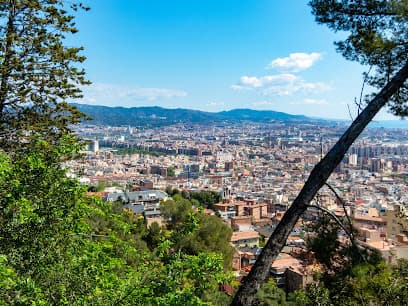
There are no kiosks here. No one is trying to sell you a lukewarm Estrella or a plastic miniature of the Sagrada Família. It’s just a slab of stone and a view that stretches from the Besòs river to the airport. From this height, Barcelona looks like a massive, intricate circuit board. You can trace the rigid, obsessive grid of the Eixample until it crashes into the chaotic, ancient tangle of the Old Town. The Sagrada Família rises out of the center like a giant, melting sandcastle, and the Agbar Tower flickers in the distance like a misplaced thumb drive.
This is one of the best viewpoints in Barcelona because it offers perspective without the performance. On a Tuesday evening, you won’t find influencers practicing their pouts. You’ll find a lone runner catching their breath, an old man staring at the horizon with a look of profound melancholy, or a couple sharing a cheap bottle of wine in total silence. It’s a place for people who actually like the city, not just the idea of it.
To your back is the Carretera de les Aigües, the long, flat dirt track that serves as the city’s collective lung. To your front is the abyss. When the sun starts to dip behind Tibidabo, the light hits the Mediterranean and turns the whole world into a bruised purple and gold. The noise of the traffic below—the scooters, the sirens, the shouting—is reduced to a low, rhythmic hum, like the breathing of a giant.
Is it worth the hike? If you need a bathroom every twenty minutes and a padded seat to enjoy a view, then no, stay in the city center and pay twenty euros for a rooftop cocktail. But if you want to see Barcelona for what it really is—a beautiful, crowded, noisy, defiant mess of a place—then lace up your boots. The Mirador de la Mitja Lluna doesn’t care if you like it. It’s been there long before the tourists arrived, and it’ll be there long after they find a new city to colonize. It’s honest. It’s quiet. And in a city that’s increasingly loud and fake, that’s worth the sweat.
Type
Tourist attraction
Duration
1 hour
Best Time
Late afternoon for sunset and city lights
What People Say
walk(3)space(2)sunset(2)
Features
Tourist attraction
Categories
ViewpointNatureHikingPhotography
Ticket Prices
Free Admission
No tickets required
Must-See Highlights
The crescent-shaped stone wall
View of the Sagrada Família from the north
The intersection of the city grid and the Collserola mountains
Visitor Tips
Wear sturdy walking shoes; the path is gravel and can be slippery.
Bring a headlamp if you plan to stay past sunset, as the trail down is not lit.
Combine this with a visit to the nearby Labyrinth Park for a full afternoon.
Good For
HikersPhotographersBudget travelersCouples
Why Visit
Zero commercialization with no tickets, kiosks, or crowds
Unobstructed 180-degree views of the Horta-Guinardó valley and the Mediterranean
Direct access to the Carretera de les Aigües, Barcelona's premier mountain trail
Nearby Landmarks
- 12-minute walk from Velòdrom d'Horta
- 15-minute walk from Parc del Laberint d'Horta
- 20-minute walk from Mundet Metro Station (L3)
Accessibility
- Steep dirt paths
- Not recommended for wheelchairs
- Requires moderate physical fitness
Location
Carrer de Maurici Vilomara, 130
Municipality of Horta-Guinardó, Barcelona
Nearby Hotels
Nearby Restaurants
In Municipality of Horta-Guinardó
ATTRACTION
メリーゴーランド
Municipality of Horta-Guinardó
A spinning, neon-lit relic of neighborhood childhood, tucked away in the dusty, unvarnished heart of Horta-Guinardó, far from the Gaudi-crazed tourist herds.
0.0(0)
Park
ATTRACTION
SunsetBoatBarcelona
Municipality of Horta-Guinardó
Escape the sweltering, tourist-choked streets for the open Mediterranean, where the city skyline bleeds into the dusk and the Cava actually tastes like freedom.
0.0(0)
Tourist attraction

ATTRACTION
Labyrinth
Municipality of Horta-Guinardó
Barcelona’s oldest garden is a neoclassical middle finger to the city’s chaos, featuring a cypress maze where you can actually lose yourself—and the crowds—for a few euros.
0.0(0)
Tourist attraction
Frequently Asked Questions
Is Mirador de la Mitja Lluna worth visiting?
Yes, if you want a quiet, non-touristy panoramic view of Barcelona. It requires a bit of a hike, but the 180-degree vista of the city and sea is one of the most honest experiences in the Horta-Guinardó district.
How do I get to Mirador de la Mitja Lluna?
Take the L3 Metro to Mundet. From there, it is a 15-20 minute uphill walk past the Velòdrom d'Horta toward the Carretera de les Aigües. The path is steep but well-marked.
What is the best time to visit?
Sunset is spectacular, but the 'blue hour' immediately following is when the city lights begin to flicker on, offering the best photographic opportunities without the midday heat.
Are there facilities at the viewpoint?
No. There are no toilets, water fountains, or shops at the Mirador. You must bring your own water and supplies, and be prepared to carry your trash back down.
Reviews
0 reviews for Mirador de la Mitja lluna
No reviews yet. Be the first to share your experience!