3.8
17 verified reviews
About
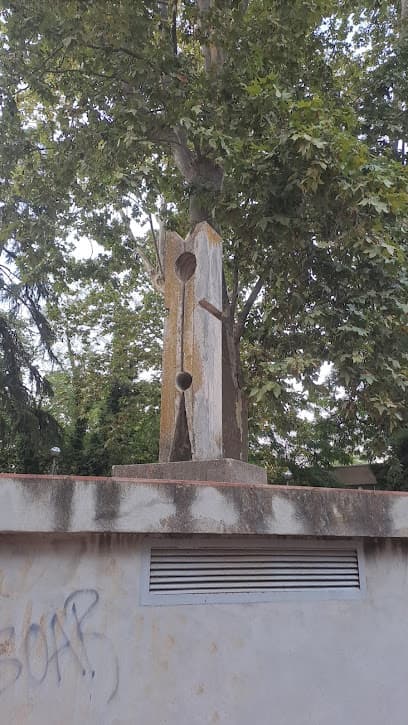
You’re out in Horta-Guinardó, far from the sweating, selfie-stick-wielding masses of the Gothic Quarter, and you stumble upon a giant clothespin. Not just any clothespin, but a massive, weathered pincer gripping a capital 'A' like it’s trying to keep the very concept of language from blowing away in the Mediterranean breeze. This is La Pinça, and it’s exactly the kind of weird, unapologetic art that makes Barcelona more than just a living museum of dead architects.
To understand this thing, you have to understand Joan Brossa. He was a poet who decided that paper was too small for his ideas. He wanted the city to be his page, and he treated the streets like a notebook for his visual poems. La Pinça is the first act of a three-part installation titled 'Visual Poem in Three Times.' It represents birth—the letter 'A' being the beginning of everything, the first cry, the start of the alphabet. The pincer? That’s the focus, the grip of reality, or maybe just a reminder that even the most monumental ideas start with something as humble as a household tool.
The trek up here is a palate cleanser. You take the L3 metro to Mundet, and suddenly the air feels thinner and the city sounds like a distant memory. You’re near the Velòdrom d'Horta, a relic of the 1992 Olympic fever, but the vibe here is much older and quieter. There are no velvet ropes here. No gift shops selling miniature plastic versions of the sculpture. It’s just a massive piece of stone and steel standing on a patch of grass, ignored by the locals walking their dogs and stared at by the few travelers who bothered to look at a map.
There is a stark, industrial beauty to the materials. The 'A' is solid, immovable, while the pincer looks like it could have been plucked from a giant’s laundry line. It’s a masterclass in scale. By taking a domestic object and blowing it up to the size of a small building, Brossa forces you to actually look at it. He’s mocking the pretension of traditional monuments. Why build another bronze general on a horse when you can celebrate the simple utility of a clip? It’s irreverent, it’s slightly absurd, and it’s deeply Catalan in its refusal to be boring.
Is it worth the trip? If you’re the kind of person who needs a guided tour and a headset to tell you what to feel, probably not. But if you appreciate the quiet satisfaction of finding something strange in an unexpected place, then yes. It’s a reminder that art doesn’t have to live in a gallery with climate control and surly security guards. Sometimes, the best things to do in Horta-Guinardó involve just standing in front of a giant clothespin and wondering why the hell it’s there.
Pair this with a walk through the nearby Laberint d'Horta. You get the surrealism of Brossa followed by the neoclassical madness of an 18th-century hedge maze. It’s a day spent in the corners of the city’s mind, away from the polished version of Barcelona they sell on postcards. It’s raw, it’s quiet, and it’s honest. Just don't expect a café nearby to serve you a ten-euro avocado toast. This is a neighborhood for living, not for performing, and La Pinça stands there as a silent witness to the beautiful, mundane reality of it all.
Type
Tourist attraction
Duration
15-30 minutes
Best Time
Late afternoon for the best shadows and golden hour light on the metal.
Features
Tourist attraction
Categories
SculptureModern ArtPublic ArtSurrealism
Ticket Prices
Free Admission
No tickets required
Opening Hours
- MondayOpen 24 hours
- TuesdayOpen 24 hours
- WednesdayOpen 24 hours
- ThursdayOpen 24 hours
- FridayOpen 24 hours
- SaturdayOpen 24 hours
- SundayOpen 24 hours
Must-See Highlights
The weathered texture of the steel pincer
The contrast of the grey stone 'A' against the green hills
The surrounding 'Visual Poem' elements near the Velòdrom
Visitor Tips
Combine this with a visit to the Labyrinth Park nearby to make the trip to Horta worthwhile.
Look for the other two parts of the 'Visual Poem' nearby to see the full story of Birth, Path, and Death.
Bring water, as this residential area has fewer kiosks than the city center.
Good For
Art loversSolo travelersPhotography enthusiastsBudget travelers
Why Visit
Designed by legendary Catalan poet and artist Joan Brossa
Part of a unique 'Visual Poem' installation across the neighborhood
Completely free and devoid of typical tourist crowds
Nearby Landmarks
- Velòdrom d'Horta (2-minute walk)
- Parc del Laberint d'Horta (10-minute walk)
- Mundet Metro Station (7-minute walk)
Accessibility
- Outdoor public space
- Paved sidewalks
- Wheelchair accessible
Location
Carrer d'Hipàtia d'Alexandria
Municipality of Horta-Guinardó, Barcelona
Nearby Hotels
Nearby Restaurants
In Municipality of Horta-Guinardó
ATTRACTION
メリーゴーランド
Municipality of Horta-Guinardó
A spinning, neon-lit relic of neighborhood childhood, tucked away in the dusty, unvarnished heart of Horta-Guinardó, far from the Gaudi-crazed tourist herds.
0.0(0)
Park
ATTRACTION
SunsetBoatBarcelona
Municipality of Horta-Guinardó
Escape the sweltering, tourist-choked streets for the open Mediterranean, where the city skyline bleeds into the dusk and the Cava actually tastes like freedom.
0.0(0)
Tourist attraction

ATTRACTION
Labyrinth
Municipality of Horta-Guinardó
Barcelona’s oldest garden is a neoclassical middle finger to the city’s chaos, featuring a cypress maze where you can actually lose yourself—and the crowds—for a few euros.
0.0(0)
Tourist attraction
Frequently Asked Questions
Is La Pinça worth visiting?
Yes, if you are a fan of surrealist art or Joan Brossa's work. It is a quiet, uncrowded spot that offers a different perspective on Barcelona's artistic heritage away from the main tourist hubs.
How do I get to La Pinça?
Take the Metro Line 3 (Green) to the Mundet station. From there, it is a short 5-10 minute walk toward the Velòdrom d'Horta on Carrer d'Hipàtia d'Alexandria.
Do I need tickets for La Pinça?
No, it is a public sculpture located outdoors. It is free to visit and accessible 24 hours a day.
What else is near La Pinça?
The sculpture is very close to the Parc del Laberint d'Horta (Labyrinth Park) and the Velòdrom d'Horta. It's a great area for walking and escaping the city center crowds.
Reviews
0 reviews for La Pinça
No reviews yet. Be the first to share your experience!