ATTRACTION
Escales mecàniques del carrer Telègraf
Municipality of Horta-Guinardó, Barcelona
5.0 · 2 reviews
5.0
2 verified reviews
About
Most people experience Barcelona as a flat, sun-drenched postcard—a stroll along the beach, a shuffle through the Gothic Quarter, a slow crawl up the Rambla. They are missing the point. Barcelona is a city that wants to kill your calves. It is a vertical labyrinth that leans hard against the Collserola ridges, and if you want to understand how the people here actually live, you have to go up. You have to go to the Escales mecàniques del carrer Telègraf.
Located in the Horta-Guinardó district, these aren’t your typical tourist attractions. There are no ticket booths, no gift shops selling plastic bulls, and no guys in oversized mascot costumes trying to shake you down for a Euro. This is pure urban infrastructure—a series of outdoor escalators that serve as a mechanical middle finger to the laws of gravity. They were built because the incline here is so steep it would make a mountain goat think twice, and the locals, God bless them, have better things to do than spend their lives panting on a 30-degree slope.
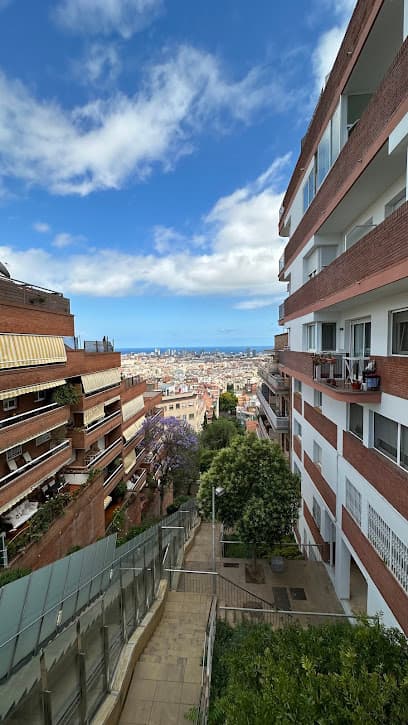
When you arrive at the base near Carrer del Dr. Cadevall, the first thing you notice is the sound. It’s not the roar of traffic, but the steady, rhythmic hum of the machinery—a metallic heartbeat echoing between the apartment blocks. You step onto the metal treads and let the city do the work for you. As you rise, the perspective shifts. You aren't just moving up; you’re moving through the private lives of the barrio. You’re eye-level with laundry drying on balconies, the scent of frying garlic and pimentón wafting out of kitchen windows, and the muffled sounds of daytime television. It’s intimate, slightly voyeuristic, and entirely real.
The payoff, however, is at the top. As the escalator deposits you at the higher reaches of Carrer de Telègraf, turn around. This is the shot. The street drops away with terrifying speed, a straight line of asphalt that aims directly at the Mediterranean. From here, the Eixample is laid out like a giant, orderly blueprint. You can see the Sagrada Família poking out of the urban canopy like a cluster of stone cacti, and beyond it, the shimmering blue of the sea. It is one of the most honest views in the city because it includes everything—the beautiful, the mundane, the cranes, and the smog.
The atmosphere here is defined by the people who use these stairs every day. You’ll see grandmothers with wheeled grocery bags, their faces set in expressions of stoic endurance, and teenagers hunched over phones, oblivious to the spectacular backdrop behind them. There is a quiet dignity to it. This isn't a place for 'experiences'; it's a place for getting home after a long shift.
Is it worth the trek? If you’re the kind of person who needs a velvet rope and a brochure to feel like you’ve 'seen' something, then no. Stay in the center with the rest of the herd. But if you want to see the bones of the city, if you want to feel the wind coming off the hills and see the sun hit the tiles of the Hospital de Sant Pau from an angle most visitors never find, then get on the Metro. It’s free, it’s functional, and it’s a reminder that the best things in Barcelona usually require a bit of an ascent. Just don't expect the escalator to be working 100% of the time—this is a real neighborhood, and sometimes the machinery gets tired, just like the rest of us.
Type
Tourist attraction
Duration
30-45 minutes
Best Time
Late afternoon or sunset for the best lighting over the city and sea.
Features
Tourist attraction
Categories
ArchitectureViewpointsLocal Life
Ticket Prices
Free Admission
No tickets required
Must-See Highlights
The view looking back down the street toward the sea
The proximity to the modernist masterpiece Hospital de Sant Pau
The contrast between the residential quiet and the massive city grid below
Visitor Tips
Check the city's maintenance alerts if you absolutely rely on the escalators, as they can occasionally be out of service.
Combine this with a visit to the Hospital de Sant Pau for a perfect afternoon away from the Rambla crowds.
Bring a camera with a zoom lens to compress the street view against the Sagrada Família.
Good For
PhotographersBudget travelersUrban explorersArchitecture buffs
Why Visit
Unobstructed 'straight-down' view of the Eixample and the sea
Zero cost and zero crowds compared to central viewpoints
A unique look at Barcelona's vertical urban planning and local daily life
Nearby Landmarks
- Hospital de Sant Pau (8-minute walk)
- Parc del Guinardó (10-minute walk)
- Bunkers del Carmel (20-minute walk uphill)
- Sagrada Família (20-minute walk downhill)
Accessibility
- Escalators provide upward mobility, but the surrounding streets are very steep and may be challenging for those with limited mobility if the machinery is undergoing maintenance.
Location
Carrer del Dr. Cadevall, 1
Municipality of Horta-Guinardó, Barcelona
Nearby Hotels
Nearby Restaurants
In Municipality of Horta-Guinardó
ATTRACTION
メリーゴーランド
Municipality of Horta-Guinardó
A spinning, neon-lit relic of neighborhood childhood, tucked away in the dusty, unvarnished heart of Horta-Guinardó, far from the Gaudi-crazed tourist herds.
0.0(0)
Park
ATTRACTION
SunsetBoatBarcelona
Municipality of Horta-Guinardó
Escape the sweltering, tourist-choked streets for the open Mediterranean, where the city skyline bleeds into the dusk and the Cava actually tastes like freedom.
0.0(0)
Tourist attraction

ATTRACTION
Labyrinth
Municipality of Horta-Guinardó
Barcelona’s oldest garden is a neoclassical middle finger to the city’s chaos, featuring a cypress maze where you can actually lose yourself—and the crowds—for a few euros.
0.0(0)
Tourist attraction
Frequently Asked Questions
Is Escales mecàniques del carrer Telègraf worth visiting?
Yes, if you want a spectacular, uncrowded view of the city and the Sagrada Família without paying for a rooftop bar. It's a great spot for photography and seeing authentic local life.
How much does it cost to use the escalators?
It is completely free. These are public escalators maintained by the city for the residents of the Horta-Guinardó neighborhood.
How do I get to Carrer de Telègraf?
The easiest way is to take the Metro L4 (Yellow Line) to Alfons X or L5 (Blue Line) to Sant Pau | Dos de Maig and walk uphill toward the Guinardó park area.
What is the best time to visit?
Late afternoon provides the best light. The sun hits the Eixample grid and the sea perfectly, and the neighborhood settles into a quiet, evening rhythm.
Reviews
0 reviews for Escales mecàniques del carrer Telègraf
No reviews yet. Be the first to share your experience!