4.4
1,777 verified reviews
About
Forget the mosaic lizards and the gingerbread houses for a second. If you want to see Barcelona for what it really is—a sprawling, chaotic, beautiful mess pinned between the mountains and the Mediterranean—you have to earn it. You have to keep climbing past the tour groups and the selfie sticks until the path turns to dust and the air gets a little thinner. This is the Turó de les Tres Creus, the Hill of the Three Crosses, and it is the highest point in Park Güell. It’s the place where Antoni Gaudí decided to stop playing architect and start listening to the earth.
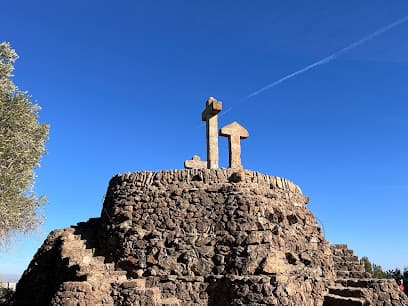
Originally, the man had grander plans. He wanted to put a chapel here, a 'Chapel of the Passion' that would crown his park like a liturgical jewel. But then they started digging. They found prehistoric remains—fossils, caves, the literal bones of the land. Most architects would have paved over them and moved on. Not Gaudí. He pivoted. He respected the ground enough to change his mind, building this rough-hewn, Calvary-style monument instead. It looks less like a masterpiece and more like something that’s been here since the dawn of time—a pile of stones, stacked with a purpose that feels ancient and heavy.
The structure itself is a stone mound, a 'talayot' inspired by prehistoric burial sites. At the top sit three stone crosses. Two are the standard variety, but the third is a Tau cross—shaped like a T. It’s a raw, jagged piece of work that doesn't care about your aesthetic sensibilities. It’s there to mark a spot, to hold a line against the wind.
The climb up the stone steps is short but steep enough to make you regret that third glass of vermouth from the night before. Your lungs will burn just a bit, and the sun will beat down on the exposed rock, but then you reach the platform. This is where the magic happens. From here, the Sagrada Família doesn't look like a cathedral; it looks like a giant sandcastle rising out of the Eixample grid. You can see the Agbar Tower shimmering like a blue bullet, the hills of Tibidabo standing guard to the north, and the Mediterranean stretching out into an infinite blue haze. It is a 360-degree panoramic hit to the cortex.
Let’s be honest: it’s going to be crowded. You’ll be dodging influencers trying to find the perfect angle and families struggling with strollers on the uneven ground. The wind up here can be relentless, whipping hair into eyes and threatening to take your hat as a souvenir. But there is a moment, if you time it right—maybe just as the sun starts to dip behind the Collserola range—when the light hits the stone and the city below begins to glow. In that moment, the noise of the tourists fades. You realize that Gaudí was right to leave the chapel unbuilt. No roof could compete with this.
Is it worth the hike? Absolutely. It’s the best view in Barcelona because it’s the most honest one. You see the beauty, the density, and the sheer scale of the city all at once. It’s a reminder that while we’re down there arguing over tapas prices and metro maps, the mountain is still here, and the sea isn't going anywhere. Wear decent shoes, bring water, and for the love of God, don't just look through your phone screen. Stand there, feel the wind, and take the hit. This is the roof of the city, and it’s spectacular.
Type
Observation deck, Park
Duration
30-45 minutes
Best Time
Early morning or 30 minutes before sunset for the best light and slightly fewer crowds than midday.
Guided Tours
Available
Audio Guide
Available
What People Say
monument(14)panoramic(13)climb(13)sagrada familia(12)cross(12)gaudi(11)tibidabo(7)musicians(7)
Features
Observation deck
Park
Tourist attraction
Categories
ArchitectureParkGaudí
Ticket Prices
adult€10
child€0 (under 7)
senior€7
Opening Hours
- Monday9 AM to 5:30 PM
- Tuesday9 AM to 5:30 PM
- Wednesday9 AM to 5:30 PM
- Thursday9 AM to 5:30 PM
- Friday9 AM to 5:30 PM
- Saturday9 AM to 5:30 PM
- Sunday9 AM to 5:30 PM
Must-See Highlights
The Tau (T-shaped) cross
The view of Sagrada Família framed by the park's trees
The prehistoric-style stone masonry of the mound
Visitor Tips
The wind is much stronger at the top than at the park entrance; bring a light layer.
The steps are narrow; wait for people to descend before starting your climb.
Bring a zoom lens if you want the iconic shot of the Sagrada Família with the sea behind it.
Good For
Photography enthusiastsGaudí fansActive travelersCouples
Why Visit
Highest elevation point in the entire Park Güell complex
Uninterrupted 360-degree views of the Barcelona skyline and sea
Unique 'Tau' cross monument designed by Gaudí to preserve prehistoric remains
Nearby Landmarks
- 5-minute walk from Plaça de la Natura
- 8-minute walk from Casa Museu Gaudí
- 10-minute walk from the Dragon Stairway
Accessibility
- Not wheelchair accessible
- Uneven stone steps
- Steep incline
Location
Av. del Coll del Portell, 72I
Gràcia, Barcelona
Nearby Hotels
Nearby Restaurants
In Gràcia
ATTRACTION
Maison Sara
Gràcia
Forget the mass-produced kitsch on La Rambla. This is Gràcia at its best: a tactile, clay-smeared workshop where the art is as raw and honest as the neighborhood itself.
0.0(0)
Tourist attraction
ATTRACTION
Intercambiador de libros
Gràcia
A humble, weather-beaten box in the hills of Vallcarca where local history is traded one dog-eared paperback at a time. No tourists, no Wi-Fi, just paper and community.
0.0(0)
Park
ATTRACTION
View
Gràcia
Forget the elbow-to-elbow chaos of Park Güell. This is the raw, vertical soul of Gràcia, where the city unfolds in a silent, sun-drenched sprawl at your feet.
0.0(0)
Garden
Frequently Asked Questions
Is Turó de les Tres Creus worth visiting?
Yes, it offers the highest 360-degree panoramic view of Barcelona within Park Güell. It is the best spot to see the Sagrada Família and the coastline simultaneously, though it requires a bit of a climb.
Do I need a ticket to see the Three Crosses?
Yes, Turó de les Tres Creus is located within the Restricted Zone of Park Güell. You must purchase a general admission ticket to the park to access this viewpoint.
What is the best time to visit Turó de les Tres Creus?
Sunset is the most spectacular time for the light, but it is also the most crowded. For a quieter experience with better photography light on the city, try arriving right when the park opens in the morning.
How difficult is the climb to the top?
It is a short but steep climb up stone stairs. It is not wheelchair accessible and can be slippery when wet, so wear sturdy shoes.
Reviews
0 reviews for Turó de les Tres Creus
No reviews yet. Be the first to share your experience!