4.5
316 verified reviews
About
Let’s get one thing straight: calling this the 'Greek Theatre' is a bit of a misnomer, a marketing pivot from a century ago when Antoni Gaudí and his patron, Eusebi Güell, realized their dream of a gated community for the elite was going belly-up. They needed a 'social hub,' a place for community festivals and open-air performances to lure in the wealthy. What they ended up with—the Plaça de la Natura—is something far more strange and enduring than a mere stage. It is a massive, elevated terrace held aloft by a forest of eighty-six Doric columns, a stone ribcage that feels like it was exhaled by the earth rather than built by men.
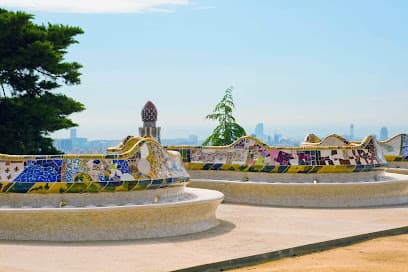
You’ll likely arrive here sweating. The climb up from the Lesseps metro station is a vertical slog that separates the pilgrims from the tourists. By the time you reach the plateau of the theatre, your lungs are burning, and you’re greeted by a sea of selfie sticks. It’s a circus, no doubt about it. But then you look past the crowds, past the influencers posing in linen, and you see the bench. The Banc de Trencadís is a serpentine explosion of trencadís—shards of discarded ceramic, broken plates, and glass bottles repurposed into a jagged, colorful mosaic that snakes around the entire perimeter of the square.
This isn't just art; it’s ergonomics designed by a madman. Gaudí supposedly had a workman sit in wet plaster to get the curve of the human spine just right. It’s surprisingly comfortable, a cool ceramic embrace that offers one of the best views in Barcelona. From here, the city spills out toward the Mediterranean like a slow-motion landslide. You can see the Sagrada Família rising in the distance, looking like a melting sandcastle, and the blue smudge of the sea beyond. It’s the kind of view that makes you forget, for a fleeting second, that you’re surrounded by five hundred other people trying to capture the exact same moment.
Look down at the ground beneath your feet. It’s not just dirt; it’s a sophisticated drainage system. Gaudí, ever the obsessive, designed the theatre to collect rainwater, filtering it through layers of stone and sand into a massive cistern below. That water was meant to irrigate the gardens of the estate. It’s a reminder that beneath the whimsical colors and the hallucinogenic shapes, there was a rigorous, almost brutal engineering logic at play. The man didn't just want things to look pretty; he wanted them to work.
Is it a tourist trap? In the sense that everyone and their mother is here, yes. But some places are popular for a reason. The Greek Theatre is the beating heart of Park Güell, a testament to a time when architecture wasn't about efficiency or 'minimalism,' but about the sheer, unadulterated joy of creation. It’s messy, it’s loud, and it’s undeniably beautiful.
If you want to experience it without losing your mind, get here at the crack of dawn. When the light hits those mosaics at 8:00 AM, before the tour buses arrive and the heat starts to shimmer off the gravel, you can almost hear the ghosts of the performances that never quite happened. It’s a quiet, visceral reminder of what happens when you give a genius enough rope to hang himself—or, in this case, to build a park that would outlive the very city it was meant to serve.
Type
Park, Tourist attraction
Duration
1-2 hours
Best Time
8:00 AM to beat the heat and the heavy crowds
Guided Tours
Available
Audio Guide
Available
What People Say
mosaics(11)gaudi(9)columns(7)bank(6)space(6)barcelona(5)designing(5)tourist(4)
Features
Park
Tourist attraction
Categories
ArchitectureUNESCO World HeritageGaudíModernisme
Ticket Prices
adult€10
child€0 (under 7)
senior€7
Must-See Highlights
The trencadís mosaic bench
The view of the city and the Mediterranean
The 86 Doric columns supporting the square from below
The iron railings designed to look like palm fronds
Visitor Tips
Book tickets at least a week in advance as they sell out daily
Enter via the Carretera del Carmel entrance to avoid the steepest uphill climb
Bring water; the kiosks inside the park charge a premium for basic hydration
Look closely at the bench mosaics to find recycled pieces of 19th-century Catalan pottery
Good For
Architecture enthusiastsPhotographersFamiliesFirst-time visitors
Why Visit
The world's longest undulating mosaic bench designed for perfect lumbar support
A hidden 19th-century rainwater filtration system integrated into the theatre floor
Unobstructed views of the Sagrada Família framed by Gaudí's colorful ceramic shards
Nearby Landmarks
- Casa Museu Gaudí (5-minute walk)
- Hypostyle Room (2-minute walk directly below)
- Turó de les Tres Creus (10-minute walk)
- Austria Gardens (3-minute walk)
Accessibility
- Wheelchair accessible via specific ramps
- Accessible toilets available nearby
- Some steep inclines in the surrounding park
Location
Carrer d'Olot, 5
Gràcia, Barcelona
Nearby Hotels
Nearby Restaurants
In Gràcia
ATTRACTION
Maison Sara
Gràcia
Forget the mass-produced kitsch on La Rambla. This is Gràcia at its best: a tactile, clay-smeared workshop where the art is as raw and honest as the neighborhood itself.
0.0(0)
Tourist attraction
ATTRACTION
Intercambiador de libros
Gràcia
A humble, weather-beaten box in the hills of Vallcarca where local history is traded one dog-eared paperback at a time. No tourists, no Wi-Fi, just paper and community.
0.0(0)
Park
ATTRACTION
View
Gràcia
Forget the elbow-to-elbow chaos of Park Güell. This is the raw, vertical soul of Gràcia, where the city unfolds in a silent, sun-drenched sprawl at your feet.
0.0(0)
Garden
Frequently Asked Questions
Is the Greek Theatre at Park Güell worth visiting?
Yes, it offers a sprawling look at the Barcelona skyline alongside the famous undulating trencadís bench. Even with the crowds, seeing Gaudí's engineering set against the city vista is a singular experience.
Do I need a separate ticket for the Greek Theatre?
No, access to the Greek Theatre (Plaça de la Natura) is included in the general Park Güell 'Restricted Zone' ticket, which currently costs €10 for adults.
What is the best time to visit the Greek Theatre?
Arrive at the park opening (usually 8:00 AM) or stay until the final hour before sunset. This avoids the peak mid-day tour groups and provides the best lighting for photos of the mosaics and the city skyline.
How do I get to the Greek Theatre?
Take Metro Line 3 to Lesseps or Vallcarca and follow the signs for a 15-20 minute uphill walk. There are escalators on Baixada de la Glòria that can save you some of the vertical climb.
Reviews
0 reviews for The Greek Theatre
No reviews yet. Be the first to share your experience!