4.0
3 verified reviews
About
The Raval is the kind of neighborhood that doesn’t care if you like it or not. It’s the old 'Barrio Chino,' a place that for decades was synonymous with everything the city’s polite society wanted to hide: vice, grit, and a stubborn refusal to be sanitized. But if you want to see the real Barcelona—the one that hasn’t been polished into a theme park for cruise ship passengers—you come here. And standing right in the heart of it, on the Rambla del Raval, is a massive, hallucinogenic splash of color known simply as the Mural.
Created in 1989 by the artistic duo Eduard Arranz-Bravo and Rafael Bartolozzi, this piece was part of the 'Barcelona Posa’t Guapa' (Barcelona, Get Pretty) campaign. It was the city’s attempt to put on some makeup before the 1992 Olympics arrived and the world started looking under the rug. While the rest of the city was getting new stadiums and high-speed rail, the Raval got art. And not just any art—a surrealist, pop-infused fever dream that looks like it was pulled directly from the subconscious of a Mediterranean rebel.
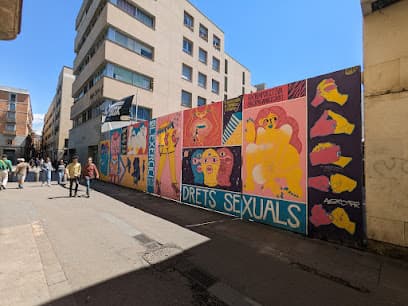
The mural dominates a blind wall near the intersection with Carrer de l’Hospital. It’s a chaotic dance of figures, abstract shapes, and saturated pigments that somehow manage to feel both dated and timeless. It’s a relic of a time when Barcelona was transitioning from a grey, post-dictatorship industrial hub into the global design capital it is today. You see the influence of the Informalists, a touch of Miró’s playfulness, and a whole lot of 1980s bravado. It’s weathered now, of course. The Mediterranean sun has baked the paint, and local graffiti artists have added their own unauthorized layers over the years. But that’s exactly how it should be. In the Raval, if something stays too clean, it’s probably a trap.
Standing under the mural, you get the full, noisy weight of the Rambla del Raval. This isn’t the tourist-clogged La Rambla a few blocks away. This is a wide, palm-lined boulevard where the air smells of roasting lamb from the nearby kebab shops and strong mint tea. You’ll see skaters grinding on the benches, old men from the Maghreb arguing over dominoes, and the occasional confused tourist looking for the beach. Just a few steps away sits Botero’s Cat, a giant bronze feline that has become the neighborhood’s unofficial mascot. The mural serves as the backdrop to this entire theater of the absurd.
Is it 'beautiful' in the traditional sense? Maybe not. It’s jarring. It’s loud. It’s a bit messy. But it represents a moment in history when the city decided that even its most neglected corners deserved a flash of the unexpected. It’s a testament to the fact that art doesn’t just belong in the white-walled galleries of the MACBA down the street; it belongs on the bricks and mortar where people actually live, work, and struggle.
Don’t just snap a photo and move on. Sit at one of the terrace cafes nearby, order a vermut, and watch the neighborhood move against the backdrop of Arranz-Bravo’s colors. You’ll realize that the mural isn't just a painting; it’s a piece of the city’s skin. It’s a reminder that even when a city tries to 'get pretty,' its scars and its soul are always going to show through. And in Barcelona, the soul is always more interesting than the makeup.
Type
Tourist attraction
Duration
15-30 minutes
Best Time
Late afternoon when the sun hits the colors and the Rambla comes alive with locals.
Features
Tourist attraction
Categories
Street ArtModern ArtPublic Art
Ticket Prices
Free Admission
No tickets required
Must-See Highlights
The surrealist figures at the top of the mural
The contrast with the modern Barceló Raval hotel next door
The nearby bronze 'Gat de Botero' sculpture
Visitor Tips
Combine this with a visit to the 360-degree rooftop bar at the Barceló Raval for a bird's-eye view of the neighborhood.
Watch out for pickpockets in this area, especially when distracted by the art.
The mural is best viewed from across the Rambla to take in the full scale.
Good For
Art loversPhotographersBudget travelersUrban explorers
Why Visit
1980s Olympic-era relic of the 'Barcelona Posa't Guapa' campaign
Surrealist collaboration between masters Arranz-Bravo and Bartolozzi
Located in the heart of Barcelona's most multicultural and artistic district
Nearby Landmarks
- 1-minute walk from Botero's Cat (El Gat de Botero)
- 1-minute walk from Barceló Raval 360 Terrace
- 5-minute walk from Sant Pau del Camp Monastery
- 8-minute walk from Mercat de la Boqueria
Accessibility
- Fully accessible public space
- Flat paved boulevard
Location
Rambla del Raval, 40
Ciutat Vella, Barcelona
Nearby Hotels
Nearby Restaurants
In Ciutat Vella
ATTRACTION
Park
Ciutat Vella
A thousand years of silence tucked behind a Romanesque monastery, where the grit of El Raval dissolves into ancient stone, cool shadows, and the heavy weight of history.
0.0(0)
Park
ATTRACTION
BARSHELONA
Ciutat Vella
Forget the plastic bulls and tacky magnets. This is where Barcelona’s soul is bottled into art, a small sanctuary of local design hidden in the shadows of the Gothic Quarter.
0.0(0)
Tourist attraction
ATTRACTION
Minajoe art
Ciutat Vella
A raw, paint-splattered antidote to the sterile museum circuit. This is where pop-art meets the grit of the street, served straight from the artist’s hands in the heart of old Barcelona.
0.0(0)
Tourist attraction
Frequently Asked Questions
Is the Mural worth visiting?
Yes, if you appreciate street art and want to see the authentic, gritty side of Barcelona. It's a landmark of the Raval's 1980s transformation and sits right next to Botero's Cat.
Who created the mural on Rambla del Raval?
It was painted in 1989 by the renowned Catalan artists Eduard Arranz-Bravo and Rafael Bartolozzi as part of a city-wide beautification project.
Is the Raval neighborhood safe for tourists?
The Raval is generally safe during the day but has a gritty reputation. Stay aware of pickpockets and stick to well-lit main streets like Rambla del Raval at night.
How do I get to the mural?
It is located on the Rambla del Raval, about an 8-minute walk from the Liceu (L3) or Sant Antoni (L2) metro stations.
Reviews
0 reviews for Mural
No reviews yet. Be the first to share your experience!