About
Let’s get one thing straight: Park Güell was a massive, spectacular failure. Before it was a UNESCO-listed selfie-magnet, it was supposed to be a high-end gated community for Barcelona’s turn-of-the-century elite. Eusebi Güell and Antoni Gaudí had this grand vision of a garden city, a utopian escape from the soot and grime of the industrial revolution down in the city center. They planned sixty luxury plots. They built two. Nobody bought in. The Jardins d'Àustria—the Gardens of Austria—is essentially the most beautiful 'empty lot' in the history of failed real estate ventures.
When you walk into Park Güell, most people get sucked into the gravitational pull of the 'Monumental Zone.' They fight for a clean shot of the mosaic lizard, they crowd the Hypostyle Room, and they shuffle along the Plaça de la Natura like sardines in a tin. But if you have the sense to peel off to the side, you find yourself in the Jardins d'Àustria. It feels different here. The architecture of the rest of the park is all about organic curves and hallucinogenic tiles, but this space is defined by something much older and more grounded: trees.
The name isn't just some marketing fluff. In 1977, the Republic of Austria donated a massive haul of trees to Barcelona for an exhibition, and they ended up here. You’ve got cedars, pines, and various conifers that feel more like a Northern European forest than a Mediterranean hillside. For a moment, the humidity of Barcelona fades, replaced by the sharp, clean scent of resin and needles. It’s a botanical oddity that shouldn't work in the middle of Gaudí’s fever dream, but it does. It provides the negative space that the rest of the park desperately needs.
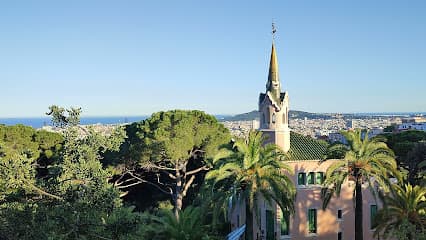
From the center of these gardens, you get a perspective on the park that the guidebooks usually skip. You can see the two houses that actually made it past the planning stage. One is the Casa Museu Gaudí, the pink, spire-topped house where the man himself lived for two decades. The other is the Casa Trias, a private residence that serves as a reminder of what the whole hill was supposed to look like if the rich people of 1900 had actually had any taste. Looking down from here, the famous 'gingerbread' entrance pavilions look like toys, and the city of Barcelona stretches out toward the Mediterranean in a hazy grid.
For years, this area served as a municipal plant nursery, and it still retains that sense of being a working garden rather than just a stage set for tourists. The paths are wider, the air feels cooler, and the noise of the crowds below is muffled by the canopy. It’s the place where you can actually sit on a bench and process the fact that you’re standing in the middle of one of the most ambitious architectural projects in human history—one that was rejected by the very people it was built for.
Is it worth the hike? If you’ve already paid for the Park Güell tickets, you’d be a fool to skip it. It’s the palate cleanser. It’s the quiet room at the party where you can finally hear yourself think. Don't come here looking for more broken-tile mosaics; come here to see the landscape that Gaudí was trying to tame, and to appreciate the irony that the most peaceful spot in his 'Monumental Zone' is the part he never actually got around to building on.
Type
Park, Garden
Duration
30-45 minutes
Best Time
Early morning (9:30 AM) or late afternoon to avoid the peak tour group crush and catch the best light for photos.
Guided Tours
Available
Audio Guide
Available
Features
Park
Garden
Categories
ArchitectureUNESCO World HeritageGaudíLandscaping
Ticket Prices
adult€10
child€0 (under 7)
senior€7
Opening Hours
- Monday9:30 AM to 7:30 PM
- Tuesday9:30 AM to 7:30 PM
- Wednesday9:30 AM to 7:30 PM
- Thursday9:30 AM to 7:30 PM
- Friday9:30 AM to 7:30 PM
- Saturday9:30 AM to 7:30 PM
- Sunday9:30 AM to 7:30 PM
Must-See Highlights
The view of Casa Trias
The contrast between the Austrian pines and the Mediterranean palms
The vantage point overlooking the Hypostyle Room roof
Visitor Tips
Bring water; the climb to this part of the park is steeper than it looks on the map.
This is the best place in the park for a quiet sit-down, as the benches here are rarely as crowded as the famous serpentine bench.
Look for the specific Austrian pines that give the garden its name.
Good For
Photography enthusiastsArchitecture buffsCouplesNature lovers
Why Visit
Unrivaled views of the Casa Museu Gaudí and Casa Trias
A unique Northern European micro-climate with Austrian conifers
The quietest zone within the paid 'Monumental' area of Park Güell
Nearby Landmarks
- Casa Museu Gaudí (2-minute walk)
- Plaça de la Natura (5-minute walk)
- Park Güell Entrance Pavilions (8-minute walk)
Accessibility
- Partial wheelchair access (some paths are gravel and steep)
- Accessible toilets nearby in the park
Location
Carrer de Marianao, 24
Gràcia, Barcelona
Nearby Hotels
Nearby Restaurants
In Gràcia
ATTRACTION
Maison Sara
Gràcia
Forget the mass-produced kitsch on La Rambla. This is Gràcia at its best: a tactile, clay-smeared workshop where the art is as raw and honest as the neighborhood itself.
0.0(0)
Tourist attraction
ATTRACTION
Intercambiador de libros
Gràcia
A humble, weather-beaten box in the hills of Vallcarca where local history is traded one dog-eared paperback at a time. No tourists, no Wi-Fi, just paper and community.
0.0(0)
Park
ATTRACTION
View
Gràcia
Forget the elbow-to-elbow chaos of Park Güell. This is the raw, vertical soul of Gràcia, where the city unfolds in a silent, sun-drenched sprawl at your feet.
0.0(0)
Garden
Frequently Asked Questions
Is Jardins d'Àustria worth visiting?
Yes, especially if you want to escape the densest crowds of Park Güell. It offers a unique 'forest' atmosphere and one of the best vantage points to photograph the park's famous entrance buildings from a distance.
Do I need a separate ticket for Jardins d'Àustria?
No, it is included in the general admission ticket for the Park Güell 'Monumental Zone.' You cannot access this specific garden without a paid ticket.
What is the history of the Gardens of Austria?
Originally intended as residential plots for a failed housing project, the area became a municipal nursery before being named after a large donation of trees from Austria in 1977.
How do I get to Jardins d'Àustria?
It is located within Park Güell. The easiest way is to take the L3 Metro to Lesseps or Vallcarca and follow the signs uphill, or take the H6 or D40 bus.
Reviews
0 reviews for Jardins d'Àustria
No reviews yet. Be the first to share your experience!