4.6
435 verified reviews
About
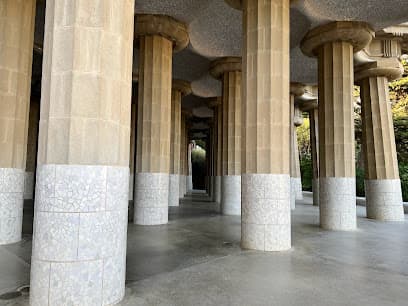
Walk into the Hypostyle Room and the first thing that hits you isn't the art—it’s the temperature. In the brutal heat of a Barcelona July, this place is a stone-cold sanctuary. It was supposed to be a market for a luxury housing estate that nobody wanted to buy, a failed real estate venture that accidentally gave us one of the most hallucinogenic spaces on the planet. Gaudí, ever the eccentric genius, took the classical Doric column and gave it a structural middle finger, making the outer rows lean inward to support the weight of the massive square sitting right on top of its head.
There are eighty-six columns here, and standing among them feels like being lost in a petrified forest. It’s heavy, it’s grey, and it’s undeniably cool. But don't just look at the stone. Look up. The ceiling is where the real madness lives. Those circular medallions, bursting with color and shattered glass, weren't even done by Gaudí. They were the work of his right-hand man, Josep Maria Jujol. He used the 'trencadís' technique—smashing perfectly good ceramic tiles and plates and putting them back together in a way that makes a traditional mosaic look like a paint-by-numbers kit. There are four large medallions representing the seasons and the cycles of the moon, surrounded by smaller suns. It’s a celestial map rendered in trash and treasure.
But here’s the thing most people miss while they’re busy lining up for the perfect Instagram shot: this entire room is a machine. It’s a giant, beautiful, stone-carved water filter. When it rains on the Plaça de la Natura—the big open square directly above you—the water doesn't just sit there. It drains through the sand, filters through the layers of the roof, and travels down through the hollow centers of these massive columns into a 1,200,000-liter cistern buried underground. Gaudí wasn't just building a park; he was building a self-sustaining ecosystem. He wanted to use that water to irrigate the gardens. It’s brilliant, functional engineering disguised as a Greek temple on acid.
You’ll hear the echoes of a thousand languages bouncing off the stone. You’ll see the tour groups shuffling through like slow-moving cattle. It can be frustrating. The 'Monumental Zone' of Park Güell has become a victim of its own fame, and the Hypostyle Room is the bottleneck where everyone stops to stare. But if you can find a corner, lean against a cold column, and ignore the selfie sticks for a second, you can feel the sheer weight of the ambition here. This wasn't meant for us; it was meant for a community of wealthy Catalans who never showed up. Their loss is our gain.
Is it worth the price of admission? If you care about how things are built, how art can serve a purpose beyond just looking pretty, then yes. It’s one of the few places in Barcelona where you can see Gaudí’s brain working in three dimensions—solving problems of gravity and irrigation while making sure the ceiling looks like a dream. Just get there early, or late, or whenever the crowds thin out enough for the stone to breathe. It’s a reminder that even a failed real estate project can become immortal if you have enough imagination and a lot of broken plates.
Type
Tourist attraction
Duration
20-30 minutes
Best Time
Early morning (8:30 AM) to beat the heat and the tour bus crowds.
Guided Tours
Available
Audio Guide
Available
What People Say
gaudi(21)ceiling(20)mosaic(14)architecture(10)cost(7)doric order(6)market(6)color(5)
Features
Tourist attraction
Categories
ArchitectureUNESCO World HeritageGaudíModernisme
Ticket Prices
adult€10
child€0-7
senior€7
Opening Hours
- Monday9:30 AM to 7:30 PM
- Tuesday9:30 AM to 7:30 PM
- Wednesday9:30 AM to 7:30 PM
- Thursday9:30 AM to 7:30 PM
- Friday9:30 AM to 7:30 PM
- Saturday9:30 AM to 7:30 PM
- Sunday9:30 AM to 7:30 PM
Must-See Highlights
The leaning outer columns
Jujol's trencadís medallions
The view looking up from the Dragon Staircase
Visitor Tips
Look closely at the medallions to see recycled pieces of plates and bottles
The room is significantly cooler than the rest of the park, making it a great rest stop
Photography is best from the corners to capture the depth of the column forest
Good For
Architecture buffsPhotography enthusiastsHistory lovers
Why Visit
Hidden 1,200,000-liter water filtration system built into the columns
Psychedelic trencadís ceiling medallions by Josep Maria Jujol
86 Doric columns supporting the massive Plaça de la Natura above
Nearby Landmarks
- Plaça de la Natura - 1-minute walk (directly above)
- The Dragon Staircase (Escalinata del Drac) - 1-minute walk
- Austria Gardens - 3-minute walk
- Gaudí House Museum - 5-minute walk
Accessibility
- Wheelchair accessible via specific park routes
- Level flooring inside the room
Location
Carrer d'Olot, 11
Gràcia, Barcelona
Nearby Hotels
Nearby Restaurants
In Gràcia
ATTRACTION
Maison Sara
Gràcia
Forget the mass-produced kitsch on La Rambla. This is Gràcia at its best: a tactile, clay-smeared workshop where the art is as raw and honest as the neighborhood itself.
0.0(0)
Tourist attraction
ATTRACTION
Intercambiador de libros
Gràcia
A humble, weather-beaten box in the hills of Vallcarca where local history is traded one dog-eared paperback at a time. No tourists, no Wi-Fi, just paper and community.
0.0(0)
Park
ATTRACTION
View
Gràcia
Forget the elbow-to-elbow chaos of Park Güell. This is the raw, vertical soul of Gràcia, where the city unfolds in a silent, sun-drenched sprawl at your feet.
0.0(0)
Garden
Frequently Asked Questions
Is the Hypostyle Room worth visiting?
Yes, it is one of the most impressive structural feats in Park Güell. It offers a unique look at Gaudí's engineering and provides a much-needed shaded escape from the sun.
Do I need a separate ticket for the Hypostyle Room?
No, access to the Hypostyle Room is included in the general admission ticket for the Park Güell Monumental Zone.
What is the best time to visit the Hypostyle Room?
Go as early as possible (8:00 AM or 8:30 AM) or an hour before closing to avoid the heaviest crowds and tour groups that congest the columns.
What should I look for on the ceiling?
Look for the 18 circular medallions (4 large and 14 small) designed by Josep Maria Jujol. They use the trencadís technique with recycled ceramics and represent the seasons and lunar cycles.
Reviews
0 reviews for Hypostyle Room
No reviews yet. Be the first to share your experience!