3.6
7 verified reviews
About
To understand Park Güell, you first have to understand that it was a colossal failure. Antoni Gaudí, a man whose brain clearly operated on a frequency the rest of us can’t even hear, teamed up with his patron Eusebi Güell to build a luxury gated community for Barcelona’s elite. They wanted a garden city, a mountain retreat far from the soot and noise of the industrial sprawl below. They built the roads, the plazas, and two gingerbread-style houses that look like they were baked in a kiln of madness. Then, nobody bought in. The rich stayed in the Eixample, and the project collapsed. What remains is a beautiful, technicolor middle finger to the boring, the straight-edged, and the commercially viable.
Getting here is a slog. Don’t let the glossy brochures lie to you. Unless you’re taking a taxi like a high-roller, you’re going to be hiking up the steep hills of Gràcia, sweating through your shirt while elderly locals breeze past you like you’re standing still. But then you hit the entrance, and the sheer audacity of the place hits you. It’s not a park in any traditional sense; it’s a hallucination rendered in stone and ceramic. The 'trencadís' technique—smashing perfectly good tiles into shards just to rearrange them into something better—is everywhere. It’s chaotic, vibrant, and deeply human.
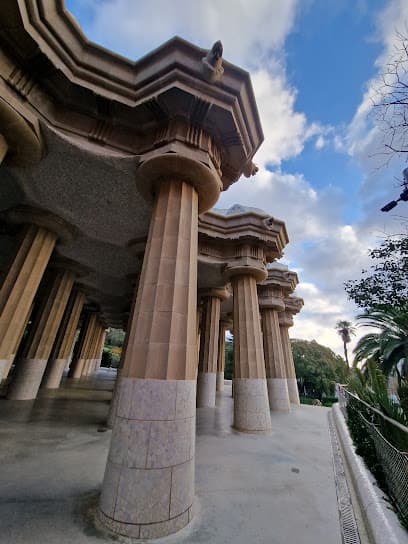
The centerpiece is the Plaça de la Natura, a massive esplanade held up by the Hypostyle Room’s eighty-six thick, Doric columns. It feels like a subterranean forest made of rock. Above, the world’s longest undulating bench snakes around the perimeter, covered in a mosaic of discarded glass and ceramic. It’s designed to fit the human spine, or at least Gaudí’s idea of one. Sit there for a minute. Look past the forest of selfie sticks and the influencers trying to find their light. Look at the view. You can see the entire grid of Barcelona stretching out toward the Mediterranean, with the Sagrada Família rising like a giant, melting sandcastle in the distance. This is one of the best things to do in Barcelona, not because it’s popular, but because it’s genuinely weird.
Then there’s the lizard. Or the dragon. Or the salamander. Whatever you want to call the multicolored beast guarding the staircase, it’s become the unofficial mascot of the city. It’s usually surrounded by a mosh pit of tourists, but if you catch it at the right moment, you see the genius in the grit. Gaudí didn’t just build a park; he created an ecosystem where nature and architecture are indistinguishable. The stone porticos look like they were carved by wind and water rather than chisels. The viaducts feel like they’ve been growing out of the hillside for centuries.
Is Park Güell worth it? Yes, but with caveats. If you show up at noon without a ticket, you’re going to have a bad time. The 'Monumental Zone'—the part you actually want to see—is strictly ticketed and timed. It’s a circus, and the crowds can be suffocating. But if you get here early, when the light is hitting the mosaics and the city is still waking up, you can feel the ghost of Gaudí wandering through the pines. It’s a place that reminds you that even the most spectacular failures can become something immortal.
Ultimately, this is a monument to a man who refused to see a straight line. It’s messy, it’s over-the-top, and it’s occasionally exhausting. But in a world of glass boxes and sterile urban planning, we need more failed housing projects that look like they were designed by a druid on a bender. Don’t just tick it off your list. Walk the dirt paths away from the crowds, find a quiet stone bench, and appreciate the fact that someone was crazy enough to build this.
Type
Park
Duration
2-3 hours
Best Time
Early morning (8:00 AM - 9:30 AM) to beat the tour groups and the midday sun.
Guided Tours
Available
Audio Guide
Available
Features
Park
Categories
ArchitectureUNESCOGaudíArt
Ticket Prices
adult€10
child€7
senior€7
Must-See Highlights
The Salamander (El Drac) at the entrance stairway
The Hypostyle Room with its 86 forest-like columns
Nature Square (Plaça de la Natura) and the serpentine bench
The Laundry Room Portico with its wave-like stone structure
Visitor Tips
Book your tickets at least a week in advance as they sell out daily.
Wear comfortable shoes; the park is built on a hill and involves significant walking on uneven terrain.
Bring water, as the on-site cafes are overpriced and often crowded.
Good For
Architecture loversPhotographersFamiliesFirst-time visitors
Why Visit
The world's longest undulating bench covered in vibrant trencadís mosaic shards.
A failed luxury housing estate that transformed into a UNESCO-listed psychedelic masterpiece.
Unrivaled panoramic views of the Barcelona skyline and the Mediterranean Sea.
Nearby Landmarks
- Casa Museu Gaudí (2-minute walk)
- Turó de les Tres Creus (10-minute walk)
- Plaça de Lesseps (15-minute walk)
- Casa Vicens (20-minute walk)
Accessibility
- Wheelchair accessible routes available
- Specific entrance for reduced mobility
- Accessible toilets
Location
Av. de la Mare de Déu de Montserrat, 2-6
Gràcia, Barcelona
Nearby Hotels
Nearby Restaurants
In Gràcia
ATTRACTION
Maison Sara
Gràcia
Forget the mass-produced kitsch on La Rambla. This is Gràcia at its best: a tactile, clay-smeared workshop where the art is as raw and honest as the neighborhood itself.
0.0(0)
Tourist attraction
ATTRACTION
Intercambiador de libros
Gràcia
A humble, weather-beaten box in the hills of Vallcarca where local history is traded one dog-eared paperback at a time. No tourists, no Wi-Fi, just paper and community.
0.0(0)
Park
ATTRACTION
View
Gràcia
Forget the elbow-to-elbow chaos of Park Güell. This is the raw, vertical soul of Gràcia, where the city unfolds in a silent, sun-drenched sprawl at your feet.
0.0(0)
Garden
Frequently Asked Questions
Is Park Güell worth visiting?
Absolutely, but only if you book in advance. It offers some of the most iconic views of Barcelona and showcases Gaudí's unique 'trencadís' mosaic style in a way no other site does.
How do I get to Park Güell?
Take the Metro L3 to Lesseps or Vallcarca, but be prepared for a 15-minute uphill walk. Alternatively, Bus 24 from Plaça de Catalunya drops you much closer to the entrance.
Do I need tickets for Park Güell?
Yes, you need a paid ticket to enter the 'Monumental Zone' where the famous mosaics and dragon are located. The surrounding forest park area is also restricted to ticket holders during peak hours.
What is the best time to visit Park Güell?
Go as early as possible, ideally at opening time, to avoid the heat and the heaviest crowds. Sunset is beautiful but extremely crowded with photographers.
Reviews
0 reviews for Guell park
No reviews yet. Be the first to share your experience!