4.9
7 verified reviews
About
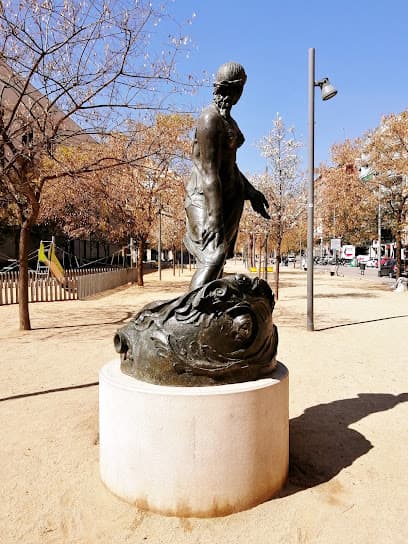
Most people come to Barcelona for the big hits—the Sagrada Familias, the Ramblas, the stuff that looks good on a postcard and fits neatly into a guided tour. But the real soul of this city is often found in the weird, forgotten corners where the past just sits there, ignored by the crowds. The Escultura de Selene is exactly that. It’s a bronze goddess of the moon, cast in 1925 by Joan Borrell i Nicolau, standing in a small, unassuming niche on Avinguda de Vallcarca. It’s not a 'destination' in the way travel agents use the word. It’s a ghost.
To find it, you have to head up toward the northern edge of Gràcia, where the neighborhood starts to tilt upward toward the hills. You’re near the Viaducte de Vallcarca, a massive piece of engineering that feels more like Gotham City than the Mediterranean. The sculpture sits in a small landscaped area that most commuters drive past without a second glance. This is one of the best sculptures in Barcelona precisely because it isn't surrounded by velvet ropes or gift shops. It’s just there, living with the locals, weathering the exhaust fumes and the occasional Mediterranean rain.
Selene herself is a product of Noucentisme, a Catalan cultural movement that traded the wild, organic chaos of Gaudí’s Modernisme for something more classical, orderly, and serene. Borrell i Nicolau was a master of this style. He originally created this piece, along with several others, for the 1929 International Exposition—the same event that gave us the Palau Nacional and the Magic Fountain. For decades, Selene was tucked away in the gardens of the Palauet Albéniz on Montjuïc, a place for dignitaries and kings. But in 2002, the city moved her here, to this quiet corner of Vallcarca, giving the neighborhood a piece of high art to call its own.
The statue depicts the goddess in a moment of quiet repose, her bronze skin having taken on that deep, dark patina that only comes with a century of exposure to the elements. She stands on a simple stone pedestal, her form elegant and unpretentious. There’s a certain melancholy to it—a goddess of the night standing under the harsh glare of streetlights and the shadow of a concrete bridge. If you’re looking for things to do in Gràcia that don't involve waiting in line for forty minutes to buy a overpriced gelato, this is your spot.
Is Escultura de Selene worth it? If you’re the kind of person who needs a plaque and a souvenir shop to tell you something is important, probably not. But if you appreciate the quiet dignity of a well-crafted object in an unexpected place, it’s a revelation. It’s a reminder that Barcelona was a city of artists long before it was a city of tourists. You stand there for a few minutes, watching the neighbors walk their dogs or the teenagers lean against the nearby walls, and you realize that this is how art should be experienced: as part of the furniture of daily life.
Don’t make a special pilgrimage just for the statue unless you’re an art history obsessive. Instead, incorporate it into a walk through the upper reaches of Gràcia. Start at the Lesseps metro station, walk past the madness of the Park Güell crowds, and head toward the Vallcarca bridge. The area is steep, the stairs are brutal, and the architecture is a jumble of old village houses and mid-century apartment blocks. It’s honest. It’s the Barcelona that doesn't care if you like it or not. And right in the middle of it, Selene is still there, watching the moon rise over the Tibidabo mountain, just as she has for a hundred years.
Type
Park
Duration
10-15 minutes
Best Time
Late afternoon when the sun hits the bronze, or at night when the streetlights give it a moody, cinematic feel.
What People Say
sculptures(2)
Features
Park
Categories
SculpturePublic ArtHistory
Ticket Prices
Free Admission
No tickets required
Must-See Highlights
The intricate bronze patina of the goddess
The contrast between the classical sculpture and the industrial Viaducte de Vallcarca
The artist's signature on the base
Visitor Tips
Combine this with a walk across the Vallcarca bridge for great views of the city.
Wear comfortable shoes; the walk from the Lesseps metro is entirely uphill.
Look for the other Noucentisme details in the small garden surrounding the statue.
Good For
Art loversSolo travelersPhotography enthusiastsBudget travelers
Why Visit
Authentic Noucentisme masterpiece by Joan Borrell i Nicolau
Zero tourist crowds compared to city center monuments
Located near the impressive 1920s Viaducte de Vallcarca
Nearby Landmarks
- Viaducte de Vallcarca (2-minute walk)
- Casa Vicens Gaudí (12-minute walk)
- Park Güell (15-minute walk uphill)
- Biblioteca Juan Marsé (5-minute walk)
Accessibility
- Outdoor public space
- Sidewalk access
- Steep hills in the surrounding area
Location
Av. de Vallcarca, 19
Gràcia, Barcelona
Nearby Hotels
Nearby Restaurants
In Gràcia
ATTRACTION
Maison Sara
Gràcia
Forget the mass-produced kitsch on La Rambla. This is Gràcia at its best: a tactile, clay-smeared workshop where the art is as raw and honest as the neighborhood itself.
0.0(0)
Tourist attraction
ATTRACTION
Intercambiador de libros
Gràcia
A humble, weather-beaten box in the hills of Vallcarca where local history is traded one dog-eared paperback at a time. No tourists, no Wi-Fi, just paper and community.
0.0(0)
Park
ATTRACTION
View
Gràcia
Forget the elbow-to-elbow chaos of Park Güell. This is the raw, vertical soul of Gràcia, where the city unfolds in a silent, sun-drenched sprawl at your feet.
0.0(0)
Garden
Frequently Asked Questions
Is Escultura de Selene worth visiting?
It is worth a stop if you are already exploring the Vallcarca or Gràcia neighborhoods. It is a beautiful, historic bronze sculpture, but as a standalone destination, it only takes about five minutes to see.
How do I get to Escultura de Selene?
The easiest way is to take the L3 Metro to the Vallcarca or Lesseps stations. From there, it is a short but uphill walk to Avinguda de Vallcarca, 19, located near the base of the Vallcarca bridge.
Do I need tickets for Escultura de Selene?
No, it is a public sculpture located in a small street-side garden. It is free to view 24 hours a day.
Reviews
0 reviews for Escultura de Selene
No reviews yet. Be the first to share your experience!