4.5
944 verified reviews
About
You don’t just walk up the Escalinata Monumental; you survive it. This is the grand, double-flight staircase that serves as the ceremonial heart of Park Güell, and it is quite possibly the most photographed set of steps on the planet. It’s a brilliant, clashing mess of color, a manic collection of shattered ceramics, and a testament to the fact that Antoni Gaudí didn’t do 'subtle.' If you’re looking for a quiet moment of reflection, you’ve come to the wrong place. You’re here for the spectacle, the sweat, and the sheer, unadulterated audacity of Catalan Modernism.
As you pass through the entrance pavilions—those gingerbread houses that look like they were baked in a kiln by a giant with a sweet tooth—the staircase rises before you like a tidal wave of stone and tile. It was built between 1900 and 1914, back when this whole park was supposed to be an exclusive gated community for Barcelona’s elite. The housing project failed miserably, but the staircase remained, a gateway to a utopia that never quite arrived. Now, it’s the gateway for thousands of visitors a day, all vying for a clean shot of the dragon.
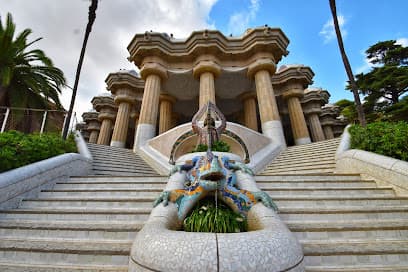
Let’s talk about that dragon—or the 'Drac,' as the locals call it. It’s a salamander, really, covered in a skin of trencadís—shards of broken plates, cups, and tiles salvaged from local factories. It’s the unofficial mascot of Barcelona, and it sits there, stoic and grinning, while tourists from every corner of the globe shove their cameras in its face. It’s been vandalized, restored, and worshipped. Just above it, you’ll find the head of a snake emerging from a medallion of the Catalan flag, a subtle nod to the nationalism that fueled Gaudí’s creative fire. The whole thing is dripping with symbolism, from the four-armed cross to the references to alchemy and mythology, but most people are too busy checking their lighting to notice.
Under the brutal Mediterranean sun, the colors of the staircase are blinding. The blues, yellows, and greens of the mosaics pop against the grey stone, creating a shimmering intensity that’s almost overwhelming. It’s the definitive proof of the trencadís technique, a method Gaudí used to cover curved surfaces with rigid materials. He took the discarded, the broken, and the forgotten, and turned it into something that feels more alive than the people walking on it. The craftsmanship is staggering when you get close enough to see the individual grout lines and the way the light catches the glazed surfaces.
Rising above the stairs are the eighty-six massive Doric columns of the Hypostyle Room, which look like they’re holding up the very sky. The contrast between the organic, swirling chaos of the staircase and the rigid, forest-like order of the columns above is what makes this place work. It’s a tension between nature and geometry that Gaudí spent his life trying to resolve. You feel the weight of it here—the ambition, the religious fervor, and the architectural genius that borders on madness.
Is it a tourist trap? Of course it is. You’ll be elbowed by teenagers, blocked by tour groups, and probably overcharged for a bottle of water at the gate. But when you stand at the base of those stairs and look up at that shimmering, shattered masterpiece, none of that matters. It’s one of the few places in the world that actually lives up to the postcards. It’s loud, it’s crowded, and it’s beautiful. It’s Barcelona in a nutshell: proud, stubborn, and absolutely refusing to be boring.
Type
Tourist attraction, Park
Duration
30-45 minutes (for the stairs and immediate area)
Best Time
Early morning at opening to beat the heat and the heaviest tour groups.
Guided Tours
Available
Audio Guide
Available
What People Say
gaudi(40)mosaic(21)architecture(20)art works(17)lizard(15)picture(8)selfie(6)trencadís(5)
Features
Tourist attraction
Park
Categories
ArchitectureUNESCO World HeritageGaudíModernism
Ticket Prices
adult€10
child€0 (under 7)
senior€7
Must-See Highlights
The Mosaic Salamander (El Drac)
The Snake Head Medallion with the Catalan flag
The tripod-shaped bench at the first landing
The view looking up toward the Hypostyle Room columns
Visitor Tips
Book your tickets weeks in advance during peak season; there are no walk-up sales if the time slots are full.
The stairs are slippery when wet and very bright in the sun; wear shoes with grip and bring sunglasses.
Don't just look at the dragon; check out the ceiling mosaics in the Hypostyle Room just above the stairs.
Good For
Architecture loversPhotography enthusiastsFirst-time visitorsFamilies
Why Visit
The 'El Drac' mosaic salamander, the most famous symbol of Barcelona
Masterpiece of the trencadís technique using recycled ceramic shards
The grand ceremonial entrance to Gaudí's visionary (but failed) garden city
Nearby Landmarks
- Hypostyle Room (1-minute walk)
- Casa del Guarda (2-minute walk)
- Plaça de la Natura / Greek Theatre (3-minute walk)
- Austria Gardens (5-minute walk)
Accessibility
- Ramps are available to bypass the stairs for those with limited mobility, though the main dragon photo op is on the steps.
Location
Carrer d'Olot, 78
Gràcia, Barcelona
Nearby Hotels
Nearby Restaurants
In Gràcia
ATTRACTION
Maison Sara
Gràcia
Forget the mass-produced kitsch on La Rambla. This is Gràcia at its best: a tactile, clay-smeared workshop where the art is as raw and honest as the neighborhood itself.
0.0(0)
Tourist attraction
ATTRACTION
Intercambiador de libros
Gràcia
A humble, weather-beaten box in the hills of Vallcarca where local history is traded one dog-eared paperback at a time. No tourists, no Wi-Fi, just paper and community.
0.0(0)
Park
ATTRACTION
View
Gràcia
Forget the elbow-to-elbow chaos of Park Güell. This is the raw, vertical soul of Gràcia, where the city unfolds in a silent, sun-drenched sprawl at your feet.
0.0(0)
Garden
Frequently Asked Questions
Is the Escalinata Monumental worth visiting?
Yes, it is the iconic heart of Park Güell featuring the famous mosaic dragon. While crowded, the architectural detail and trencadís work are the pure, unvarnished soul of the city’s creative madness.
Do I need a ticket to see the dragon at Park Güell?
Yes, the Escalinata Monumental is located within the Restricted Zone (Monumental Zone) of the park, which requires a paid entry ticket. It is highly recommended to book online in advance as they often sell out.
What is the best time to visit the stairs to avoid crowds?
The best time is at the very first entry slot (usually 9:30 AM) or about an hour before closing. Mid-day is extremely crowded with tour groups and harsh lighting for photos.
How do I get to the Escalinata Monumental?
Take the L3 Metro to Lesseps or Vallcarca and follow the signs for a 15-minute uphill walk. Alternatively, Bus 24 from Plaça de Catalunya drops you closer to the upper entrance.
Reviews
0 reviews for Escalinata monumental
No reviews yet. Be the first to share your experience!