4.6
659 verified reviews
About
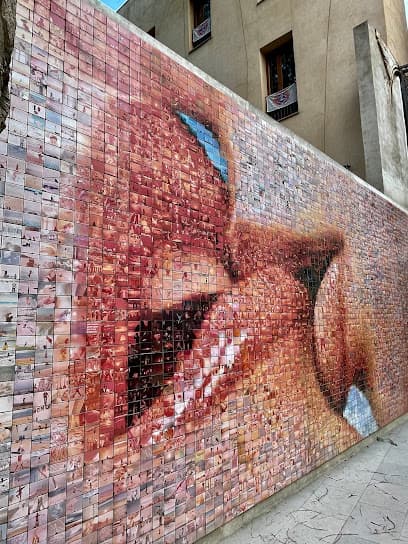
You’re wandering the Gothic Quarter, dodging the human traffic on Avinguda de la Catedral, and you duck into a side street to escape the sun or a particularly aggressive tour group. You stumble into Plaça d'Isidre Nonell, and there it is. A massive, pixelated image of two people locked in a kiss. From a distance, it looks like a standard piece of street art, the kind of thing designed specifically to end up on a postcard or a digital feed. But get closer. Move past the influencers posing for the perfect shot and actually look at the thing.
'El món neix en cada besada'—The world is born in every kiss. It’s the work of Joan Fontcuberta, a man who understands that a photograph is often a lie, but four thousand of them might just tell a truth. This isn't just paint on a wall. It’s a mosaic of four thousand individual ceramic tiles, each one a photograph submitted by a resident of Barcelona. When the city asked its people to send in images representing 'moments of freedom,' this is what they got: babies, sunsets, protests, dogs, old couples holding hands, blurred nights out. It’s a collective memory bank disguised as a romantic gesture.
There’s a heavy irony to the location. This mural was unveiled in 2014 to mark the 300th anniversary of the fall of Barcelona in 1714. Usually, these kinds of anniversaries are marked by bronze statues of men on horses or somber plaques about sacrifice and defeat. Instead, Fontcuberta gave the city a kiss. He took the quote from Oliver Wendell Holmes—'The sound of a kiss is not as loud as that of a cannon, but its echo lasts a great deal longer'—and turned it into a permanent fixture of the Ciutat Vella. It’s a giant, ceramic middle finger to the idea that history is only written in blood and cannons. It suggests that maybe, just maybe, the small, private moments of freedom are what actually matter.
The atmosphere here is a strange cocktail of reverence and vanity. You’ll see couples trying to recreate the pose in front of the wall, which is meta and slightly exhausting. But you’ll also see people standing inches away from the tiles, scanning the tiny images like they’re looking for a lost relative. There’s a quiet power in seeing a grainy photo of someone’s grandmother or a blurry shot of a beach day integrated into this grand, public statement. It’s messy, it’s personal, and it’s deeply human.
Is it a tourist trap? In the sense that it’s on every 'top 10 photo spots' list, yes. But unlike a lot of the curated, hollow experiences in this neighborhood, the mural has a soul. It doesn't cost you a cent to look at it. It doesn't try to sell you a souvenir. It just sits there, tucked away in a square that used to be a cemetery, reminding you that while empires fall and borders shift, people still want to press their faces together and feel something.
Go early in the morning if you want to see the tiles without a crowd of people blocking your view. The light hits the ceramic at an angle that makes the colors pop, and you can actually hear the city waking up around you. Or go late, when the square is empty and the mural feels like a secret shared between you and four thousand strangers. It’s one of the few places in the Gothic Quarter where the weight of the past feels light, replaced by the collective breath of a city that refused to stay defeated.
Type
Tourist attraction
Duration
15-30 minutes
Best Time
Early morning to avoid the Instagram crowds and see the detail of the tiles in natural light.
What People Say
pictures(43)kiss(25)mosaic(22)mural(21)tiles(11)cathedral(10)lip(7)instagram(6)
Features
Tourist attraction
Categories
Public ArtPhotographyHistoryStreet Art
Ticket Prices
Free Admission
No tickets required
Opening Hours
- MondayOpen 24 hours
- TuesdayOpen 24 hours
- WednesdayOpen 24 hours
- ThursdayOpen 24 hours
- FridayOpen 24 hours
- SaturdayOpen 24 hours
- SundayOpen 24 hours
Must-See Highlights
The individual ceramic tiles featuring personal photos of Barcelona residents
The Oliver Wendell Holmes quote inscribed on the plaque nearby
The way the mosaic resolves into a single image from a distance
Visitor Tips
Step as close as possible to the wall to see the individual photos; they range from domestic scenes to political protests.
The square is a great place for a quick rest, but it gets very busy with tour groups between 11:00 AM and 4:00 PM.
Combine this with a visit to the nearby Cathedral cloisters for a quiet morning in the Gothic Quarter.
Good For
PhotographersCouplesArt loversBudget travelers
Why Visit
Composed of 4,000 individual photos submitted by Barcelona residents
Created by world-renowned photographer and conceptual artist Joan Fontcuberta
Commemorates the 300th anniversary of the 1714 Siege of Barcelona through a message of peace
Nearby Landmarks
- Barcelona Cathedral (2-minute walk)
- Plaça de la Seu (2-minute walk)
- Palau de la Música Catalana (5-minute walk)
- Plaça de Catalunya (7-minute walk)
Accessibility
- Outdoor public square
- Flat paved ground
- Wheelchair accessible
Location
Carrer dels Capellans, 16
Ciutat Vella, Barcelona
Nearby Hotels
Nearby Restaurants
In Ciutat Vella
ATTRACTION
Park
Ciutat Vella
A thousand years of silence tucked behind a Romanesque monastery, where the grit of El Raval dissolves into ancient stone, cool shadows, and the heavy weight of history.
0.0(0)
Park
ATTRACTION
BARSHELONA
Ciutat Vella
Forget the plastic bulls and tacky magnets. This is where Barcelona’s soul is bottled into art, a small sanctuary of local design hidden in the shadows of the Gothic Quarter.
0.0(0)
Tourist attraction
ATTRACTION
Minajoe art
Ciutat Vella
A raw, paint-splattered antidote to the sterile museum circuit. This is where pop-art meets the grit of the street, served straight from the artist’s hands in the heart of old Barcelona.
0.0(0)
Tourist attraction
Frequently Asked Questions
Is El món neix en cada besada worth visiting?
Yes, especially if you appreciate public art with deep local meaning. It's a free, quick stop in the Gothic Quarter that offers a more intimate look at Barcelona's identity than the nearby crowded landmarks.
What is the best time to visit the Kiss Mural?
Early morning (before 9:00 AM) is best to avoid the crowds of tourists and influencers. The square is small, so it feels cramped quickly once the tour groups arrive.
Where exactly is the Kiss Mural located?
It is located in Plaça d'Isidre Nonell, just a two-minute walk from the Barcelona Cathedral in the Gothic Quarter. Look for the small square tucked off Carrer dels Capellans.
Do I need tickets for the Kiss Mural?
No, it is a public art installation located in an open square. It is free to view and accessible 24 hours a day.
Reviews
0 reviews for El món neix en cada besada
No reviews yet. Be the first to share your experience!