4.4
7,659 verified reviews
About
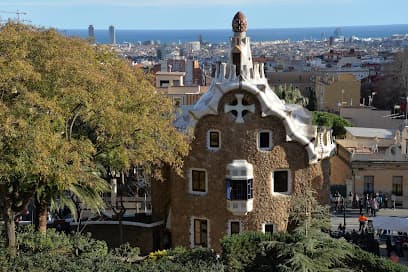
You’re standing at the gates of Park Güell, and before you even see the famous lizard, you’re staring at a house that looks like it was baked in a kiln by a madman with a sugar habit. This is the Casa del Guarda. It’s the right-hand pavilion of the two gingerbread-style houses guarding the entrance on Carrer d'Olot. While the rest of the world is elbowing each other for a selfie with the mosaic dragon, you should take a second to look at this place. It wasn't built for a count or a textile tycoon. It was built for the guy who worked the gate. The help. And even for the help, Antoni Gaudí didn't know how to do 'simple.'
Built between 1901 and 1903, the Casa del Guarda is a masterclass in what happens when you give a genius a modest brief and he decides to ignore the concept of a straight line entirely. The roof is a hallucinatory explosion of trencadís—those broken ceramic shards that Gaudí turned into high art. It’s topped with a double-cross that looks like it’s melting into the sky. It’s beautiful, it’s weird, and it’s a little bit unsettling, like a fairy tale that might end with someone getting shoved into an oven. This is one of the best examples of Gaudí architecture in Barcelona because it shows his ability to apply complex geometry to a domestic, functional space.
Step inside, and the vibe changes. This is part of the MUHBA (Museu d’Història de Barcelona) now. It’s small—claustrophobically so when the mid-August crowds are thick—but it tells the story of what this place was supposed to be. Park Güell wasn't meant to be a tourist playground; it was a failed real estate development. A gated community for the Barcelona elite that nobody wanted to move into because it was too far from the city center. The Casa del Guarda houses an exhibition called 'Güell, Gaudí and Barcelona,' which strips away the 'Disney-fied' gloss and explains the urban ideal behind the madness. You see the plans, the struggle, and the sheer ego it took to try and reshape a hillside into a high-end utopian experiment.
The interior is sparse. Don't expect velvet curtains or gold leaf. It’s about the bones of the building—the organic curves, the narrow staircases, and the way the light hits the uneven walls. It feels like being inside the belly of a very large, very artistic whale. You’ll probably have to wait in a separate queue to get in, even after you’ve cleared the main Park Güell gates. The capacity is tiny, and the security guards take their jobs seriously. Is it worth the twenty-minute shuffle in the sun? If you give a damn about how Barcelona became the architectural freak-show it is today, then yes. If you’re just here for the 'Gram, you’ll probably find it too cramped and 'educational.'
The heavy lifting of the Casa del Guarda isn't just the architecture; it's the irony. In any other city, the caretaker’s shack is a cinderblock afterthought. Here, it’s a UNESCO World Heritage site. It represents a time when Barcelona was obsessed with reinventing itself, throwing off the shackles of the old city walls and climbing into the hills with a pocketful of broken tiles and a dream. It’s a reminder that even the most functional parts of a project can be elevated to something transcendent if you’re brave enough—or crazy enough—to try. When you leave, take a look at the roof again. Notice how the colors shift in the Mediterranean light. It’s a messy, beautiful, uncompromising piece of work. It’s pure Gaudí. It’s pure Barcelona.
Type
Tourist attraction
Duration
30-45 minutes
Best Time
8:30 AM to beat the first wave of tour buses or one hour before closing for the best light on the ceramic roof.
Guided Tours
Available
Audio Guide
Available
What People Say
gaudi(293)architecture(126)tickets(100)video(29)queue(23)mosaic(20)sagrada familia(14)genius(14)
Features
Tourist attraction
Categories
ArchitectureUNESCOGaudíMuseum
Ticket Prices
adult€10
child€0
senior€7
Opening Hours
- Monday9:30 AM to 5:30 PM
- Tuesday9:30 AM to 5:30 PM
- Wednesday9:30 AM to 5:30 PM
- Thursday9:30 AM to 5:30 PM
- Friday9:30 AM to 5:30 PM
- Saturday9:30 AM to 5:30 PM
- Sunday9:30 AM to 5:30 PM
Must-See Highlights
The trencadís (broken tile) roof and mushroom-shaped chimneys
The MUHBA video presentation on the park's history
The hyper-paraboloid roof structure visible from the top floor
Visitor Tips
Head straight to the house as soon as you enter the park to avoid the midday queue.
The interior is very narrow; avoid bringing large backpacks as you'll be asked to leave them or carry them in front.
Look for the original ironwork on the windows, which mimics organic plant forms.
Good For
Architecture enthusiastsHistory buffsGaudí fans
Why Visit
Part of the MUHBA (Barcelona History Museum) network
Original 1903 'gingerbread house' design with trencadís roof
Deep-dive exhibition into the failed 'Garden City' urban planning of Park Güell
Nearby Landmarks
- Dragon Stairway (1-minute walk)
- Hypostyle Room (2-minute walk)
- Plaça de la Natura (5-minute walk)
- Austria Gardens (7-minute walk)
Accessibility
- Ground floor accessible
- Upper floors via narrow stairs only
- No elevator
Location
Carrer d'Olot
Gràcia, Barcelona
Nearby Hotels
Nearby Restaurants
In Gràcia
ATTRACTION
Maison Sara
Gràcia
Forget the mass-produced kitsch on La Rambla. This is Gràcia at its best: a tactile, clay-smeared workshop where the art is as raw and honest as the neighborhood itself.
0.0(0)
Tourist attraction
ATTRACTION
Intercambiador de libros
Gràcia
A humble, weather-beaten box in the hills of Vallcarca where local history is traded one dog-eared paperback at a time. No tourists, no Wi-Fi, just paper and community.
0.0(0)
Park
ATTRACTION
View
Gràcia
Forget the elbow-to-elbow chaos of Park Güell. This is the raw, vertical soul of Gràcia, where the city unfolds in a silent, sun-drenched sprawl at your feet.
0.0(0)
Garden
Frequently Asked Questions
Is Casa del Guarda worth visiting?
Yes, if you want to understand the history of Park Güell beyond the mosaics. It provides essential context on Gaudí's failed 'garden city' project and offers a rare look inside a functional Gaudí-designed residence.
Do I need a separate ticket for Casa del Guarda?
No, entry is included with your Park Güell Monumental Zone ticket. However, because the building is very small, there is often a separate queue at the door to manage capacity.
How long should I spend at Casa del Guarda?
The exhibition inside takes about 15-20 minutes to walk through. Factor in an additional 15-30 minutes for the queue during peak tourist hours.
Is the building accessible for people with disabilities?
The ground floor exhibition is accessible, but the upper floors are reached via narrow, steep, original staircases that are not suitable for wheelchairs or those with significant mobility issues.
Reviews
0 reviews for Casa del Guarda
No reviews yet. Be the first to share your experience!