4.4
7 verified reviews
About
If you’re looking for a place to drop your bags, get a lukewarm continental breakfast, and complain about the Wi-Fi, keep walking. The name is a bit of a local joke on the uninitiated. In Catalonia, a 'Hotel d’Entitats' isn’t a place for tourists to sleep; it’s a place for ideas to live. It’s a 'house of entities,' a municipal barracks for the non-profits, the neighborhood watchdogs, the ecologists, and the people who actually make this city breathe when the cruise ships aren't looking.
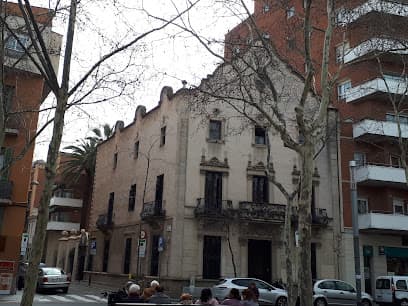
Standing on the corner of Carrer de Cuba, Can Guardiola is a middle finger to the glass-and-steel monotony of modern urban planning. Built in 1920 by the architect Josep Codina i Tramunt, it was originally a private residence for the Guardiola family. It’s a prime slice of late Modernisme—the kind of architecture that doesn’t feel the need to scream for your attention like a Gaudí chimney, but commands it nonetheless. Look at the facade: the wrought ironwork on the balconies, the rhythmic placement of the windows, and that corner tower that looks like it’s keeping a watchful eye on the neighborhood. It’s beautiful, sure, but it’s a functional beauty. It’s a building that has aged like a veteran stage actor—a few wrinkles, a lot of character, and a refusal to retire.
Step inside and the illusion of a luxury hotel evaporates instantly, replaced by the glorious, mundane hum of civic life. There is no concierge. Instead, you’ll find bulletin boards plastered with flyers for local protests, yoga for the elderly, and manifestos on urban gardening. The air smells of old paper, floor wax, and the kind of strong espresso that fuels long meetings about neighborhood zoning. This is the headquarters for groups like the Grup de Medi Ambient de Sant Andreu. It’s where the people of the barrio come to organize, to argue, and to ensure that Sant Andreu remains Sant Andreu.
You have to understand the neighborhood to understand why this place matters. Sant Andreu was an independent village until the late 19th century, and if you ask the locals, it still is. It’s a place of narrow, pedestrian-only streets, hidden plazas, and a fierce sense of identity. Can Guardiola is a cornerstone of that identity. It’s a bridge between the bourgeois past of the 1920s and the gritty, activist present. It’s located just a stone’s throw from the massive Fabra i Coats textile factory—another local icon turned cultural hub—and the towering church of Sant Andreu del Palomar.
Is it worth visiting? If you’re a fan of architecture who wants to see a masterpiece without having an elbow shoved in your ribs by a selfie-stick-wielding tourist, then yes. If you want to see the 'real' Barcelona—the one that exists for its residents rather than its visitors—then absolutely. But don't expect a tour guide or a gift shop. You’re an observer here, a ghost in the machine of local democracy. Walk the perimeter, admire Codina’s lines, and then head to a nearby bodega for a vermouth.
The soul of Can Guardiola isn't in what it sells, because it isn't selling anything. It’s in the fact that it exists at all—a century-old mansion preserved not as a museum for the elite, but as a workspace for the community. It’s a reminder that cities are built of more than just stone and mortar; they’re built of the people who give a damn about their corner of the world. Just don't try to check in at the front desk. They'll just give you a flyer for a recycling initiative and send you on your way.
Why Stay Here
Late Modernist masterpiece by architect Josep Codina i Tramunt
Authentic look into the civic and activist heart of the Sant Andreu neighborhood
Imposing 1920s facade and corner tower without the tourist crowds of Eixample
Nearby Landmarks
- 3-minute walk from Sant Andreu del Palomar Church
- 5-minute walk from Fabra i Coats Cultural Center
- 4-minute walk from Plaça d'Orfila
- 6-minute walk from Mercat de Sant Andreu
Accessibility
- Wheelchair accessible entrance
- Elevator access to upper floors
Location
Carrer de Cuba, 2
Sant Andreu, Barcelona
In Sant Andreu
ATTRACTION
Camsbio,S.L
Sant Andreu
Not a park for picnics, but the workshop where Barcelona’s green future is built. Camsbio is the grit behind the city's vertical gardens and bio-construction.
0.0(0)
ATTRACTION
Multan los Domingos
Sant Andreu
A defiant slice of Sant Andreu where industrial ruins meet community gardens. It’s the anti-tourist Barcelona: raw, brick-heavy, and smelling of vermut and rebellion.
0.0(0)
ATTRACTION
Plaça d'Albert Badia i Mur
Sant Andreu
A gritty, honest slice of Sant Andreu where the 'Cases Barates' history meets modern life. No Gaudí here—just real people, a playground, and the unvarnished soul of Bon Pastor.
0.0(0)
Frequently Asked Questions
Is Hotel d'Entitats Can Guardiola a real hotel?
No, despite the name, it is a 'Hotel d’Entitats' (House of Entities), which is a Catalan term for a civic center that provides office space and meeting rooms for local non-profits and associations.
Can I go inside Can Guardiola?
Yes, the building is a public municipal facility. While you can't tour the private offices of the associations, the common areas and the stunning modernist exterior are accessible to the public during business hours.
What is the history of the building?
It was built in 1920 as a private residence for the Guardiola family, designed by modernist architect Josep Codina i Tramunt. It was later acquired by the city to serve as a community hub.
How do I get to Can Guardiola?
The easiest way is to take the Metro L1 (Red Line) to the Sant Andreu station. From there, it is a short 5-minute walk through the heart of the neighborhood.
Reviews
0 reviews for Hotel d'Entitats Can Guardiola
No reviews yet. Be the first to share your experience!