4.3
602 verified reviews
About
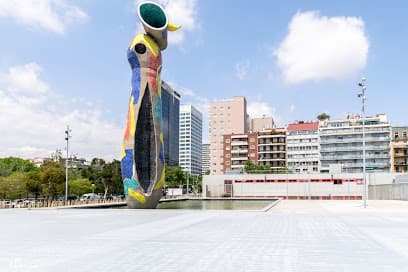
Standing twenty-two meters tall over a concrete reflecting pool, Joan Miró’s 'Dona i Ocell'—Woman and Bird—is a giant, primary-colored middle finger to the boring and the beige. It sits in the Parc de Joan Miró, a space that used to be the city’s central slaughterhouse. There’s a certain poetic justice in that: where blood once ran into the gutters, we now have a monolithic totem covered in vibrant trencadís tile work, shimmering under the brutal Catalan sun.
This wasn't some committee-designed piece of corporate art. This was Miró’s final major work, inaugurated in 1983 just months before the man checked out for good. He was ninety years old, still playing with shapes and colors like a kid who’d found a box of forbidden crayons. He collaborated with the ceramicist Joan Gardy Artigas to cover the concrete structure in shards of red, blue, and yellow—the holy trinity of the Miró palette. It’s rough, it’s tactile, and it looks like it grew out of the earth rather than being hoisted there by a crane.
Let’s address the elephant in the room, or rather, the giant ceramic cylinder. To the casual observer, 'Dona i Ocell' is undeniably phallic. Miró wasn't shy about the primal forces of nature. The 'woman' is represented by a vertical slit—a hollowed-out vulva shape—running down the side, while the 'bird' is a crescent moon perched precariously at the top. In Miró’s personal symbology, the bird represents the connection between the stars and the mud, the celestial and the terrestrial. It’s high-concept stuff delivered in a package that looks like a prehistoric toy.
The park itself, often called 'Parc de l’Escorxador' by locals who remember its bloody history, isn't your typical manicured European garden. It’s a neighborhood park in the truest sense. You’ll see old men playing pétanque, teenagers looking bored on benches, and dogs chasing shadows across the dusty paths. It lacks the curated polish of Park Güell, and that’s exactly why you should come here. It’s honest. It’s a place where the city actually lives, tucked just behind the massive Arenas de Barcelona shopping mall—a former bullring that’s been gutted and turned into a temple of consumerism.
Coming here is about seeing art in the wild. There are no velvet ropes, no hushed galleries, and no security guards telling you to stand back. You can walk right up to the edge of the water and watch the reflection of the tiles dance on the surface. It’s one of the best things to do in Eixample if you’re tired of the Gaudí-centric crowds and want to see how Barcelona honors its other favorite son.
Is it worth the trek? If you’re looking for a postcard-perfect park with rose bushes and fountains, maybe not. But if you want to stand in the shadow of a twenty-two-meter tall piece of surrealist history, to feel the scale of Miró’s imagination, then yes. It’s a reminder that even in a city as old and storied as Barcelona, there’s always room for something weird, something bold, and something that refuses to blend into the background. It’s a landmark that demands you look at it, whether you like what you see or not. And in a world of bland architecture, that’s worth a hell of a lot.
Type
Sculpture, Park
Duration
30-45 minutes
Best Time
Late afternoon for the best light on the ceramic tiles and a more local atmosphere in the park.
What People Say
joan miró(71)park(48)colours(15)square(15)1983(7)ceramic(7)democracy(6)grand opening(6)
Features
Sculpture
Park
Tourist attraction
Categories
SculptureModern ArtPublic ParkSurrealism
Ticket Prices
Free Admission
No tickets required
Opening Hours
- MondayOpen 24 hours
- TuesdayOpen 24 hours
- WednesdayOpen 24 hours
- ThursdayOpen 24 hours
- FridayOpen 24 hours
- SaturdayOpen 24 hours
- SundayOpen 24 hours
Must-See Highlights
The intricate trencadís ceramic patterns
The crescent moon 'bird' at the very peak
The reflection of the sculpture in the surrounding water basin
The contrast with the nearby Arenas bullring architecture
Visitor Tips
Combine this with a visit to the Fundació Joan Miró on Montjuïc for the full experience.
The park has a great playground if you're traveling with kids.
Avoid the heat of midday as there is limited shade directly around the sculpture.
Good For
Art enthusiastsBudget travelersFamiliesPhotographers
Why Visit
Miró's final monumental work completed just before his death
Iconic trencadís tile work by renowned ceramicist Joan Gardy Artigas
Located on the site of the city's historic 19th-century slaughterhouse
Nearby Landmarks
- Arenas de Barcelona (3-minute walk)
- Plaça d'Espanya (5-minute walk)
- Magic Fountain of Montjuïc (12-minute walk)
- Fira de Barcelona (8-minute walk)
Accessibility
- Wheelchair accessible park paths
- Flat terrain around the sculpture
- Accessible by public transport
Location
Carrer de Tarragona, 76
Eixample, Barcelona
Nearby Hotels
Nearby Restaurants
In Eixample
ATTRACTION
Mural Margalef
Eixample
A towering splash of Mediterranean blue breaking the rigid geometry of Eixample, Joan Margalef’s mural is a visceral reminder that Barcelona’s soul isn't just in its museums.
0.0(0)
Tourist attraction
ATTRACTION
Mural Margalef
Eixample
A geometric middle finger to urban decay, this massive kinetic mural by Eduard Margalef turns a drab Eixample blind wall into a rhythmic, shifting explosion of optical art.
0.0(0)
Tourist attraction
ATTRACTION
Happy Foodies
Eixample
Forget the plastic-wrapped tourist traps; this is a deep dive into the grease, garlic, and soul of Catalan cooking where you actually learn to handle a knife and a porrón.
0.0(0)
Sightseeing tour agencyTour agency
Frequently Asked Questions
Is Dona i Ocell worth visiting?
Yes, especially for art lovers. It is one of Joan Miró's most significant public works and offers a massive, colorful contrast to the surrounding urban landscape without the crowds of other major landmarks.
What does the Woman and Bird sculpture represent?
The sculpture uses Miró's personal symbolism where the bird represents a link between the earthly and celestial worlds, while the form itself explores themes of femininity and nature through surrealist shapes.
How do I get to Parc de Joan Miró?
The park is easily accessible via the Tarragona (L3) or Espanya (L1, L3) metro stations. It is located just behind the Arenas de Barcelona shopping mall.
Is there an entrance fee for the sculpture?
No, the sculpture is located in a public park and is free to view 24/7, though the park itself may have specific closing hours at night.
Reviews
0 reviews for Woman and Bird
No reviews yet. Be the first to share your experience!