4.6
1,851 verified reviews
About
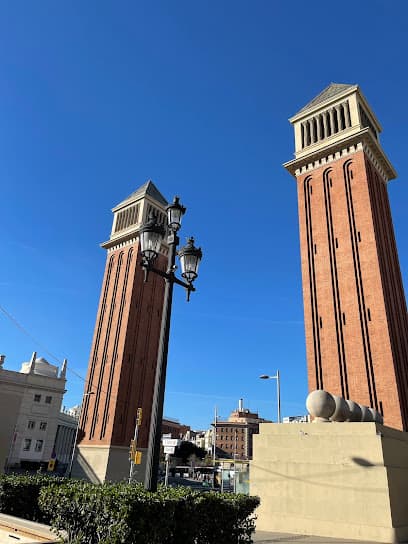
You’re standing at the edge of Plaça d’Espanya, and the first thing you notice isn’t the architecture—it’s the noise. The relentless, exhaust-choked roar of a thousand scooters and delivery vans circling the fountain like sharks. But then you look up, and there they are: two massive, 47-meter-tall brick exclamation points. The Torres Venecianes. They look like they were plucked straight out of St. Mark’s Square in Venice and dropped into the middle of a Catalan traffic jam. It’s a weird, beautiful, and slightly hallucinogenic sight.
These towers weren't built by some ancient doge. They were the work of Ramon Reventós, an architect who understood that if you’re going to throw a party, you need a hell of an entrance. That party was the 1929 International Exposition. The towers were designed as the grand gateway, the ceremonial threshold that told visitors they were leaving the grit of the city behind and entering a world of high-concept pavilions, manicured gardens, and the looming majesty of the Palau Nacional. They are built of hard red brick and artificial stone, topped with copper-roofed observation decks that, sadly, you can’t actually climb. They are purely decorative sentinels, standing watch over an avenue that was meant to showcase the best of the world.
Walking between them today feels like a transition. On one side, you have the Arenas de Barcelona—a former bullring turned shopping mall that represents the city’s modern, commercial heart. On the other, the long, rising sweep of Avinguda de la Reina Maria Cristina, leading your eye past the columns and the fountains toward the mountain of Montjuïc. It’s one of the most deliberate urban vistas in Europe. When you stand between these two giants, you’re standing in the footprint of history, in the exact spot where millions of people once shuffled toward the future with their eyes wide and their hats in their hands.
The detail on the towers is worth a closer look, even if you have to dodge a few tourists with selfie sticks to get it. The brickwork is intricate, a nod to the mudéjar style that runs through the DNA of Spanish architecture, even when it’s pretending to be Italian. The copper roofs have aged into a dull, dignified green, and the small windows near the top hint at a space that feels like it should be inhabited by a lonely bell-ringer or a very confused pigeon.
Is it a tourist trap? No, because it’s free and it’s just there. It’s part of the furniture of the city. You don’t 'do' the Torres Venecianes; you experience them as you move toward something else. They are the opening act for the Magic Fountain and the MNAC, but they hold their own. They represent a moment in time when Barcelona decided it was a world-class player and built the monuments to prove it. Even with the smell of diesel and the frantic energy of the Sants-Montjuïc neighborhood swirling around them, they maintain a certain stoic dignity. They are a reminder that even in a city as obsessed with the new as Barcelona, the ghosts of 1929 still have the best seats in the house. Don't just drive past them in a cab. Get out, stand in the middle of the sidewalk, and let the scale of the thing hit you. It’s a protein rush of pure, unadulterated civic ambition.
Type
Monument, Tourist attraction
Duration
15-30 minutes
Best Time
Sunset or evening when the towers and the nearby fountains are illuminated.
What People Say
architectural(35)square(24)1929(23)fountain(16)world's fair(14)emblem(13)1927(7)subway(7)
Features
Monument
Tourist attraction
Categories
ArchitectureHistoryMonument
Ticket Prices
Free Admission
No tickets required
Opening Hours
- MondayOpen 24 hours
- TuesdayOpen 24 hours
- WednesdayOpen 24 hours
- ThursdayOpen 24 hours
- FridayOpen 24 hours
- SaturdayOpen 24 hours
- SundayOpen 24 hours
Must-See Highlights
The intricate brickwork patterns
The weathered copper roofs
The view looking up the avenue toward the National Museum
Visitor Tips
Be extremely careful of traffic when crossing toward the towers
Combine this with a visit to the Magic Fountain show in the evening
The best photo angle is from the center of the pedestrian crossing on Avinguda de la Reina Maria Cristina
Good For
Architecture enthusiastsPhotographersHistory buffsBudget travelers
Why Visit
Authentic 1929 International Exposition architecture
Modeled after the St Mark's Campanile in Venice
The grand ceremonial gateway to the Montjuïc museum district
Nearby Landmarks
- 5-minute walk from the Magic Fountain of Montjuïc
- 10-minute walk from the Museu Nacional d'Art de Catalunya (MNAC)
- 3-minute walk from Arenas de Barcelona
- 12-minute walk from Poble Espanyol
Accessibility
- Fully accessible from the public sidewalk
- Flat paved areas surrounding the base
Location
Av. de la Reina Maria Cristina
Sants-Montjuïc, Barcelona
Nearby Hotels
Nearby Restaurants
In Sants-Montjuïc
ATTRACTION
Bolets1
Sants-Montjuïc
A gritty, earthy temple to the Catalan obsession with wild mushrooms, where the dirt is real, the fungi are seasonal gold, and the air smells like the damp floor of a Pyrenean forest.
0.0(0)
Tourist attraction
ATTRACTION
Montjuic aparca
Sants-Montjuïc
The unglamorous base camp for your Montjuïc assault. A tactical slab of asphalt where the city's chaos fades into the pine-scented ghosts of the 1992 Olympics.
0.0(0)
Tourist attraction
ATTRACTION
Паркінг Барселона
Sants-Montjuïc
A sprawling slab of industrial reality in the Zona Franca. No Gaudí here—just hot asphalt, diesel fumes, and the honest utility of a secure place to park your rig.
0.0(0)
Park
Frequently Asked Questions
Is Torres Venecianes worth visiting?
Yes, as a quick architectural stop. You can't go inside, but they are an iconic part of the Barcelona skyline and mark the entrance to the Magic Fountain and Montjuïc.
Can you go inside the Venetian Towers?
Generally, no. The towers are closed to the public except for rare special events like the 48h Open House Barcelona festival.
What is the history of the Torres Venecianes?
They were built by architect Ramon Reventós for the 1929 International Exposition as a ceremonial gateway to the fairgrounds on Montjuïc.
How do I get to Torres Venecianes?
Take the Metro (L1 or L3) to the Espanya station. The towers are impossible to miss as they stand at the start of Avinguda de la Reina Maria Cristina.
Reviews
0 reviews for Torres Venecianes
No reviews yet. Be the first to share your experience!