4.5
64 verified reviews
About
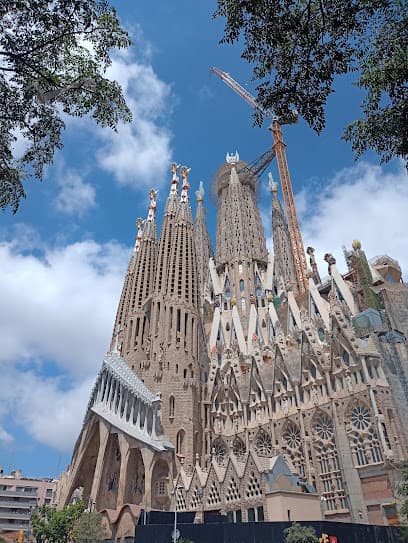
Most people are too busy craning their necks at the stone forest of the Sagrada Família to notice the small, wavy brick building huddled at its feet. That’s a mistake. While the basilica is a testament to Antoni Gaudí’s obsession with the divine, the Escoles de la Sagrada Família—the schools—are a testament to his humanity. Built in 1909, this wasn't a commission for a wealthy industrialist or a play for immortality. It was a functional, low-budget schoolhouse for the children of the men who were breaking their backs building the church, and for the local kids of the Eixample neighborhood who had nowhere else to go.
Architecturally, it’s a masterclass in making something out of nothing. Gaudí had a shoestring budget and a temporary site, yet he produced a structure that architects still study with religious fervor. The walls and the roof don't just sit there; they flow. Using a conoidal geometry—basically, a series of waves—Gaudí created a roof that was incredibly strong despite being made of thin layers of brick. It’s a design that sheds water perfectly and looks like it was breathed into existence rather than built. It’s the kind of structural honesty you rarely see in modern architecture, where everything is hidden behind drywall and glass. Here, the structure is the ornament. The brick is the story.
You have to imagine the context of 1909 Barcelona. The city was a powder keg of social unrest, culminating in the Tragic Week. While the world was burning, Gaudí was figuring out how to give the sons and daughters of stonemasons a decent place to learn. Inside, the space is divided into three classrooms. It’s cramped, sure, but it’s filled with light. The reconstruction of the early 20th-century classroom—complete with tiny wooden desks and slate boards—is a haunting reminder of the human scale of this massive project. You can almost smell the chalk dust and the sweat of a hundred years ago. It’s a sharp, grounding contrast to the dizzying heights of the Nativity Facade just a few meters away.
There is a certain irony in the fact that the building was moved. In 2002, to make room for the ongoing construction of the Glory Facade, the entire school was dismantled and reconstructed brick by brick a few yards away. It’s a museum piece now, a stop on the tourist circuit, but it hasn't lost its soul. It still feels like a workspace. It still feels like a place where problems were solved with logic and geometry rather than just throwing money at them. Gaudí’s own office is reconstructed here too, and seeing the simplicity of his tools—the weights, the strings, the sketches—tells you more about the man than any glossy coffee table book ever could.
Is it worth the detour? If you’re looking for gold leaf and marble, no. But if you want to see the moment where Gaudí’s genius met the needs of the common man, it’s essential. It’s a reminder that great architecture isn't just about reaching for the clouds; it’s about how we live on the ground. It’s Gaudí at his most essential for those who prefer substance over spectacle. You’ll spend maybe twenty minutes here, but those twenty minutes will give you the context the rest of the basilica lacks. It’s the heart of the site, sitting right there in the open while the crowds look the other way.
When you walk through the doors, don't just look at the desks. Look at the way the light hits the undulating walls. Think about the kids who sat there while their fathers were high up on the scaffolding, building a dream they’d never see finished. This is the most honest building in the city. It’s a small, perfect thing in a world of oversized egos. Don't be the tourist who walks past it to get a better selfie with a tower. Stop, go inside, and pay your respects to the man who cared enough to build a masterpiece for the children of the poor.
Type
Historical place museum, Tourist attraction
Duration
20-30 minutes
Best Time
Early morning or late afternoon when the main basilica crowds are thinner, allowing for a quieter experience inside the small classrooms.
Guided Tours
Available
Audio Guide
Available
What People Say
architect(5)structure(4)tickets(3)kids(3)basilica(2)1909(2)2002(2)church(2)
Features
Historical place museum
Tourist attraction
Categories
ArchitectureGaudíModernismeHistory
Ticket Prices
adult€26.00
child€0.00
senior€21.00
Must-See Highlights
The undulating conoidal roof
Reconstructed 1909 classroom with period furniture
Gaudí’s studio and architectural models
Visitor Tips
The school is located on the corner of the site near the Passion Facade exit.
Look closely at the brickwork to see how Gaudí achieved curves without expensive materials.
The interior is small and can get crowded; wait a few minutes for a tour group to pass for a better experience.
Good For
Architecture enthusiastsHistory buffsFamilies with childrenGaudí fans
Why Visit
Revolutionary conoidal (wavy) roof and wall design
Built specifically for the children of the basilica's construction workers
A rare example of Gaudí's genius applied to low-cost, functional architecture
Nearby Landmarks
- 1-minute walk from Sagrada Família Basilica
- 2-minute walk from Avinguda de Gaudí
- 12-minute walk from Hospital de Sant Pau Recinte Modernista
Accessibility
- Wheelchair accessible
- Ground level entry
- Flat terrain
Location
Carrer de Sardenya, 316
Eixample, Barcelona
Nearby Hotels
Nearby Restaurants
In Eixample
ATTRACTION
Mural Margalef
Eixample
A towering splash of Mediterranean blue breaking the rigid geometry of Eixample, Joan Margalef’s mural is a visceral reminder that Barcelona’s soul isn't just in its museums.
0.0(0)
Tourist attraction
ATTRACTION
Mural Margalef
Eixample
A geometric middle finger to urban decay, this massive kinetic mural by Eduard Margalef turns a drab Eixample blind wall into a rhythmic, shifting explosion of optical art.
0.0(0)
Tourist attraction
ATTRACTION
Happy Foodies
Eixample
Forget the plastic-wrapped tourist traps; this is a deep dive into the grease, garlic, and soul of Catalan cooking where you actually learn to handle a knife and a porrón.
0.0(0)
Sightseeing tour agencyTour agency
Frequently Asked Questions
Is the Sagrada Família Schools worth visiting?
Yes, especially if you appreciate architectural history. It offers a rare look at Gaudí's functional, low-cost design and provides a human context to the massive basilica next door.
Do I need a separate ticket for the schools?
No, entry to the schools is included with any standard Sagrada Família entrance ticket. You can find it on the grounds near the Passion Facade.
What is unique about the school's architecture?
The building features a revolutionary conoidal (wavy) roof and walls made of thin brick layers, designed by Gaudí to provide structural strength and water drainage on a very limited budget.
How much time should I spend at the schools?
You only need about 15 to 20 minutes to explore the interior classrooms and Gaudí's reconstructed office, making it an easy addition to your basilica tour.
Reviews
0 reviews for Sagrada Família Schools
No reviews yet. Be the first to share your experience!