4.0
991 verified reviews
About
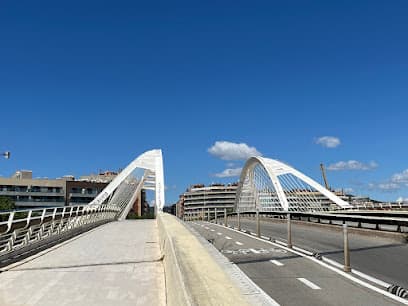
You don’t come to Sant Andreu for the postcard-perfect Gothic alleys or the overpriced sangria of the Rambla. You come here because you want to see the bones of the city. And standing over the train tracks like a bleached prehistoric skeleton is the Pont de Calatrava, or as the locals call it, the Pont de Bac de Roda. This isn't just a way to get from point A to point B; it’s the moment Santiago Calatrava—before he became the world’s most famous and controversial architect of high-concept, high-maintenance structures—decided to show the world what he could do with a bit of steel and a lot of ego.
Built between 1985 and 1987, this was Calatrava’s first bridge. It was part of the massive pre-Olympic facelift that dragged Barcelona out of its post-Franco industrial hangover and into the spotlight. It’s a bow-string arch bridge, all white paint and parabolic curves, designed to bridge the divide between the districts of Sant Andreu and Sant Martí. In a neighborhood dominated by functional, gray apartment blocks and the relentless hum of the R2 train line, the bridge hits you like a lightning bolt. It’s bright, it’s aggressive, and it’s undeniably beautiful in that cold, structural way that only Calatrava can pull off.
But here’s the truth they won’t tell you in the glossy architecture mags: the bridge is showing its age. If you look closely, the white paint is peeling in places, revealing the rust and the grime of a city that breathes exhaust fumes. There’s graffiti on the lower supports, and the lighting—once a revolutionary feature—doesn't always hit the way it used to. And you know what? That makes it better. It’s not a museum piece. It’s a working bridge. It’s where people walk their dogs, where commuters rush to catch the metro at Bac de Roda, and where teenagers hang out because it looks like something out of a sci-fi movie that’s been left to rot in the sun.
Walking across it is a sensory trip. You’ve got the vibration of the trains passing underneath, the sharp Mediterranean sun reflecting off the white steel arches, and the wind whipping through the open structure. It’s one of the best architecture spots in Barcelona precisely because it isn't crowded with tour groups. You can actually stand here, lean against the railing, and appreciate the geometry without someone hitting you with a backpack. It’s a masterclass in tension and compression, a reminder that even the most utilitarian structures can be turned into art if you’ve got enough vision—and enough concrete.
Is it worth the trek out to Sant Andreu? If you give a damn about how cities are built, then yes. It’s a pivot point in Barcelona’s history, the moment the city decided it wasn't going to be just another Mediterranean port, but a global capital of design. It’s flawed, it’s a bit neglected, and it’s spectacular. It’s the real Barcelona—the one that exists when the tourists go home and the sun sets over the tracks, turning the white arches into a ghostly silhouette against the darkening sky. Don't expect a gift shop. Just bring your camera and a sense of appreciation for a structure that’s been working for a living for nearly forty years.
Type
Bridge, Tourist attraction
Duration
30-45 minutes
Best Time
Sunset for the best light on the white steel structure.
What People Say
artwork(30)santiago calatrava(23)advertising slogan(14)maintenance(13)vision(13)traffic(7)1987(6)architect(5)
Features
Bridge
Tourist attraction
Categories
ArchitectureBridgeModernismUrban Design
Ticket Prices
Free Admission
No tickets required
Opening Hours
- MondayOpen 24 hours
- TuesdayOpen 24 hours
- WednesdayOpen 24 hours
- ThursdayOpen 24 hours
- FridayOpen 24 hours
- SaturdayOpen 24 hours
- SundayOpen 24 hours
Must-See Highlights
The twin parabolic arches
The view of the train tracks stretching toward Sagrera
The intricate steel cable tension system
Visitor Tips
Bring a wide-angle lens if you're a photographer; the scale is hard to capture otherwise.
Combine this with a visit to the nearby Parc del Clot for a full afternoon of off-the-beaten-path architecture.
Watch your step on the stairs during rainy days as the surfaces can get surprisingly slick.
Good For
Architecture loversPhotographersUrban explorersBudget travelers
Why Visit
Santiago Calatrava's first-ever bridge project
Striking skeletal, parabolic white steel design
Authentic local atmosphere away from the main tourist zones
Nearby Landmarks
- 5-minute walk from Bac de Roda Metro Station
- 10-minute walk from Parc de Sant Martí
- 15-minute walk from Parc del Clot
Accessibility
- Wheelchair accessible walkways
- Elevators available at nearby metro stations
Location
Carrer de Felip II
Sant Andreu, Barcelona
Nearby Hotels
Nearby Restaurants
In Sant Andreu
ATTRACTION
Camsbio,S.L
Sant Andreu
Not a park for picnics, but the workshop where Barcelona’s green future is built. Camsbio is the grit behind the city's vertical gardens and bio-construction.
0.0(0)
Park
ATTRACTION
Multan los Domingos
Sant Andreu
A defiant slice of Sant Andreu where industrial ruins meet community gardens. It’s the anti-tourist Barcelona: raw, brick-heavy, and smelling of vermut and rebellion.
0.0(0)
Garden
ATTRACTION
Plaça d'Albert Badia i Mur
Sant Andreu
A gritty, honest slice of Sant Andreu where the 'Cases Barates' history meets modern life. No Gaudí here—just real people, a playground, and the unvarnished soul of Bon Pastor.
0.0(0)
Park
Frequently Asked Questions
Is the Pont de Calatrava worth visiting?
Yes, especially for architecture enthusiasts and photographers. It is Santiago Calatrava's first bridge and offers a unique, skeletal aesthetic far from the typical tourist crowds of central Barcelona.
How do I get to the Pont de Calatrava?
The easiest way is to take the L2 Metro to the Bac de Roda station. From there, it is a short 5-minute walk to the bridge, which connects the Sant Andreu and Sant Martí districts.
Is there an entrance fee for the bridge?
No, the Pont de Calatrava is a public pedestrian and vehicular bridge. It is free to visit and open 24 hours a day.
What is the best time to visit the bridge?
Sunset or early morning are best for photography to capture the light hitting the white steel arches. At night, the bridge is illuminated, though maintenance of the lights can be inconsistent.
Reviews
0 reviews for Pont de Calatrava
No reviews yet. Be the first to share your experience!