4.0
1 verified reviews
About
If you’re looking for the neon-soaked chaos of Las Ramblas or the architectural gymnastics of Gaudí, you’ve taken the wrong train. Get back on the FGC and head south. But if you want to understand the quiet, unvarnished soul of Sarrià—a neighborhood that still feels like the independent village it was until the city swallowed it whole in 1921—then you step off at the Sarrià station and walk a few paces to the Placeta d'Angelina Alòs i Tormo.
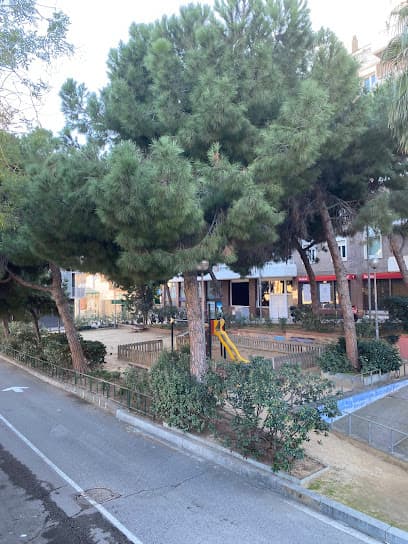
This isn’t a park in the way the tourism boards describe them. There are no sprawling lawns, no overpriced kiosks selling lukewarm gelato, and certainly no selfie-stick-wielding hordes. It is a 'placeta'—a small square, a literal breathing room in the urban fabric. Located at the intersection of the busy Via Augusta and the more intimate Carrer de l'Hort de la Vila, it serves as a buffer between the high-speed pulse of modern Barcelona and the slow-motion life of the old quarter. It’s a place where the air feels a little cooler, the shadows of the plane trees a little longer, and the local bourgeoisie sit on benches reading the morning paper while their dogs sniff at the edges of the planters.
The square is named after Angelina Alòs i Tormo, a woman who understood the tactile, messy reality of the earth. She was a master ceramicist, a teacher at the Escola del Treball, and a woman who spent her life coaxing beauty out of clay and fire. There’s something fitting about naming this specific patch of ground after her. It’s not grand or pretentious; it’s functional, solid, and rooted in the neighborhood. In a city that often feels like it’s being turned into a theme park for visitors, places like this are a necessary rebellion. They exist for the people who live here, for the commuters waiting for a ride, and for the elderly residents who have watched the neighborhood change over decades.
When you sit here, you’re in the heart of Sarrià-Sant Gervasi, the district that locals call the 'Zona Alta.' It’s wealthy, sure, but it’s also fiercely protective of its identity. You’ll hear more Catalan than Spanish here, and you’ll see a version of Barcelona that doesn’t care if you like it or not. The placeta itself is minimalist—clean lines, sturdy benches, and a sense of order that reflects the surrounding streets. It’s the kind of place where you can actually hear your own thoughts, a rarity in a city that usually hums with a 24-hour soundtrack of scooters and shouting.
Is it worth a cross-town trek? Probably not if you’ve only got forty-eight hours in the city. But if you’re a traveler who values the 'nothing' moments—the moments between the landmarks where you actually get to see how a city breathes—then it’s essential. It’s a spot to sit with a takeaway coffee from a nearby bakery, watch the light filter through the leaves, and appreciate the fact that not every square inch of Barcelona has been sold to the highest bidder. It’s a tribute to a woman of craft and a neighborhood that refuses to lose its cool. It’s honest, it’s quiet, and in this town, that’s a hell of a lot.
Type
Park
Duration
15-30 minutes
Best Time
Weekday mornings when the neighborhood is waking up and the light is soft.
Features
Park
Categories
Urban SquareLocal HistoryPublic Art
Ticket Prices
Free Admission
No tickets required
Must-See Highlights
The commemorative plaque for Angelina Alòs i Tormo
The surrounding traditional architecture of old Sarrià
The quiet contrast to the busy Via Augusta traffic
Visitor Tips
Grab a pastry from a nearby 'fleca' (bakery) and enjoy it on one of the benches.
Use this as a starting point for a walk through the narrow, pedestrian streets of old Sarrià.
It's a great spot for people-watching if you want to see the 'real' upper-class Barcelona.
Good For
Solo travelersLocalsArchitecture enthusiastsBudget travelers
Why Visit
Authentic local atmosphere away from the tourist center
Dedicated to a significant female Catalan artist and ceramicist
A peaceful urban oasis in the upscale Sarrià-Sant Gervasi district
Nearby Landmarks
- 2-minute walk from Sarrià FGC Station
- 5-minute walk from Mercat de Sarrià
- 7-minute walk from Bar El Tomàs de Sarrià
Accessibility
- Flat paved surface
- Wheelchair accessible
- Public benches available
Location
Via Augusta, 329X
Sarrià-Sant Gervasi, Barcelona
Nearby Hotels
Nearby Restaurants
In Sarrià-Sant Gervasi
ATTRACTION
Casa Narcís Bosch
Sarrià-Sant Gervasi
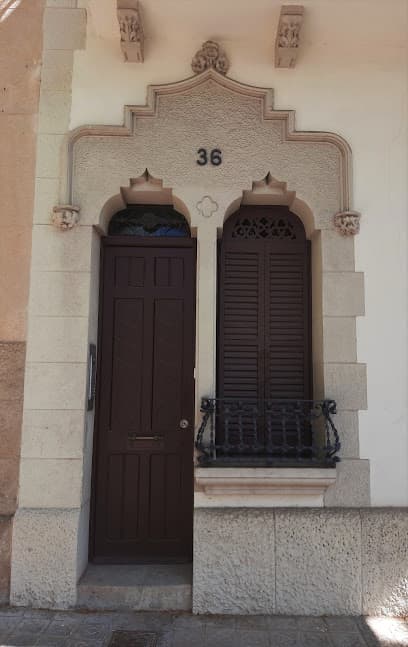
A Modernista fever dream tucked away in Sarrià, where Salvador Valeri i Pupurull’s stone curves and ironwork prove that Gaudí wasn't the only genius in town.
0.0(0)
Tourist attraction
ATTRACTION
Plaça de Calvó
Sarrià-Sant Gervasi
A quiet, unpretentious slice of Sant Gervasi where the only drama is a toddler losing a shoe. No Gaudí, no crowds, just trees, benches, and the sound of real life in the Zona Alta.
0.0(0)
Park
ATTRACTION
Pipican Piscines i Esports
Sarrià-Sant Gervasi
A dirt-caked arena of canine chaos set against the polished backdrop of Sarrià-Sant Gervasi, where the neighborhood’s elite and their four-legged shadows come to settle scores.
0.0(0)
Park
Frequently Asked Questions
Is Placeta d'Angelina Alòs i Tormo worth visiting?
It is worth a stop if you are already exploring the Sarrià neighborhood or looking for a quiet place to sit near the FGC station. It is a small, local urban square rather than a major tourist attraction.
Who was Angelina Alòs i Tormo?
She was a renowned Catalan ceramicist and teacher (1917–1997) who was a key figure in the Barcelona art scene. The square was named in her honor to recognize her contributions to the city's cultural heritage.
How do I get to the square?
The easiest way is to take the FGC (Ferrocarrils de la Generalitat) to the Sarrià station. The square is located just a minute's walk away at the junction of Via Augusta and Carrer de l'Hort de la Vila.
What is near Placeta d'Angelina Alòs i Tormo?
The Mercat de Sarrià is a short walk away, as is the historic center of Sarrià with its boutique shops and traditional tapas bars like El Tomàs de Sarrià.
Reviews
0 reviews for Placeta d'Angelina Alòs i Tormo
No reviews yet. Be the first to share your experience!