3.4
34 verified reviews
About
Barcelona isn’t all Gaudí chimneys and overpriced tapas on the Rambla. If you want the unvarnished truth of the city, you have to look at the spaces where the locals actually breathe—or at least try to. Plaça Enriqueta Gallinat, sitting like a concrete island on Avinguda de Roma, is one of those places. It’s not a 'must-see' in any guidebook, and that’s exactly why it matters. It’s a functional, slightly weary piece of the Eixample grid that serves as a reminder that a city is a living, breathing, and sometimes tired organism.
To understand this square, you have to understand the woman it’s named after. Enriqueta Gallinat i Romaní wasn't some minor bureaucrat. She was a titan of the Catalan resistance, a woman who fought for the Republic, survived the horrors of the French refugee camps, and spent decades in exile before returning to become the 'Grandmother of the ERC.' She was a fighter. There’s a certain poetic irony in naming this particular slab of pavement after her. It’s not a lush, manicured garden; it’s a tough, urban space that sits directly over the subterranean arteries of the city’s rail system. You can feel the vibration of the trains beneath your feet, a constant reminder of the movement and friction that defines modern Barcelona.
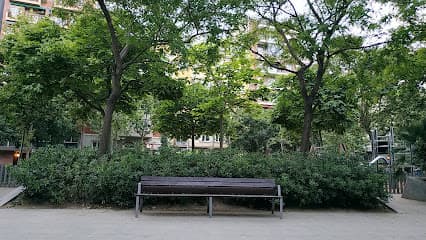
Architecturally, the square is a product of the massive project to cover the open railway tracks that once sliced through Avinguda de Roma like a jagged wound. What’s left is a wide, paved promenade that feels more like a bridge than a park. You’ve got the standard-issue Barcelona benches—the ones reviewers mention for their utility—and a small playground where local kids burn off energy while their parents stare into the middle distance. It’s a place of transit. People are walking dogs, heading to the Sants station, or just killing time between shifts.
The reviews mention 'beer' and 'sleep' for a reason. This isn't a place for a romantic picnic. It’s a place where the city’s edges are visible. You’ll see the occasional weary soul catching a nap on a bench or a group of locals sharing a couple of cans of Estrella Damm as the sun dips behind the Eixample apartment blocks. It’s honest. It’s the kind of place where you can sit and realize that you are just one of millions of people trying to navigate the day. There’s no pretense here, no gift shops, and nobody is trying to sell you a plastic bull or a fake Messi jersey.
If you’re looking for 'best parks in Barcelona,' you’ll probably find yourself at Ciutadella or Park Güell. But if you find yourself wandering the lower reaches of the Eixample near Rocafort, take a moment to sit here. Watch the light hit the weathered facades of the surrounding buildings. Listen to the hiss of traffic and the muffled roar of the AVE trains underneath. It’s a lesson in urban survival and the quiet persistence of memory. Enriqueta Gallinat spent her life fighting for a specific vision of Catalonia; this square, in all its mundane, gritty reality, is part of the city that vision helped build. It’s not pretty, but it’s real, and in a city increasingly polished for tourist consumption, that’s worth something.
Type
Park
Duration
15-30 minutes
Best Time
Late afternoon when the neighborhood fills with locals finishing work and kids claiming the playground.
What People Say
bank(2)beer(2)sleep(2)
Features
Park
Categories
Urban SquareLocal HistoryPublic Space
Ticket Prices
Free Admission
No tickets required
Must-See Highlights
The commemorative plaque for Enriqueta Gallinat
The view down the long axis of Avinguda de Roma
The subtle vibrations of the trains passing underneath
Visitor Tips
Don't expect a lush garden; it's mostly paved.
Great spot for people-watching if you want to see the 'real' Barcelona.
Combine it with a visit to the nearby Parc de Joan Miró for more greenery.
Good For
LocalsHistory buffsBudget travelersDog walkers
Why Visit
Named after a legendary figure of the Catalan resistance
Unique urban design built over active railway tracks
Authentic, unvarnished glimpse into daily Eixample life
Nearby Landmarks
- Parc de Joan Miró (8-minute walk)
- Estació de Sants (12-minute walk)
- Las Arenas de Barcelona (10-minute walk)
- Metro Rocafort (5-minute walk)
Accessibility
- Flat paved surfaces
- Ramped access from street level
- Accessible benches
Location
Av. de Roma, 116
Eixample, Barcelona
Nearby Hotels
Nearby Restaurants
In Eixample
ATTRACTION
Mural Margalef
Eixample
A towering splash of Mediterranean blue breaking the rigid geometry of Eixample, Joan Margalef’s mural is a visceral reminder that Barcelona’s soul isn't just in its museums.
0.0(0)
Tourist attraction
ATTRACTION
Mural Margalef
Eixample
A geometric middle finger to urban decay, this massive kinetic mural by Eduard Margalef turns a drab Eixample blind wall into a rhythmic, shifting explosion of optical art.
0.0(0)
Tourist attraction
ATTRACTION
Happy Foodies
Eixample
Forget the plastic-wrapped tourist traps; this is a deep dive into the grease, garlic, and soul of Catalan cooking where you actually learn to handle a knife and a porrón.
0.0(0)
Sightseeing tour agencyTour agency
Frequently Asked Questions
What should I expect when visiting Plaça Enriqueta Gallinat?
Expect a wide, paved urban promenade built directly over the city's railway lines. It is a functional neighborhood space featuring a local playground, simple benches, and the constant hum of trains passing beneath your feet.
Who was Enriqueta Gallinat?
She was a prominent Catalan politician and activist who fought for the Republic during the Spanish Civil War and spent years in exile before returning to Barcelona.
What is near Plaça Enriqueta Gallinat?
It is located on Avinguda de Roma, within walking distance of the Sants train station and the Parc de Joan Miró.
Is there a playground at Plaça Enriqueta Gallinat?
Yes, there is a small, basic children's play area that serves the local neighborhood families.
Reviews
0 reviews for Plaça Enriqueta Gallinat
No reviews yet. Be the first to share your experience!