4.0
28 verified reviews
About
If you’re looking for the Barcelona of the postcards—the one with the fluttering flags, the overpriced sangria, and the endless queues of people holding selfie sticks—keep walking. Plaça dels Enamorats isn’t for you. It isn’t even a 'plaza' in the way most people understand the word. It’s a triangular hiccup in the city’s geometry, a small, paved widening of a street that shouldn’t exist according to the grand, orderly plans of Ildefons Cerdà.
In the mid-19th century, Cerdà designed the Eixample as a perfect grid of octagonal blocks, a rationalist dream meant to bring light and air to the masses. But Carrer dels Enamorats was already there. It was an ancient path, a dusty track that led from the old city toward the village of Sant Martí de Provençals. It ran diagonally, cutting across the future grid like a scar that refused to heal. When the city grew, the grid tried to swallow it, but the street remained, leaving us with these weird, jagged corners and accidental squares like this one at number 51.
The name 'Enamorats'—the Lovers—sounds like something dreamed up by a tourism board to sell romantic walking tours. The truth is likely far more mundane and, frankly, more interesting. Most historians agree it’s a linguistic corruption of 'Murets,' referring to the small walls or ruins that once lined the old path. Over centuries, 'Murets' became 'Enamorats,' and a legend was born out of a phonetic mistake. It’s a classic Barcelona move: taking something functional and turning it into something poetic, even if by accident.
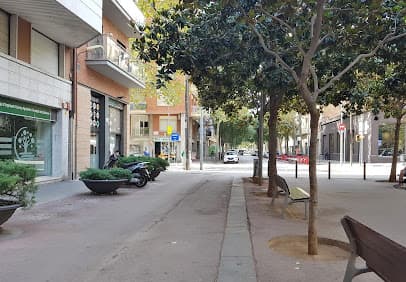
When you stand here, you’re caught between two worlds. To one side, you have the roar of Carrer d’Aragó, one of the city’s great multi-lane concrete arteries, pulsing with the frantic energy of commuters and delivery vans. But step into the Plaça, and the volume drops. It’s a neighborhood sanctuary. You’ll see the real Eixample here: the grandmothers in floral dresses pushing shopping carts, the construction workers taking a break with a canned coffee, and the occasional dog owner letting their pet sniff the base of a hardy urban tree. There are no monuments here, no plaques explaining why you should care. You care because it’s quiet, and in this city, quiet is a luxury.
It’s a place where the air smells of roasted coffee from a nearby portal and the faint, metallic tang of the metro rumbling somewhere deep underground. You don't come here to be entertained; you come here to exist, briefly, in a space that doesn't care about your itinerary. It’s the kind of spot where you can actually hear yourself think, a rare commodity in a metropolis that often feels like a beautiful, sun-drenched fever dream.
Is it worth a special trip? Probably not if you only have forty-eight hours to see the hits. But if you’re the kind of traveler who finds beauty in the way a city’s past refuses to be paved over, it’s essential. It’s a place to sit on a bench, peel an orange, and watch the light filter through the leaves while the rest of the world rushes toward the Sagrada Família. It’s a reminder that the best parts of a city are often the ones that weren't planned at all. It’s honest, it’s a little bit gritty, and it’s entirely indifferent to whether you like it or not. That’s the Barcelona I give a damn about.
Type
Park
Duration
15-30 minutes
Best Time
Late afternoon when the neighborhood comes alive with locals finishing their workday.
Features
Park
Categories
Urban SpaceHistoryLocal Life
Ticket Prices
Free Admission
No tickets required
Opening Hours
- MondayOpen 24 hours
- TuesdayOpen 24 hours
- WednesdayOpen 24 hours
- ThursdayOpen 24 hours
- FridayOpen 24 hours
- SaturdayOpen 24 hours
- SundayOpen 24 hours
Must-See Highlights
The diagonal orientation of the street cutting through the grid
The contrast between the quiet square and the busy Carrer d'Aragó
Local life away from the Gaudí-centric tourist zones
Visitor Tips
Grab a coffee from a nearby local bakery and use the benches for a break.
Look at a map to see how the street defiantly cuts through the surrounding square blocks.
Combine this with a visit to the nearby Encants flea market for a full 'local' morning.
Good For
Solo travelersHistory buffsBudget travelersLocals
Why Visit
Ancient diagonal path that predates the Eixample grid
Zero tourist crowds even during peak season
Fascinating linguistic history of its romantic name
Nearby Landmarks
- Sagrada Família: 12-minute walk
- Mercat dels Encants: 8-minute walk
- Torre Glòries: 10-minute walk
- Design Museum of Barcelona (DHUB): 10-minute walk
Accessibility
- Flat paved surface
- Public benches available
Location
Carrer dels Enamorats, 51
Eixample, Barcelona
Nearby Hotels
Nearby Restaurants
In Eixample
ATTRACTION
Mural Margalef
Eixample
A towering splash of Mediterranean blue breaking the rigid geometry of Eixample, Joan Margalef’s mural is a visceral reminder that Barcelona’s soul isn't just in its museums.
0.0(0)
Tourist attraction
ATTRACTION
Mural Margalef
Eixample
A geometric middle finger to urban decay, this massive kinetic mural by Eduard Margalef turns a drab Eixample blind wall into a rhythmic, shifting explosion of optical art.
0.0(0)
Tourist attraction
ATTRACTION
Happy Foodies
Eixample
Forget the plastic-wrapped tourist traps; this is a deep dive into the grease, garlic, and soul of Catalan cooking where you actually learn to handle a knife and a porrón.
0.0(0)
Sightseeing tour agencyTour agency
Frequently Asked Questions
Is Plaça dels Enamorats worth visiting?
Only if you want to escape the crowds and see a quiet, non-touristy slice of the Eixample. It's a small neighborhood spot, not a major landmark with monuments.
What is the history of the name 'Enamorats'?
While it translates to 'Lovers,' it likely comes from 'Murets' (small walls), an old name for the ruins that lined this ancient path to Sant Martí.
How do I get to Plaça dels Enamorats?
It's located in the Eixample near the Glòries area. The closest metro stations are Sagrada Família (L2/L5) or Glòries (L1), both about a 10-minute walk away.
Reviews
0 reviews for Plaça dels Enamorats
No reviews yet. Be the first to share your experience!