About
The Eixample grid is a meat grinder. It’s a relentless river of steel, exhaust, and the high-pitched whine of scooters that defines the modern Barcelona hustle. It’s where the city tries to be a metropolis, all glass and business and impatient taxis. But if you know where to look—specifically at Carrer de Rosselló, 149—there’s a crack in the armor. You step through a nondescript passage, the kind that looks like it should lead to a private lobby or a dentist’s office, and suddenly, the volume drops forty decibels. Welcome to the Plaça del 'Sine Die.'
This isn't a park in the way the tourism brochures describe them. There are no sweeping vistas, no Gaudí-designed benches, and no kiosks selling overpriced gelato. It’s an 'interior d’illa'—one of the interior block gardens that were supposed to be the lungs of Ildefons Cerdà’s Eixample. Cerdà had this beautiful, utopian dream of a city where every block had a green heart. Then greed happened. Developers filled those hearts with warehouses, workshops, and parking lots. Places like Sine Die are the survivors, the small victories of the neighborhood over the bottom line.
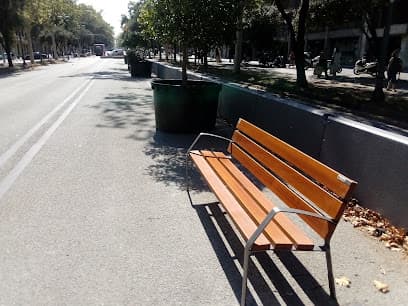
The name itself, 'Sine Die,' is Latin for 'without a day' or 'indefinitely.' It’s an apt description for a place where time seems to have developed a limp. You come here when the sun is hitting the pavement too hard or when the weight of being a tourist in a city that’s increasingly tired of tourists starts to grate on your soul. It’s a functional space. You’ve got some gravel, some sturdy benches, a few trees that have seen better days but still provide a decent patch of shade, and the surrounding walls of residential apartments.
This is the real Eixample. Look up and you’ll see the laundry hanging from balconies, the flickering blue light of a television in a darkened living room, and maybe an old woman leaning on her elbows, watching the world go by. The soundtrack isn't a curated playlist; it’s the muffled sound of a neighbor’s argument, the clatter of a kitchen being cleaned, and the occasional shout of a kid who’s finally escaped the confines of a fourth-floor flat. It’s honest. It’s unadorned. It’s the kind of place where you can sit with a cheap ham sandwich and a bottle of water and feel, for twenty minutes, like you aren't part of the problem.
Is it worth visiting? If you’re looking for a 'best things to do in Barcelona' checklist, probably not. You’ll be bored in five minutes. But if you want to understand the rhythm of life in this neighborhood, if you want to see where the locals go to simply exist without being sold something, then yes, it’s essential. It’s a reminder that even in a city as hyper-commodified as Barcelona, there are still pockets of silence that haven't been turned into a gift shop. It’s a place for the weary, the locals, and the few travelers smart enough to know that the best part of a city is often found in the spaces between the landmarks. Just don't expect a parade. It’s just a courtyard, some trees, and the beautiful, indifferent silence of a city taking a breath.
Type
Community garden
Duration
20-40 minutes
Best Time
Late afternoon when the shadows stretch across the courtyard and the neighborhood kids come out to play.
Features
Community garden
Categories
Urban GardenArchitectureLocal Life
Ticket Prices
Free Admission
No tickets required
Opening Hours
- MondayOpen 24 hours
- TuesdayOpen 24 hours
- WednesdayOpen 24 hours
- ThursdayOpen 24 hours
- FridayOpen 24 hours
- SaturdayOpen 24 hours
- SundayOpen 24 hours
Must-See Highlights
The residential architecture surrounding the courtyard
The peaceful contrast with the noise of Carrer de Rosselló
The 'Sine Die' plaque at the entrance
Visitor Tips
Bring a book or a sandwich; there are no services inside the plaza.
Respect the neighbors—sound echoes loudly in these interior courtyards.
Look for the passage at Rosselló 149; it's easy to walk right past it.
Good For
Solo travelersBudget travelersPeople seeking quietLocal experience seekers
Why Visit
Absolute silence in the middle of the busiest part of Eixample
Authentic glimpse into the 'interior d'illa' urban planning of Barcelona
Zero tourist crowds, even during peak season
Nearby Landmarks
- 8-minute walk from Rambla de Catalunya
- 15-minute walk from Casa Milà (La Pedrera)
- 10-minute walk from Passeig de Gràcia
- 2-minute walk from Carrer de Muntaner
Accessibility
- Flat entrance passage
- Paved and gravel surfaces
- Accessible benches
Location
Av. Diagonal, 90
Eixample, Barcelona
Nearby Hotels
Nearby Restaurants
In Eixample
ATTRACTION
Mural Margalef
Eixample
A towering splash of Mediterranean blue breaking the rigid geometry of Eixample, Joan Margalef’s mural is a visceral reminder that Barcelona’s soul isn't just in its museums.
0.0(0)
Tourist attraction
ATTRACTION
Mural Margalef
Eixample
A geometric middle finger to urban decay, this massive kinetic mural by Eduard Margalef turns a drab Eixample blind wall into a rhythmic, shifting explosion of optical art.
0.0(0)
Tourist attraction
ATTRACTION
Happy Foodies
Eixample
Forget the plastic-wrapped tourist traps; this is a deep dive into the grease, garlic, and soul of Catalan cooking where you actually learn to handle a knife and a porrón.
0.0(0)
Sightseeing tour agencyTour agency
Frequently Asked Questions
Is Plaça del Sine Die worth visiting?
Only if you are looking for a quiet escape from the noise of the Eixample streets. It is a simple, local courtyard with no major tourist attractions, perfect for a peaceful break.
How do I find the entrance to Plaça del Sine Die?
The entrance is located through a passage at Carrer de Rosselló, 149. It looks like a residential entrance but leads directly to the public interior garden (officially known as Jardins de Beatriu de Pinós).
What are the opening hours for the garden?
Like most Eixample interior gardens, it typically opens at 10:00 AM and closes at sunset, though hours can vary slightly by season.
Is there an entrance fee for Plaça del Sine Die?
No, it is a public space managed by the city and is completely free to enter.
Reviews
0 reviews for Plaça del 'Sine Die'
No reviews yet. Be the first to share your experience!