4.1
43 verified reviews
About
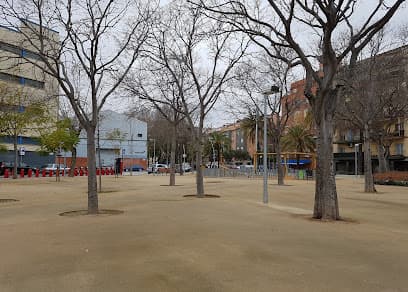
If you’re looking for the Barcelona of the postcards—the one with the shimmering trencadís, the overpriced sangria, and the slow-moving herds of selfie-stick-wielding tourists—you’ve taken a very wrong turn. Plaça de Mossèn Joan Cortinas isn’t a 'sight.' It’s a neighborhood lung. It’s a patch of concrete and trees in the heart of Sant Andreu de Palomar, a district that still carries the chip on its shoulder from when it was an independent village swallowed by the city in 1897. This square doesn't care if you like it. It doesn't have a gift shop. It doesn't have a QR code. And that is exactly why it matters.
The square is named after Mossèn Joan Cortinas, the 'priest of the poor.' This wasn't some high-altitude prelate living in a gilded rectory. Cortinas was a man of the trenches, a guy who spent the grim post-war years fighting for the dignity of the working class in a neighborhood that knew plenty about struggle. When you sit on one of the weathered benches here, you’re sitting in a space defined by that legacy. It’s a place where the social fabric isn't just a metaphor; you can see it in the way the old men lean into their canes to argue about the local football scores and the way the kids treat the pavement like a sanctioned Wembley Stadium.
Architecturally, it’s modest. You’ve got the surrounding low-rise buildings that characterize the old core of Sant Andreu, providing a sense of enclosure that makes the plaza feel like a communal living room. There’s a lack of pretension here that is almost startling if you’ve just come from the Eixample. No one is trying to sell you a 'gastronomic experience.' Instead, you’ll hear the rhythmic thwack of a ball against a stone wall, the chatter of neighbors who have known each other since the 1960s, and the occasional tolling of the bells from the nearby Parroquia de Sant Andreu de Palomar. It’s the steady hum of the mundane, which, in a city increasingly curated for external consumption, feels radical.
To understand this place, you have to understand Sant Andreu. This isn't the Gothic Quarter. It’s a place of industry, of anarchist history, and of fierce local pride. The square serves as a quiet anchor for that identity. It’s where the Festa Major celebrations spill over, where political posters are slapped onto walls, and where the pace of life slows down to a crawl. You come here to disappear for a minute. You come here to realize that Barcelona is a city of three million stories, and most of them have nothing to do with Antoni Gaudí.
Is it 'beautiful' in the traditional sense? Maybe not. The tiles might be cracked, and the pigeons are definitely in charge. But it is honest. It’s a window into the real Barcelona—the one that exists when the cruise ships leave and the lights go down on the Rambla. It’s a place for a cheap coffee in a plastic cup, a deep breath of Mediterranean air that hasn't been filtered through a tour bus exhaust, and a moment of reflection on a priest who decided that the poor deserved a champion. If you can’t find the magic in that, you’re probably in the wrong city.
Type
Park
Duration
30-45 minutes
Best Time
Late afternoon (5 PM - 7 PM) when the neighborhood comes alive with families and locals.
Features
Park
Categories
Local LifeHistoryUrban ParksCommunity Space
Ticket Prices
Free Admission
No tickets required
Opening Hours
- MondayOpen 24 hours
- TuesdayOpen 24 hours
- WednesdayOpen 24 hours
- ThursdayOpen 24 hours
- FridayOpen 24 hours
- SaturdayOpen 24 hours
- SundayOpen 24 hours
Must-See Highlights
The surrounding traditional Sant Andreu architecture
The local 'avi' (grandfathers) congregating on benches
Proximity to the historic Sant Andreu de Palomar church
Visitor Tips
Don't look for a tourist information kiosk; there isn't one.
Grab a pastry from a nearby 'forn' (bakery) and enjoy it on a bench.
Visit during the Sant Andreu Festa Major in late November for local celebrations.
Good For
Budget travelersFamilies with childrenHistory buffsSolo travelers looking for quiet
Why Visit
True 'village' atmosphere in the heart of the city
Zero tourist crowds and genuine local interaction
Historical connection to the 'priest of the poor' and local social history
Nearby Landmarks
- Parroquia de Sant Andreu de Palomar (2-minute walk)
- Fabra i Coats Centre d'Art Contemporani (8-minute walk)
- Gran de Sant Andreu shopping street (3-minute walk)
- Plaça d'Orfila (4-minute walk)
Accessibility
- Flat terrain
- Wheelchair accessible
- Public benches
Location
Sant Andreu, Barcelona
Nearby Hotels
Nearby Restaurants
In Sant Andreu
ATTRACTION
Camsbio,S.L
Sant Andreu
Not a park for picnics, but the workshop where Barcelona’s green future is built. Camsbio is the grit behind the city's vertical gardens and bio-construction.
0.0(0)
Park
ATTRACTION
Multan los Domingos
Sant Andreu
A defiant slice of Sant Andreu where industrial ruins meet community gardens. It’s the anti-tourist Barcelona: raw, brick-heavy, and smelling of vermut and rebellion.
0.0(0)
Garden
ATTRACTION
Plaça d'Albert Badia i Mur
Sant Andreu
A gritty, honest slice of Sant Andreu where the 'Cases Barates' history meets modern life. No Gaudí here—just real people, a playground, and the unvarnished soul of Bon Pastor.
0.0(0)
Park
Frequently Asked Questions
Is Plaça de Mossèn Joan Cortinas worth visiting?
Only if you want to see the raw, non-touristy side of Barcelona. It is a simple neighborhood square with deep local roots, a place for people-watching and escaping the crowds.
Who was Mossèn Joan Cortinas?
He was a beloved local priest known as the 'priest of the poor' (mossèn dels pobres), who worked tirelessly for the social welfare of Sant Andreu residents during the mid-20th century.
How do I get to the square?
The easiest way is to take the Metro Line 1 (Red Line) to the Sant Andreu station. From there, it is a short 5-minute walk through the charming streets of the old village center.
Are there restaurants nearby?
Yes, the square is just steps away from Carrer Gran de Sant Andreu, which is lined with traditional tapas bars, bakeries, and local restaurants like Can Roca.
Reviews
0 reviews for Plaça de Mossèn Joan Cortinas
No reviews yet. Be the first to share your experience!