About
If you’re looking for the Barcelona that screams at you from a thousand Instagram feeds, you’ve taken the wrong train. Get off at Sarrià, walk uphill until your calves start to complain, and you’ll find the Plaça de Luisa Granero. It’s not a 'destination' in the way the travel industry likes to package them. It’s a neighborhood square, a pocket of silence in a city that’s increasingly forgotten how to shut up. This is one of those local spots that doesn't involve a queue or a ticket booth.
Sarrià-Sant Gervasi is the part of town where the air feels different. It’s cooler, thinner, smelling of the Collserola hills and the kind of quiet wealth that doesn't feel the need to show off. This plaza is a tribute to a woman who knew a thing or two about substance. Luisa Granero wasn't just a sculptor; she was a force of nature who hammered her way into the male-dominated world of fine arts, eventually becoming the first female professor of sculpture at the Escola de Belles Arts de Sant Jordi. She dealt in bronze and stone, in the weight of the human form, and there’s something fitting about this unpretentious space bearing her name. It’s a quiet corner of the district that most visitors completely overlook.
The square itself is a study in urban restraint. You won’t find any neon signs or overpriced mojitos here. Instead, you get stone, some greenery, and the sound of the wind moving through the trees. It’s the kind of place where locals actually live. You’ll see people walking dogs, kids coming home from school, and the occasional elderly resident sitting on a bench, staring at nothing in particular with the kind of focus only the retired can muster. It’s a window into the 'real' Barcelona—the one that exists when the cruise ships leave and the tour buses stop running. If you're looking for something genuine, this is as authentic as it gets.
Is Plaça de Luisa Granero worth visiting? That depends on what you’re after. If you need a checklist of monuments to prove you were here, skip it. You’ll be bored in five minutes. But if you’re the kind of person who finds beauty in the mundane, who wants to understand the texture of a neighborhood that refuses to turn into a theme park, then yes, it’s essential. It’s a place to sit, to think, and to appreciate the fact that not every square inch of this city has been sold to the highest bidder. It’s one of those quiet spaces the city offers to those willing to climb the hill.
The surrounding streets, like Carrer de Terré and Carrer de Pomaret, are lined with houses that look like they’ve seen a century of Sunday lunches. There’s a dignity to it. You’re near the foothills here, and the sprawl of the city feels far away, even though the center is just a twenty-minute train ride down the hill. It’s a reminder that Barcelona is a collection of villages, and Sarrià is perhaps the most fiercely independent of them all. This is Barcelona without the filter—no gimmicks, just geography and history.
Come here in the late afternoon, when the light starts to turn golden and the shadows of the buildings stretch across the pavement. Bring a book, or don’t. Just sit. Feel the stone. Think about Granero carving out a life for herself in a world that wasn't ready for her. It’s not a spectacle to be checked off—it’s a mood to be absorbed. And in a city that’s being loved to death by millions of visitors a year, a little bit of quiet, unadulterated reality is the most radical thing you can find.
Type
Park
Duration
30-45 minutes
Best Time
Late afternoon for the best light and local neighborhood vibes.
Features
Park
Categories
Urban SquareLocal HistoryArt History
Ticket Prices
Free Admission
No tickets required
Must-See Highlights
The commemorative plaque for Luisa Granero
The surrounding residential architecture of upper Sarrià
The view of the Collserola foothills nearby
Visitor Tips
Combine this with a visit to Gaudí's Torre Bellesguard nearby.
Pick up some pastries at a local 'pastisseria' in Sarrià village before walking up.
Don't expect cafes directly on the square; it's strictly residential.
Good For
Solo travelersPeace seekersArchitecture enthusiastsLocals
Why Visit
Absolute silence away from the tourist center
Authentic local Sarrià neighborhood atmosphere
Tribute to a pioneering female Catalan artist
Nearby Landmarks
- Torre Bellesguard (Gaudí) - 12-minute walk
- CosmoCaixa Science Museum - 15-minute walk
- Sarrià Market - 10-minute walk
- Parc de l'Oreneta - 15-minute walk
Accessibility
- Wheelchair accessible
- Paved surfaces
- Public benches
Location
Carrer de Terré, 23
Sarrià-Sant Gervasi, Barcelona
Nearby Hotels
Nearby Restaurants
In Sarrià-Sant Gervasi
ATTRACTION
Casa Narcís Bosch
Sarrià-Sant Gervasi
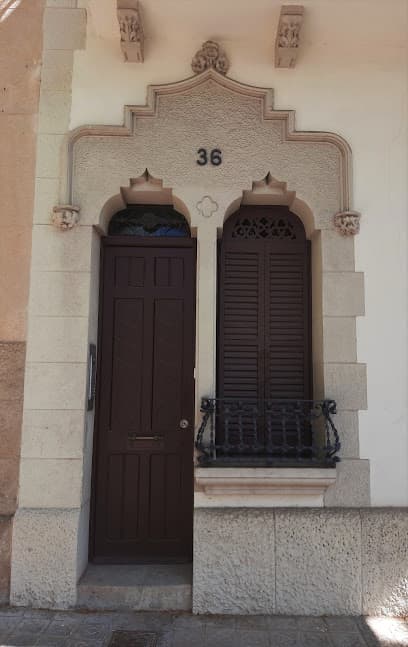
A Modernista fever dream tucked away in Sarrià, where Salvador Valeri i Pupurull’s stone curves and ironwork prove that Gaudí wasn't the only genius in town.
0.0(0)
Tourist attraction
ATTRACTION
Plaça de Calvó
Sarrià-Sant Gervasi
A quiet, unpretentious slice of Sant Gervasi where the only drama is a toddler losing a shoe. No Gaudí, no crowds, just trees, benches, and the sound of real life in the Zona Alta.
0.0(0)
Park
ATTRACTION
Pipican Piscines i Esports
Sarrià-Sant Gervasi
A dirt-caked arena of canine chaos set against the polished backdrop of Sarrià-Sant Gervasi, where the neighborhood’s elite and their four-legged shadows come to settle scores.
0.0(0)
Park
Frequently Asked Questions
Is Plaça de Luisa Granero worth visiting?
Only if you are looking for a quiet, non-touristic experience. It is a simple neighborhood square, perfect for a peaceful break, but lacks major monuments or commercial attractions.
Who was Luisa Granero?
Luisa Granero (1924–2012) was a significant Catalan sculptor and the first woman to hold a chair in sculpture at the University of Barcelona's Faculty of Fine Arts.
How do I get to Plaça de Luisa Granero?
Take the FGC train (Line S1 or S2) to the Sarrià station. From there, it is about a 10-12 minute walk uphill through the residential streets of the Sarrià district.
Reviews
0 reviews for Plaça de Luisa Granero
No reviews yet. Be the first to share your experience!