3.8
93 verified reviews
About
You’re standing on the bones of a legend, though you wouldn’t know it from the plastic slides and the rhythmic thud of a basketball hitting the pavement. Before the strollers and the retirees took over, this was the grease-stained nerve center of Hispano-Suiza. We’re talking about the cars that made Rolls-Royce look like farm equipment. In the 1920s, if you were a king, a movie star, or a high-end degenerate with money to burn, you wanted a Hispano-Suiza. And they were built right here, in the grit and grease of Sant Andreu. The factory is long gone, replaced by the mundane reality of urban planning, but the name remains—a ghost of a time when Barcelona was the industrial engine of the Mediterranean.
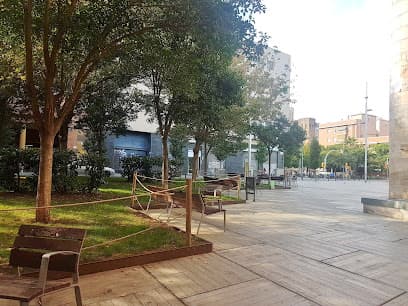
Today, the Plaça de la Hispano Suïssa isn't a museum or a manicured garden. It’s a neighborhood lung, a hard-edged concrete clearing in the dense urban fabric of La Sagrera. It’s not 'pretty' in the way the airline magazines want it to be. There are no rose bushes, no marble fountains, and certainly no gift shops. It’s a functional, honest space where the industrial giants of the past have been replaced by the very loud, very alive reality of modern Barcelona. If you’re looking for Gaudí-esque whimsy, you’re in the wrong part of town. This is where the city breathes when the tourists aren't looking.
Walk in from Carrer de Costa Rica and you’ll see the tiered layout, a mix of pavement and gravel that serves as a battlefield for local youth football matches. The playground is the main event for the under-ten crowd, and it’s usually swarming. It’s the kind of place where the 'games' mentioned in reviews aren't organized events; they’re the chaotic, beautiful mess of childhood. You’ve got basketball hoops where teenagers work on their jump shots under the indifferent gaze of old men sitting on benches, probably debating the merits of the local football club or the rising cost of a glass of vermouth.
This is Sant Andreu, a district that doesn't give a damn about your Instagram feed. It’s a place where people actually live, work, and complain about the metro being late. The square is surrounded by apartment blocks that look down like silent spectators to the daily drama of the neighborhood. There’s a raw honesty here that you won't find in the Gothic Quarter. You won't find a 'curated' cocktail bar on the corner; you’ll find a bakery smelling of flour and yeast, and a local bar where the coffee is strong enough to jumpstart a dead engine and the floor is littered with napkins.
Is it worth the trek? That depends on what you’re after. History nerds will appreciate standing on the site where the H6B—the pinnacle of automotive engineering—was born. Parents with kids climbing the walls of a hotel room will find an honest space that isn't a cynical tourist trap. But don't come here expecting a postcard. It’s a slab of neighborhood life, served without garnish. It’s a reminder that cities are built on labor and that even the most glamorous industrial empires eventually get turned into a place for kids to play tag.
The shade is sparse, the graffiti is hit-or-miss, and the concrete can feel unforgiving in the midday sun. But as the sun starts to dip and the neighborhood pours out into the square for the evening 'passeig,' there’s a sense of community here that’s increasingly hard to find in the center of the city. It’s not a 'must-see' landmark; it’s just a piece of the real Barcelona, take it or leave it.
Type
Park
Duration
30-60 minutes
Best Time
Late afternoon (17:00-19:00) when the neighborhood comes alive and the heat dissipates.
What People Say
kids(5)games(4)
Features
Park
Categories
Urban SquareIndustrial HeritagePlayground
Ticket Prices
Free Admission
No tickets required
Opening Hours
- MondayOpen 24 hours
- TuesdayOpen 24 hours
- WednesdayOpen 24 hours
- ThursdayOpen 24 hours
- FridayOpen 24 hours
- SaturdayOpen 24 hours
- SundayOpen 24 hours
Must-See Highlights
The industrial-themed layout reflecting the site's history
The local basketball court where neighborhood games happen
The surrounding architecture of La Sagrera
Visitor Tips
Don't expect a green park; it's a 'hard' urban square with lots of concrete.
Visit the nearby Nau Bostik for street art and local culture after seeing the square.
Grab a coffee at one of the unpretentious bars on Carrer de Costa Rica to watch the local life.
Good For
Families with kidsHistory enthusiastsBudget travelersLocal culture seekers
Why Visit
Site of the legendary Hispano-Suiza luxury car factory
Authentic, non-touristy neighborhood atmosphere in Sant Andreu
Multi-level urban space with dedicated zones for kids and sports
Nearby Landmarks
- 5-minute walk from Sagrera Metro Station
- 8-minute walk from Nau Bostik cultural center
- 10-minute walk from Hipercor Meridiana
Accessibility
- Ramp access between different levels
- Flat paved surfaces
- Accessible by public transport
Location
Carrer de Costa Rica, 38
Sant Andreu, Barcelona
Nearby Hotels
Nearby Restaurants
In Sant Andreu
ATTRACTION
Camsbio,S.L
Sant Andreu
Not a park for picnics, but the workshop where Barcelona’s green future is built. Camsbio is the grit behind the city's vertical gardens and bio-construction.
0.0(0)
Park
ATTRACTION
Multan los Domingos
Sant Andreu
A defiant slice of Sant Andreu where industrial ruins meet community gardens. It’s the anti-tourist Barcelona: raw, brick-heavy, and smelling of vermut and rebellion.
0.0(0)
Garden
ATTRACTION
Plaça d'Albert Badia i Mur
Sant Andreu
A gritty, honest slice of Sant Andreu where the 'Cases Barates' history meets modern life. No Gaudí here—just real people, a playground, and the unvarnished soul of Bon Pastor.
0.0(0)
Park
Frequently Asked Questions
Is Plaça de la Hispano Suïssa worth visiting?
It depends on your interests. If you are a history buff interested in Barcelona's industrial past or a parent looking for a local playground, it's a great stop. If you want traditional sightseeing and monuments, you can skip it.
What is the history of Plaça de la Hispano Suïssa?
The square is located on the former site of the Hispano-Suiza factory, which produced luxury cars and aircraft engines in the early 20th century. It later became the ENASA (Pegaso) factory before being converted into a public space.
How do I get to Plaça de la Hispano Suïssa?
The easiest way is via the Barcelona Metro. Take the L1, L5, L9N, or L10N to the Sagrera station; the square is a short 5-minute walk from there.
Is the park good for children?
Yes, it is very popular with local families. It features a dedicated playground area and open spaces for ball games and basketball.
Reviews
0 reviews for Plaça de la Hispano Suïssa
No reviews yet. Be the first to share your experience!