4.0
87 verified reviews
About
Look, if you’re looking for the Barcelona they sell you in the glossy brochures—the one with the sparkling fountains and the perfectly manicured hedges—keep walking. Plaça d'André Malraux isn't that. It’s a triangular wedge of reality jammed between the Estació del Nord and the busy arteries of the Eixample. It’s concrete, it’s a little dusty, and it’s exactly the kind of place where the city stops pretending for a minute. It’s a transition zone, a place where people are actually going somewhere else, and that’s exactly why it’s worth a look.
The first thing that hits you—literally, if you aren't looking—is the 'Braç d'André Malraux.' It’s a massive, brutalist concrete sculpture of an arm and hand by Viladomat and Ollé Pinell, erupting from the pavement like a buried giant trying to claw its way back to the surface. In any other city, this would be a cordoned-off piece of high art. In Barcelona, and specifically in this neighborhood, it’s a climbing frame. You’ll see local kids scaling the thumb and sliding down the forearm while their parents smoke cigarettes and check their phones on the nearby benches. It’s art as utility, which is the most honest kind of art there is.
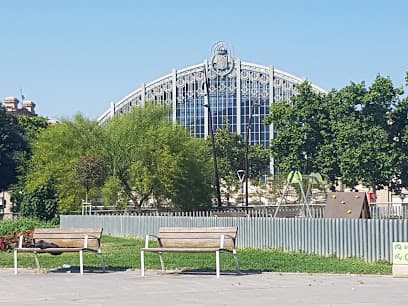
The plaza is named after André Malraux, the French novelist and adventurer who flew for the Republicans during the Spanish Civil War. There’s a certain poetic justice in naming this rugged, unpretentious space after a man who lived a life of mud, blood, and high ideals. It doesn't feel like a memorial; it feels like a living room for the Fort Pienc neighborhood. You’ve got the Estació del Nord bus terminal right next door, which brings a constant, low-level hum of transit—travelers dragging suitcases, the hiss of air brakes, the smell of diesel and anticipation. It’s a place of arrivals and departures, but for the locals, it’s just where you take the toddler to burn off some energy before dinner.
Don't expect lush greenery. This is an urban space in the truest sense. There are trees, sure, providing some much-needed shade during the brutal July heat, but the dominant palette here is grey and ochre. The playground is functional, the pavement is worn smooth by thousands of skateboards and sneakers, and the vibe is decidedly un-touristy. If you’re staying in the Eixample and you’re sick of the crowds at the Sagrada Família, come here. Sit on a bench. Watch the skaters fail at kickflips for forty-five minutes. It’s a palate cleanser.
Is it beautiful? Not in the traditional sense. It’s a bit rough around the edges. You might see some graffiti, and the lighting at night is more 'noir film' than 'romantic stroll.' But it’s authentic. It’s a window into the side of Barcelona that doesn't care if you like it or not. It’s the sound of a city breathing between the big sights. If you want to understand the Eixample beyond the luxury boutiques of Passeig de Gràcia, you need to see places like this. It’s where the grid gets a little messy, where the history is heavy, and where a giant concrete arm reminds you that even in the middle of a modern metropolis, there’s always something strange and human lurking just beneath the surface.
Type
City park
Duration
30-45 minutes
Best Time
Late afternoon when the neighborhood comes alive with families and the shadows on the sculpture are most dramatic.
What People Say
playground(3)upper arm(2)climbing(2)
Features
City park
Categories
Urban SpacePlaygroundPublic Art
Ticket Prices
Free Admission
No tickets required
Must-See Highlights
The 'Braç' (Arm) sculpture
The view of the historic Estació del Nord facade
The local skater scene
Visitor Tips
Don't be afraid to let your kids climb the sculpture; it's a local tradition.
Grab a coffee at one of the small cafes on Carrer de Ribes before sitting down.
It can get very hot in the midday sun as there is a lot of concrete, so aim for morning or late afternoon.
Good For
Families with kidsArchitecture and art enthusiastsBudget travelersSkaters
Why Visit
The 'Braç' Sculpture: A massive, interactive concrete arm that doubles as a neighborhood climbing frame.
Authentic Local Vibe: A rare spot in Eixample that remains largely untouched by the typical tourist circuit.
Transit Proximity: The perfect spot to kill an hour if you're waiting for a bus at Estació del Nord.
Nearby Landmarks
- 2-minute walk from Estació del Nord
- 5-minute walk from Arc de Triomf
- 3-minute walk from Parc de l'Estació del Nord
- 10-minute walk from Ciutadella Park
Accessibility
- Flat paved surfaces
- Wheelchair accessible plaza
- Accessible from street level
Location
Av. de Vilanova, 9999
Eixample, Barcelona
Nearby Hotels
Nearby Restaurants
In Eixample
ATTRACTION
Mural Margalef
Eixample
A towering splash of Mediterranean blue breaking the rigid geometry of Eixample, Joan Margalef’s mural is a visceral reminder that Barcelona’s soul isn't just in its museums.
0.0(0)
Tourist attraction
ATTRACTION
Mural Margalef
Eixample
A geometric middle finger to urban decay, this massive kinetic mural by Eduard Margalef turns a drab Eixample blind wall into a rhythmic, shifting explosion of optical art.
0.0(0)
Tourist attraction
ATTRACTION
Happy Foodies
Eixample
Forget the plastic-wrapped tourist traps; this is a deep dive into the grease, garlic, and soul of Catalan cooking where you actually learn to handle a knife and a porrón.
0.0(0)
Sightseeing tour agencyTour agency
Frequently Asked Questions
Is Plaça d'André Malraux worth visiting?
It's worth a stop if you're a fan of brutalist art or need a break while near the Estació del Nord. It's not a major tourist destination, but the 'Arm' sculpture is a unique local landmark.
What is the giant arm sculpture in the plaza?
It is the 'Braç d'André Malraux,' a concrete sculpture by Viladomat and Ollé Pinell dedicated to the French writer and Republican supporter. It's popular with local children who use it as a climbing structure.
Is there a playground at Plaça d'André Malraux?
Yes, there is a small, functional playground and the sculpture itself is often used by kids for climbing, making it a decent spot for families in the Fort Pienc area.
How do I get to Plaça d'André Malraux?
The plaza is located right next to the Estació del Nord. The easiest way to get there is via the Arc de Triomf metro station (L1) or the Marina station (L1).
Reviews
0 reviews for Plaça d'André Malraux
No reviews yet. Be the first to share your experience!