4.1
1,035 verified reviews
About
Forget the Sagrada Família for a second. Forget the polished marble of Passeig de Gràcia and the overpriced sangria of the Gothic Quarter. If you want to understand how Barcelona actually works—how it breathed, sweated, and hammered itself into existence—you have to head north to Sant Andreu. This is where the tourists thin out and the real city begins, and right at the heart of it sits the Parc de la Maquinista. It isn't a 'park' in the way a British landscape architect would define it. There are no rolling emerald hills or manicured rose gardens. Instead, it’s a visceral, unvarnished monument to the iron and grease that built this town.
The park sits on the bones of what was once 'La Maquinista Terrestre y Marítima,' a massive industrial complex that churned out locomotives and steam engines for over a century. When the factory finally went quiet in the early 90s, they didn't just bulldoze the history; they left the skeletons behind. The centerpiece is the 'Roda de la Maquinista,' a gargantuan iron wheel that looks like it was ripped from the gut of a Victorian dreadnought. It stands there, rusted and defiant, a reminder that before this was a city of digital nomads and boutique hotels, it was a city of makers.
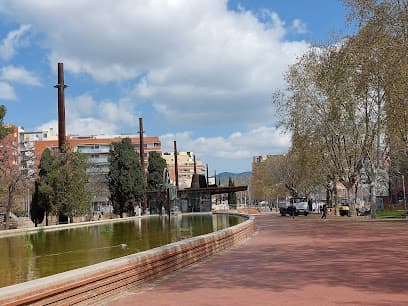
Walking into the park, you’re hit with a strange, almost hallucinatory contrast. On one side, you have the massive La Maquinista shopping center—a temple of modern consumerism where the air smells like Cinnabon and new sneakers. On the other, you have this stark, industrial landscape. There’s a large, rectangular pond that locals generously call a 'lake.' It’s not the Mediterranean, and it’s certainly not crystal clear, but it reflects the sky and the surrounding concrete in a way that feels honest. You’ll see old men from the neighborhood sitting on benches, staring at the water with the kind of thousand-yard stare you only get after forty years on an assembly line. They share the space with teenagers practicing kickflips and families taking a breather after a three-hour marathon at the Zara next door.
There’s a grit here that I find deeply satisfying. The park features table tennis tables where the competition is surprisingly fierce, and children’s play areas that feel more like training grounds for future engineers than soft-play zones. It’s a place of utility. You come here to walk the dog, to argue about football, or to simply exist in a space that hasn't been scrubbed clean for a postcard. The landscaping is functional—rows of trees providing much-needed shade against the brutal Catalan sun, and wide paved paths that accommodate the flow of people moving between the residential blocks of Sant Andreu and the commercial maw of the mall.
Is it 'beautiful'? Not in the traditional sense. It’s skeletal. It’s grey. It’s a bit rough around the edges. But it’s one of the best parks in Barcelona if you’re looking for a slice of the city’s true identity. It’s a bridge between the industrial sweat of the 20th century and the retail-driven frenzy of the 21st. If you’re already heading to the mall to replace the shoes you wore out walking the Rambla, take twenty minutes. Sit by the rusted wheel. Watch the light hit the pond. It’s a reminder that cities aren't just built of stone and dreams; they’re built of iron, oil, and the people who knew how to use them.
Type
Park, Tourist attraction
Duration
45-60 minutes
Best Time
Late afternoon when the sun hits the industrial ruins and the neighborhood locals gather to socialize.
What People Say
shopping center(23)games(21)lake(15)table tennis(13)strolling(9)bank(7)shadow(7)ideal(7)
Features
Park
Tourist attraction
Categories
Industrial HeritagePublic ParkFamily Friendly
Ticket Prices
Free Admission
No tickets required
Opening Hours
- MondayOpen 24 hours
- TuesdayOpen 24 hours
- WednesdayOpen 24 hours
- ThursdayOpen 24 hours
- FridayOpen 24 hours
- SaturdayOpen 24 hours
- SundayOpen 24 hours
Must-See Highlights
The Roda de la Maquinista (The Great Wheel)
The central pond and its industrial reflections
The preserved factory chimney
Visitor Tips
Combine your visit with a trip to the La Maquinista mall for food and shopping.
Bring your own paddles if you want to use the table tennis tables.
Explore the narrow streets of old Sant Andreu nearby for authentic local tapas.
Good For
FamiliesHistory buffsBudget travelersLocals
Why Visit
Authentic industrial heritage featuring original factory machinery and structures
A rare glimpse into the non-tourist, working-class neighborhood of Sant Andreu
The perfect 'decompression zone' located immediately adjacent to Barcelona's largest shopping mall
Nearby Landmarks
- 2-minute walk from La Maquinista Shopping Centre
- 10-minute walk from Sant Andreu Palomar Church
- 15-minute walk from Fabra i Coats Cultural Centre
Accessibility
- Fully wheelchair accessible
- Flat paved pathways
- Accessible public transport nearby
Location
Passeig de l'Havana, 2
Sant Andreu, Barcelona
Nearby Hotels
Nearby Restaurants
In Sant Andreu
ATTRACTION
Camsbio,S.L
Sant Andreu
Not a park for picnics, but the workshop where Barcelona’s green future is built. Camsbio is the grit behind the city's vertical gardens and bio-construction.
0.0(0)
Park
ATTRACTION
Multan los Domingos
Sant Andreu
A defiant slice of Sant Andreu where industrial ruins meet community gardens. It’s the anti-tourist Barcelona: raw, brick-heavy, and smelling of vermut and rebellion.
0.0(0)
Garden
ATTRACTION
Plaça d'Albert Badia i Mur
Sant Andreu
A gritty, honest slice of Sant Andreu where the 'Cases Barates' history meets modern life. No Gaudí here—just real people, a playground, and the unvarnished soul of Bon Pastor.
0.0(0)
Park
Frequently Asked Questions
Is Parc de la Maquinista worth visiting?
It is worth it if you are interested in industrial history or are already visiting the nearby shopping center. It offers a unique, unpolished look at Barcelona's manufacturing past away from the typical tourist trail.
What is the large iron wheel in the park?
It is the 'Roda de la Maquinista,' a preserved piece of machinery from the original La Maquinista Terrestre y Marítima factory that occupied this site until the 1990s.
How do I get to Parc de la Maquinista?
The easiest way is via Metro Line 1 (Red Line), getting off at either the Sant Andreu or Torras i Bages stations. It is a 10-minute walk from either.
Is the park good for families?
Yes, it features several children's play areas, table tennis tables, and wide paths suitable for strollers, making it a popular spot for local families.
Reviews
0 reviews for Parc de la Maquinista
No reviews yet. Be the first to share your experience!