3.9
76 verified reviews
About
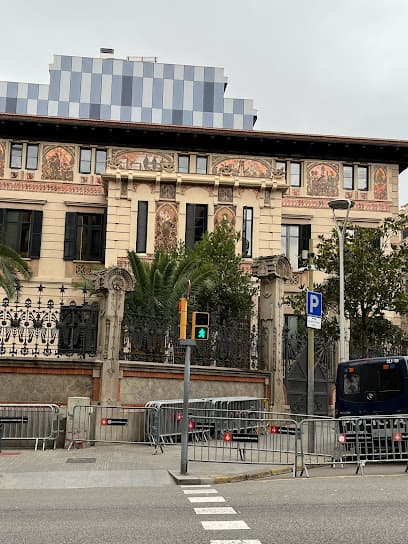
Barcelona is a city that wears its heart on its sleeve, usually in the form of a wavy Gaudí roof or a tile-covered facade that looks like it was designed during an absinthe binge. But then there’s the Palau Ramon Montaner. It sits on the corner of Carrer de Mallorca and Roger de Llúria, looking every bit the aristocratic fortress it was meant to be. It’s a Lluís Domènech i Montaner joint—the guy who gave us the Palau de la Música Catalana—but here, he had to finish what someone else started, and the result is a fascinating, slightly schizophrenic masterpiece of Modernisme.
Originally commissioned by Ramon Montaner, the big-shot publisher who co-founded Montaner i Simón, the project started under Josep Domènech i Estapà. Estapà was the guy who liked straight lines and sobriety—the architectural equivalent of a stiff drink and a firm handshake. He got the shell done, but then he and Montaner had a falling out. Enter the other Domènech—Lluís—who was the rock star of the movement. Lluís took Estapà’s rigid structure and started throwing flowers, mosaics, and stained glass at it until it screamed. It’s a collision of two very different egos, and somehow, it works.
Today, the place is the headquarters for the Delegation of the Spanish Government in Catalonia. That means it’s not a museum where you can just wander in, buy a magnet, and use the clean bathrooms. It’s a working office filled with people doing government things, guarded by guys in uniforms who aren't particularly interested in your architectural curiosity. This is the great tragedy of the Palau Ramon Montaner: it is one of the most stunning interiors in the Eixample, and for 360 days a year, you’re stuck looking at it through the iron gates.
If you’re lucky enough to catch it during the '48h Open House Barcelona' or a rare scheduled tour, the interior will knock the wind out of you. The central staircase is a vertical explosion of carved stone and wood, lit by a stained-glass skylight that makes the air feel heavy with color. The mosaics by Lluís Bru—the same guy who did the Palau de la Música—are everywhere, depicting scenes that make you wonder how anyone gets any actual paperwork done in this building. It’s a temple to the Catalan bourgeoisie’s obsession with detail, a time when even a ceiling had to tell a story.
Walking past it on a Tuesday afternoon, you’ll see the contrast that defines modern Barcelona. On one side, you have the tourists trekking toward the Sagrada Família, and on the other, the cold reality of Spanish bureaucracy housed in a palace of floral tiles. It’s a reminder that these buildings weren't built for us to take pictures of; they were built to show off wealth, power, and a very specific kind of Catalan pride.
Is it worth the effort? If you can get inside, absolutely. It’s one of the best Modernista buildings in Barcelona precisely because it hasn't been polished into a tourist theme park. It still feels like a place where things happen, even if those things are just meetings and memos. If the gates are closed, it’s still worth the detour just to see the exterior friezes and the way the light hits the ceramics. It’s a quiet, brooding masterpiece in a neighborhood that’s often too loud for its own good. Just don't expect the guards to let you in just because you asked nicely.
Type
Historical landmark, Tourist attraction
Duration
45-60 minutes
Best Time
During the 48h Open House Barcelona festival in October for full access.
Guided Tours
Available
What People Say
government(5)modernisme(3)lluís domènech i montaner(2)mosaics(2)architects(2)mansion(2)glass(2)
Features
Historical landmark
Tourist attraction
Categories
ArchitectureModernismeGovernment Building
Ticket Prices
Free Admission
No tickets required
Opening Hours
- Monday9 AM to 6 PM
- Tuesday9 AM to 6 PM
- Wednesday9 AM to 6 PM
- Thursday9 AM to 6 PM
- Friday9 AM to 3 PM
- SaturdayClosed
- SundayClosed
Must-See Highlights
The central monumental staircase
Large-scale exterior mosaics by Lluís Bru
The stained-glass skylight
The decorative frieze surrounding the top of the building
Visitor Tips
Don't try to talk your way past the guards on a normal day; they take security seriously.
Photograph the exterior friezes from the opposite side of Carrer de Mallorca for the best angle.
Combine this with a visit to the Fundació Antoni Tàpies nearby to see the other 'Montaner' building.
Good For
Architecture nerdsHistory buffsOff-the-beaten-path explorers
Why Visit
Architectural Hybrid: A rare mix of Estapà’s sobriety and Domènech i Montaner’s floral Modernisme.
Untouched Interiors: Because it’s a government office and not a high-traffic museum, the rooms remain remarkably intact.
Masterful Detail: Features intricate mosaics by Lluís Bru and sculptures by Enric Alentorn.
Nearby Landmarks
- 2-minute walk from Casa Thomas
- 8-minute walk from Fundació Antoni Tàpies (Palau Montaner i Simón)
- 10-minute walk from Casa Milà (La Pedrera)
- 12-minute walk from Passeig de Gràcia
Accessibility
- Limited public access
- Exterior viewable from street level
Location
Carrer de Mallorca, 278
Eixample, Barcelona
Nearby Hotels
Nearby Restaurants
In Eixample
ATTRACTION
Mural Margalef
Eixample
A towering splash of Mediterranean blue breaking the rigid geometry of Eixample, Joan Margalef’s mural is a visceral reminder that Barcelona’s soul isn't just in its museums.
0.0(0)
Tourist attraction
ATTRACTION
Mural Margalef
Eixample
A geometric middle finger to urban decay, this massive kinetic mural by Eduard Margalef turns a drab Eixample blind wall into a rhythmic, shifting explosion of optical art.
0.0(0)
Tourist attraction
ATTRACTION
Happy Foodies
Eixample
Forget the plastic-wrapped tourist traps; this is a deep dive into the grease, garlic, and soul of Catalan cooking where you actually learn to handle a knife and a porrón.
0.0(0)
Sightseeing tour agencyTour agency
Frequently Asked Questions
Is Palau Ramon Montaner open to the public?
Generally, no. As it is a government building (Delegation of the Spanish Government), it is closed to walk-in visitors. It typically only opens for special events like the '48h Open House Barcelona' or through pre-arranged group tours.
What is the best way to see the interior?
Keep an eye on the 48h Open House Barcelona schedule in October, or check the Barcelona City Council's cultural agenda for rare guided visits. Otherwise, you are limited to viewing the impressive exterior and friezes from the street.
Who was the architect of Palau Ramon Montaner?
The building was a collaboration (and sometimes a conflict) between Josep Domènech i Estapà, who designed the structure, and Lluís Domènech i Montaner, who completed the decoration and the top floor.
Is it worth visiting if I can't go inside?
If you are an architecture enthusiast, yes. The exterior mosaics, ironwork, and the frieze by Enric Alentorn are visible from the sidewalk and represent some of the finest Modernista craftsmanship in the Eixample.
Reviews
0 reviews for Palau Ramon Montaner
No reviews yet. Be the first to share your experience!