4.5
1,355 verified reviews
About
Everyone goes to the Block of Discord to see Gaudí’s psychedelic bone-house, but if you want to see where the real money lived—the kind of money that didn't need to scream for attention—you walk over to Passeig de Sant Joan. Palau Macaya is a white-washed slap in the face to anyone who thinks Modernisme is just about melting balconies and broken tiles. This is Josep Puig i Cadafalch at his most disciplined, blending Catalan Gothic with a sort of crisp, Northern European sensibility that feels more like a dream of Brussels than a street in Spain. It’s one of the best examples of Puig i Cadafalch architecture in Barcelona, and it remains criminally overlooked by the masses.
The first thing you notice is the sgraffito—that delicate, scratch-work pattern on the walls that looks like fine lace draped over stone. It’s elegant, it’s restrained, and it’s entirely too good for the tourists who walk right past it on their way to the Sagrada Familia. Built between 1898 and 1901 for the industrialist Romà Macaya, the building represents the peak of the Eixample’s golden age. While Gaudí was busy talking to God through chimneys, Puig i Cadafalch was building monuments to the Catalan bourgeoisie that felt grounded, structural, and deeply rooted in Mediterranean history.
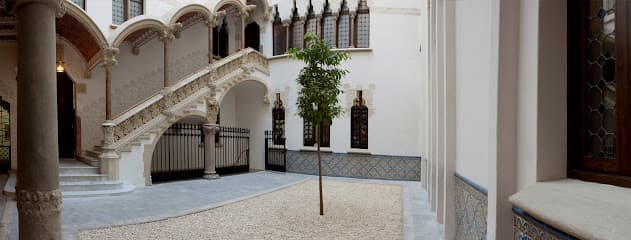
But the real magic happens when you step through the massive doors into the courtyard. Look at the base of the grand staircase. There’s a small stone carving of a man on a bicycle. In 1901, that was the equivalent of carving a guy in a Tesla today. It’s a joke, a signature. Puig i Cadafalch was reportedly riding his bike between his two major projects at the time—this and the nearby Casa de les Punxes—and the sculptor decided to immortalize the architect’s preferred mode of transport. It’s a human moment in a building that could otherwise feel intimidatingly perfect. The capitals of the columns are a riot of floral motifs and biblical scenes, all carved with a precision that makes modern construction look like it was done with a chainsaw.
Today, the place is run by the 'la Caixa' Foundation as a center for social debate, known as CaixaForum Macaya. That means it’s not a dusty museum with velvet ropes. It’s full of people in suits or academic turtlenecks arguing about the future of the Mediterranean, social ethics, or the economy. It’s a living, breathing space. You can usually wander into the patio for free, and you absolutely should. Stand there, look up at the galleries, and feel the weight of the history. It’s quiet. It’s cool. It’s the Barcelona that existed before the cheap sangria and the selfie sticks took over.
If you're looking for a corner of the neighborhood that doesn't involve a two-hour queue, this is your spot. It’s a reminder that the city’s architectural heritage isn't just a collection of postcards; it’s a functional part of the urban fabric. The interior rooms are often closed for private conferences, but the ground floor and the façade are enough to justify the walk. It’s a masterclass in detail, from the wrought iron lamps to the ceramic tiles that line the vestibule.
Is Palau Macaya worth it? If you give a damn about architecture that doesn't need a neon sign to prove its worth, yes. It’s a quiet middle finger to the over-commercialized Gaudí circuit. It’s honest, it’s beautiful, and it’s a reminder that sometimes, the best things in this city are hiding in plain sight, waiting for someone to actually look at them instead of just through a viewfinder.
Type
Cultural center, Tourist attraction
Duration
30-45 minutes
Best Time
Weekday mornings when the cultural center is active but not crowded with conference attendees.
What People Say
palace(28)conference(22)modernisme(19)patio(14)façade(11)occurrence(11)debate(8)space(8)
Features
Cultural center
Tourist attraction
Categories
ArchitectureModernismeHistoryPuig i Cadafalch
Ticket Prices
Free Admission
No tickets required
Opening Hours
- Monday9 AM to 2 PM, 4 to 8 PM
- Tuesday9 AM to 2 PM, 4 to 8 PM
- Wednesday9 AM to 2 PM, 4 to 8 PM
- Thursday9 AM to 2 PM, 4 to 8 PM
- Friday9 AM to 2 PM, 4 to 8 PM
- SaturdayClosed
- SundayClosed
Must-See Highlights
The stone cyclist at the base of the grand staircase
The intricate sgraffito work on the exterior façade
The inner courtyard (patio) with its Gothic-inspired galleries
The ornate wrought iron work on the main entrance doors
Visitor Tips
Don't just look at the outside; walk into the patio—it's free and usually open during business hours.
Look closely at the column capitals in the courtyard for hidden biblical and floral details.
Combine this with a walk down Passeig de Sant Joan, one of the city's best boulevards for local life.
Good For
Architecture loversHistory buffsBudget travelersSolo travelers seeking quiet
Why Visit
The 'Cyclist' carving—a rare humorous architectural signature from 1901
Exquisite white sgraffito façade that stands out from the typical red-brick Modernisme
A working cultural center where you can experience high-end architecture without the tourist crowds
Nearby Landmarks
- 5-minute walk from Casa de les Punxes
- 12-minute walk from Sagrada Familia
- 10-minute walk from Passeig de Gràcia
- 4-minute walk from Metro Verdaguer
Accessibility
- Wheelchair accessible ground floor
- Elevator access to upper floors for events
Location
Pg. de St. Joan, 108
Eixample, Barcelona
Nearby Hotels
Nearby Restaurants
In Eixample
ATTRACTION
Mural Margalef
Eixample
A towering splash of Mediterranean blue breaking the rigid geometry of Eixample, Joan Margalef’s mural is a visceral reminder that Barcelona’s soul isn't just in its museums.
0.0(0)
Tourist attraction
ATTRACTION
Mural Margalef
Eixample
A geometric middle finger to urban decay, this massive kinetic mural by Eduard Margalef turns a drab Eixample blind wall into a rhythmic, shifting explosion of optical art.
0.0(0)
Tourist attraction
ATTRACTION
Happy Foodies
Eixample
Forget the plastic-wrapped tourist traps; this is a deep dive into the grease, garlic, and soul of Catalan cooking where you actually learn to handle a knife and a porrón.
0.0(0)
Sightseeing tour agencyTour agency
Frequently Asked Questions
Is Palau Macaya worth visiting?
Yes, especially for architecture enthusiasts who want to see a Puig i Cadafalch masterpiece without the crowds. The courtyard and façade are stunning and usually free to enter.
What is the cyclist carving at Palau Macaya?
At the base of the main staircase, there is a small stone carving of the architect, Puig i Cadafalch, on a bicycle—a humorous nod to his habit of cycling between construction sites in 1901.
Do I need tickets for Palau Macaya?
Generally, no. The ground floor patio and vestibule are open to the public for free. However, the upper floors are used for private conferences and social debate events.
How do I get to Palau Macaya?
The palace is located on Passeig de Sant Joan, 108. The easiest way to get there is via the Metro, taking the L4 or L5 to the Verdaguer station, which is just a few minutes' walk away.
Reviews
0 reviews for Palau Macaya
No reviews yet. Be the first to share your experience!