5.0
2 verified reviews
About
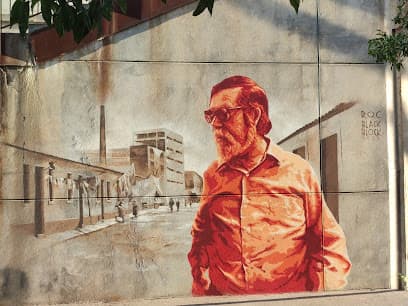
Forget the postcard-perfect facades of the Eixample and the scrubbed-clean alleys of the Gothic Quarter. If you want to see the Barcelona that actually works, the one that sweats, the one built by the calloused hands of people who weren't born here, you have to head south. You have to go to La Marina de Port, a neighborhood that for decades was the city’s backyard, tucked between the industrial port and the steep cliffs of Montjuïc. Here, on the side of a towering apartment block, stares the face of Paco Candel.
This isn't just street art; it’s a massive, unvarnished piece of social history. Painted by the renowned urban artist Suso33 in 2014, the Mural de Francesc Candel commemorates the 50th anniversary of Candel’s seminal book, 'Els altres catalans' (The Other Catalans). If you haven't heard of it, you don't know Barcelona. Candel was the guy who looked at the shantytowns, the 'Casas Baratas,' and the waves of immigrants coming from Andalusia and Murcia, and he told the world they were just as Catalan as the bourgeoisie in the city center. He gave a voice to the voiceless, and this mural is the neighborhood’s way of saying they haven't forgotten.
The scale of the thing is what hits you first. It’s a giant, monochromatic portrait that seems to emerge from the very brickwork of the barrio. Suso33 used a technique that feels more like an excavation than a painting, capturing Candel’s weathered face and his typewriter—the weapon he used to fight for social justice. It’s located right near the library that also bears his name, in a part of Sants-Montjuïc that most tourists couldn't find with a GPS and a sherpa. And that’s exactly why it’s worth the trip.
Standing here, you don't hear the rattle of tour buses or the chatter of selfie-stick-wielding crowds. You hear the hum of the nearby port, the wind whipping off the Mediterranean, and the everyday sounds of a working-class neighborhood. It’s a place of concrete and asphalt, but it’s also a place of immense pride. The mural serves as a reminder that the soul of a city isn't found in its monuments, but in its people—especially the ones who had to fight for their place in it. It’s a visceral experience, a reminder that every city has its 'others,' and that their stories are the ones that actually matter.
Is it 'beautiful' in the traditional sense? Maybe not. It’s raw. It’s grey. It’s imposing. But it’s honest. In a city that is increasingly being turned into a theme park for visitors, the Mural de Francesc Candel is a stubborn piece of reality. It’s a destination for those who want to understand the social fabric of Barcelona, the migration patterns that shaped it, and the literary giant who documented it all. It’s a pilgrimage for the curious, for the readers, and for anyone who believes that art should mean something more than just a backdrop for a photo. If you’re looking for the best street art in Barcelona that actually has something to say, this is your stop. Take the L10 Sud metro to Foneria, walk past the blocky housing projects, and look up. You’ll see a man who saw the truth, staring back at a city that is still trying to live up to his ideals.
Type
Tourist attraction
Duration
30-45 minutes
Best Time
Daylight hours to appreciate the scale and detail of the artwork.
Features
Tourist attraction
Categories
Street ArtSocial HistoryPublic Art
Ticket Prices
Free Admission
No tickets required
Must-See Highlights
The intricate monochromatic detail of Candel's face
The symbolic representation of the typewriter
The surrounding La Marina neighborhood architecture
Visitor Tips
Combine this with a visit to the nearby Biblioteca Francesc Candel to learn more about his work.
Visit during the day as the area is industrial and lighting can be sparse at night.
Use the L10 Sud metro line, which is one of the newest and cleanest in the city.
Good For
History buffsStreet art enthusiastsSolo travelersPhotography
Why Visit
Massive social-realist portrait by world-renowned artist Suso33
Located in the authentic, non-touristy neighborhood of La Marina de Port
A profound tribute to the social history of Barcelona's immigrant working class
Nearby Landmarks
- Biblioteca Francesc Candel (1-minute walk)
- Jardins de Can Farrero (3-minute walk)
- Gran Via 2 Shopping Centre (15-minute walk)
- Fira Barcelona Gran Via (20-minute walk)
Accessibility
- Fully accessible as it is located on a public street
Location
Carrer dels Ferrocarrils Catalans, 72X
Sants-Montjuïc, Barcelona
Nearby Hotels
Nearby Restaurants
In Sants-Montjuïc
ATTRACTION
Bolets1
Sants-Montjuïc
A gritty, earthy temple to the Catalan obsession with wild mushrooms, where the dirt is real, the fungi are seasonal gold, and the air smells like the damp floor of a Pyrenean forest.
0.0(0)
Tourist attraction
ATTRACTION
Montjuic aparca
Sants-Montjuïc
The unglamorous base camp for your Montjuïc assault. A tactical slab of asphalt where the city's chaos fades into the pine-scented ghosts of the 1992 Olympics.
0.0(0)
Tourist attraction
ATTRACTION
Паркінг Барселона
Sants-Montjuïc
A sprawling slab of industrial reality in the Zona Franca. No Gaudí here—just hot asphalt, diesel fumes, and the honest utility of a secure place to park your rig.
0.0(0)
Park
Frequently Asked Questions
Is the Mural de Francesc Candel worth visiting?
Yes, if you are interested in social history, literature, or large-scale street art. It offers a raw look at a neighborhood and a history that most tourists never see.
How do I get to the Francesc Candel mural?
The easiest way is to take the L10 Sud metro line to the 'Foneria' station. From there, it is a short 5-minute walk to Carrer dels Ferrocarrils Catalans.
Who was Francesc Candel?
Francesc 'Paco' Candel was a prominent writer and politician who documented the lives of 20th-century immigrants in Barcelona, most notably in his book 'Els altres catalans.'
Is there an entrance fee for the mural?
No, it is a public mural located on the exterior of a building and can be viewed for free at any time.
Reviews
0 reviews for Mural de Francesc Candel
No reviews yet. Be the first to share your experience!