4.0
2 verified reviews
About
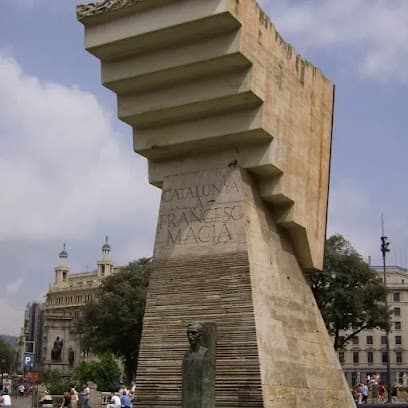
Step into the swirling, pigeon-choked chaos of Plaça de Catalunya and you’ll find yourself surrounded by the usual suspects: tourists clutching maps like shields, pickpockets eyeing backpacks, and the relentless hum of a city that never stops selling you something. But tucked into the corner where the square meets the Eixample, there is a massive, jagged block of concrete and stone that feels like it fell from a different, much more serious dimension. This is the Monument to Francesc Macià, and it doesn’t care if you think it’s pretty. It’s not here to be pretty. It’s here to tell you a story about blood, soil, and a dream that hasn't quite come true yet.
Francesc Macià was known as 'L'Avi'—The Grandfather. He wasn't just some politician in a dusty suit; he was a soldier who turned into the fiery heart of the Catalan independence movement. In 1931, he stood on a balcony and declared the Catalan Republic. It was a moment of pure, unadulterated hope that was eventually crushed under the boot of history. When you look at this monument, you aren't just looking at a statue; you’re looking at the weight of that history. It was designed by Josep Maria Subirachs, the same man who sculpted the polarizing, angular Passion Facade at the Sagrada Família. Subirachs didn’t do soft edges. He did bone, grit, and hard truths.
The monument is a two-part act. First, there’s the pedestal, a dark, heavy base that holds the bust of Macià himself, looking stern and resolute. But the real show-stopper is the inverted staircase. It’s a massive concrete structure that climbs toward the sky, only to stop abruptly and flip upside down. It’s a metaphor so blunt it hits you like a lead pipe: the history of Catalonia is a staircase that is still being built, a work in progress that has been interrupted, broken, and restarted a dozen times. It’s a necessary stop if you want to understand the city's complicated heart beyond the tapas and the beach.
Most people walk right past it on their way to the Apple Store or El Corte Inglés, which is a damn shame. They miss the contrast between the polished, commercial facade of modern Barcelona and this raw, brutalist reminder of what people here have fought for. The stone is travertine, the same stuff they used in ancient Rome, but the execution is pure 20th-century defiance. It was unveiled in 1991, just as the city was preening itself for the Olympics, a reminder that even in its most global moment, Barcelona still remembers its roots.
Is it worth visiting? If you want the 'Disney' version of Spain, keep walking. But if you want to stand in the spot where the city’s political heart beats loudest, where protesters gather when they’re angry and where the ghosts of the 1930s still linger, then yes, it’s essential. It’s a place to sit for a minute, ignore the pigeons, and feel the weight of a nation that refuses to be finished. It’s jagged, it’s grey, and it’s honest. In a world of filtered Instagram photos and tourist traps, that’s a rare thing to find.
Type
Tourist attraction
Duration
15-30 minutes
Best Time
Early morning or late evening when the square is less crowded and the shadows emphasize the monument's jagged geometry.
Features
Tourist attraction
Categories
HistorySculptureCatalan IdentityBrutalism
Ticket Prices
Free Admission
No tickets required
Opening Hours
- MondayOpen 24 hours
- TuesdayOpen 24 hours
- WednesdayOpen 24 hours
- ThursdayOpen 24 hours
- FridayOpen 24 hours
- SaturdayOpen 24 hours
- SundayOpen 24 hours
Must-See Highlights
The inverted staircase metaphor
The bust of 'L'Avi' (The Grandfather)
The contrast between the travertine stone and the surrounding modern architecture
Visitor Tips
Look for the inscription of Macià's famous words about the Catalan Republic
It's a great meeting point that's easier to find than the fountains
Keep an eye on your belongings; Plaça de Catalunya is a hotspot for pickpockets
Good For
History buffsArchitecture studentsSolo travelersBudget travelers
Why Visit
Designed by Josep Maria Subirachs, the controversial sculptor of the Sagrada Família's Passion Facade
Powerful political symbolism representing the 'unfinished' dream of Catalan independence
Located at the literal crossroads of the city, where the old town meets the modern Eixample
Nearby Landmarks
- 1-minute walk from El Corte Inglés
- 2-minute walk from La Rambla
- 3-minute walk from Passeig de Gràcia
- 5-minute walk from Casa Calvet
Accessibility
- Fully accessible public square
- Flat paved surfaces
- Visible from street level
Location
Pl. de Catalunya, 4
Eixample, Barcelona
Nearby Hotels
Nearby Restaurants
In Eixample
ATTRACTION
Mural Margalef
Eixample
A towering splash of Mediterranean blue breaking the rigid geometry of Eixample, Joan Margalef’s mural is a visceral reminder that Barcelona’s soul isn't just in its museums.
0.0(0)
Tourist attraction
ATTRACTION
Mural Margalef
Eixample
A geometric middle finger to urban decay, this massive kinetic mural by Eduard Margalef turns a drab Eixample blind wall into a rhythmic, shifting explosion of optical art.
0.0(0)
Tourist attraction
ATTRACTION
Happy Foodies
Eixample
Forget the plastic-wrapped tourist traps; this is a deep dive into the grease, garlic, and soul of Catalan cooking where you actually learn to handle a knife and a porrón.
0.0(0)
Sightseeing tour agencyTour agency
Frequently Asked Questions
Is the Monument Francesc Macià worth visiting?
Yes, especially if you are interested in Catalan history or brutalist art. It is a powerful, symbolic landmark located in the heart of the city that offers a deep look into the local identity.
What does the inverted staircase represent?
Designed by Subirachs, the staircase symbolizes the unfinished history of Catalonia, suggesting a nation that is still in the process of building its future.
Do I need tickets for the Monument Francesc Macià?
No, it is a public monument located in Plaça de Catalunya and can be viewed for free at any time of day.
Who was Francesc Macià?
He was the 122nd President of the Generalitat de Catalunya and a key figure in the struggle for Catalan autonomy, affectionately known as 'L'Avi' (The Grandfather).
Reviews
0 reviews for Monument Francesc Macià
No reviews yet. Be the first to share your experience!