4.3
698 verified reviews
About
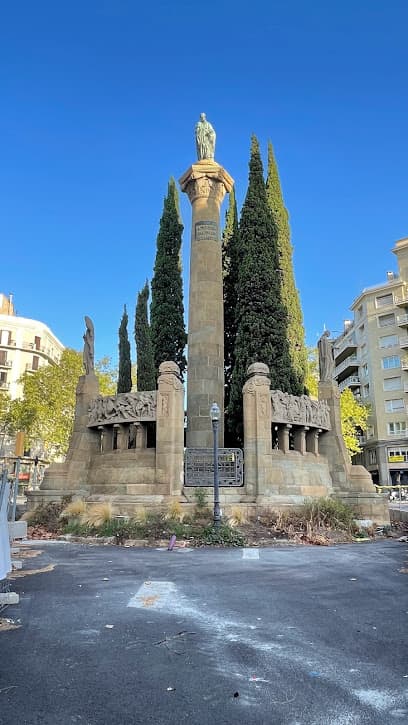
The intersection of Avinguda Diagonal and Passeig de Sant Joan is a meat grinder of scooters, taxis, and delivery vans. It is the kind of place where the city’s grid-like efficiency feels most aggressive. But right in the eye of this exhaust-choked storm stands a twenty-meter column of Montjuïc stone, topped by a man in a bronze cloak who looks like he’s seen enough of our modern nonsense. This is the Monument a Mossèn Jacint Verdaguer, and if you want to understand the soul of Barcelona, you have to look up at the man they call 'The Crow.'
Jacint Verdaguer wasn’t just a priest; he was a rockstar of the Catalan Renaixença, the 19th-century cultural revival that pulled the Catalan language out of the gutter and back into the halls of high literature. When he died in 1902, the city didn't just mourn; they shut down. This monument, inaugurated in 1924 after a decade of political bickering and construction delays, is the physical manifestation of that reverence. Designed by architect Josep Maria Pericas, it’s a massive, Noucentista-style middle finger to cultural erasure.
At the very top, the bronze statue by Joan Borrell i Nicolau depicts Verdaguer with his head slightly inclined, a pose that earned the monument its local nicknames: 'El Cuervo' (The Crow) or 'La Palmatòria' (The Candlestick). He looks down at the commuters with a mix of melancholy and stoicism, clutching a roll of paper as if he’s about to drop a verse that will shake the foundations of the Eixample. Below him, the column is surrounded by a circular balustrade where three allegorical stone figures represent the pillars of his work: Epic, Popular, and Mystical poetry. They are heavy, solid, and unyielding—much like the man himself.
If you can dodge the traffic long enough to get close to the base, look at the frieze. The Oslé brothers, Llucià and Miquel, carved intricate bas-reliefs depicting scenes from Verdaguer’s epic poems, most notably 'L’Atlàntida.' You’ll see warriors, horses, and the destruction of mythical empires, all rendered in stone that has absorbed decades of city grime. It’s visceral, detailed, and far more interesting than the generic statues you find in most European squares. There are even six cypress trees planted within the balustrade, providing a strange, green sanctuary in the middle of the asphalt.
While you’re there, turn your back to the poet for a second and look at the roof of the building at Diagonal 372. You’ll see a giant neon owl with glowing yellow eyes staring back at you. It’s the Rótulos Roura owl, a 1960s advertising relic that the city refused to tear down because it became as much a part of the neighborhood as the monument itself. It’s a perfect Barcelona moment: a 19th-century priest-poet and a mid-century neon bird sharing the same skyline.
Is it a 'must-see'? If you’re just here for the Instagram shots of the Sagrada Família, you’ll probably drive right past it in a cab. But if you give a damn about the history of this place—about how a language survived and how a city honors its giants—then it’s worth the ten-minute walk from Gaudí’s basilica. It’s not a tourist trap. It’s not a 'hidden gem.' It’s a soot-stained, traffic-encircled piece of the city’s bone structure. It’s honest, it’s loud, and it’s exactly what Barcelona is.
Type
Monument, Tourist attraction
Duration
15-30 minutes
Best Time
Late afternoon or golden hour for the best light on the bronze statue and to see the nearby neon owl light up.
What People Say
poets(10)square(8)roundabout(7)writer(6)walk(6)1902(5)priest(5)architect(5)
Features
Monument
Tourist attraction
Categories
ArchitectureLiteratureHistorySculpture
Ticket Prices
Free Admission
No tickets required
Opening Hours
- MondayOpen 24 hours
- TuesdayOpen 24 hours
- WednesdayOpen 24 hours
- ThursdayOpen 24 hours
- FridayOpen 24 hours
- SaturdayOpen 24 hours
- SundayOpen 24 hours
Must-See Highlights
The 20-meter Montjuïc stone column
Bronze statue of Verdaguer by Joan Borrell i Nicolau
Allegorical stone figures of Epic, Popular, and Mystical poetry
Bas-reliefs of L'Atlàntida at the base
Visitor Tips
Look up at the building on the corner of Diagonal to see the famous neon owl
The best angle for photos is from the pedestrian crossing on Passeig de Sant Joan looking north
Combine this with a walk down the leafy Passeig de Sant Joan, one of the city's best boulevards
Good For
History buffsArchitecture enthusiastsLiterature loversPhotography
Why Visit
The 'Crow' nickname and the unique inclined pose of the bronze statue
Intricate bas-reliefs by the Oslé brothers depicting the epic poem L'Atlàntida
The juxtaposition of a historic monument with the iconic 1960s neon 'Roura Owl' nearby
Nearby Landmarks
- 10-minute walk from Sagrada Família
- 5-minute walk from Casa de les Punxes
- 4-minute walk from Palau Macaya
Accessibility
- Wheelchair accessible square
- Public outdoor space
Location
Plaça de Mossèn Jacint Verdaguer, s/n
Eixample, Barcelona
Nearby Hotels
Nearby Restaurants
In Eixample
ATTRACTION
Mural Margalef
Eixample
A towering splash of Mediterranean blue breaking the rigid geometry of Eixample, Joan Margalef’s mural is a visceral reminder that Barcelona’s soul isn't just in its museums.
0.0(0)
Tourist attraction
ATTRACTION
Mural Margalef
Eixample
A geometric middle finger to urban decay, this massive kinetic mural by Eduard Margalef turns a drab Eixample blind wall into a rhythmic, shifting explosion of optical art.
0.0(0)
Tourist attraction
ATTRACTION
Happy Foodies
Eixample
Forget the plastic-wrapped tourist traps; this is a deep dive into the grease, garlic, and soul of Catalan cooking where you actually learn to handle a knife and a porrón.
0.0(0)
Sightseeing tour agencyTour agency
Frequently Asked Questions
Is the Monument a Mossèn Jacint Verdaguer worth visiting?
Yes, especially if you are interested in Catalan history and literature. It is a grand, detailed monument located in a major intersection, offering a glimpse into the cultural identity of Barcelona beyond the typical tourist sites.
What is the nickname of the Verdaguer statue?
Locals often call it 'El Cuervo' (The Crow) because of the poet's inclined head and dark bronze color, or 'La Palmatòria' (The Candlestick) due to the shape of the tall column.
How do I get to Plaça de Mossèn Jacint Verdaguer?
The easiest way is by Metro; take Line 4 or Line 5 to the 'Verdaguer' station. The monument is located right at the exit where Avinguda Diagonal meets Passeig de Sant Joan.
Who was Jacint Verdaguer?
He was a 19th-century priest and poet, considered the father of modern Catalan literature and a central figure of the Renaixença movement.
Reviews
0 reviews for Monument a Mossèn Jacint Verdaguer
No reviews yet. Be the first to share your experience!