3.0
2 verified reviews
About
If you’re looking for the glittering mosaics of Gaudí or the overpriced sangria of the Gothic Quarter, you’ve taken a very wrong turn. Plaça de Montserrat Roca i Baltà isn’t a destination; it’s a punctuation mark in the long, unvarnished sentence that is Sant Andreu. This is a neighborhood that was a village long before Barcelona swallowed it whole, and it still carries that stubborn, independent streak like a chip on its shoulder. The plaza itself is a modest patch of urban reality, a place where the air doesn't smell like sunblock and desperation, but like laundry detergent and the faint, metallic tang of the nearby train tracks.
To understand this space, you have to understand who it’s named after. Montserrat Roca i Baltà wasn’t a queen or a saint. She was a teacher. In the early 20th century, she was part of a movement that believed education should be secular, progressive, and—God forbid—available to women. She worked at the Grup Escolar Ignasi Iglésias, a legendary local institution. In a city that often feels like it’s being sold off piece by piece to the highest bidder, there is something deeply moving about a square dedicated to a woman who spent her life trying to make people smarter and freer. It’s a quiet middle finger to the cult of celebrity.
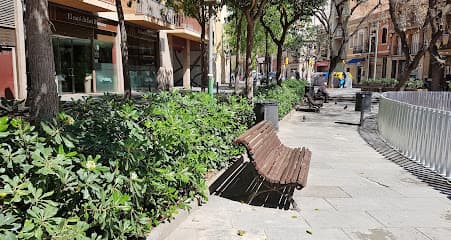
The physical reality of the plaza is, let’s be honest, underwhelming to the casual observer. It’s a functional space. You’ve got your standard-issue Barcelona benches, a few trees struggling against the Mediterranean heat, and the kind of concrete that has seen a thousand scraped knees. But sit there for twenty minutes and the rhythm of the 'real' Barcelona starts to reveal itself. You’ll see the grandmothers in sensible shoes doing their morning rounds, the delivery guys on scooters taking a five-minute breather, and the local kids who don't know or care that they're playing in a space named after a feminist pioneer.
Just a stone’s throw away is the massive Fabra i Coats complex. Once a sprawling textile mill that employed half the neighborhood, it’s now a cavernous cultural center. The shadow of that industrial past looms large over this plaza. You can almost hear the ghost of the factory whistle. This area was built on sweat and solidarity, and while the looms have stopped, that sense of community hasn't quite evaporated yet. It’s one of the few places left in the city where you can hear more Catalan than English, and where the bars still serve a 'quinto' of beer for a price that won't make you weep.
Is it worth the trek out to Sant Andreu? If you want to see the Barcelona that exists when the tourists go home, then yes. If you want to sit in a place that doesn't care if you like it or not, then absolutely. It’s a three-star park in a five-star neighborhood. It’s honest. It’s tired. It’s real. There are no gift shops here. There are no guided tours. There is just the sun hitting the pavement and the weight of a history that belongs to the people who actually live here. Come here to breathe, to people-watch, and to pay a silent respect to a teacher who saw a better future in the eyes of her students. Just don't expect a postcard moment. This is life, not a movie set.
Type
Park
Duration
15-30 minutes
Best Time
Late afternoon when the neighborhood comes alive with locals finishing work and school.
Features
Park
Categories
Urban SquareLocal HistoryFeminist Landmarks
Ticket Prices
Free Admission
No tickets required
Opening Hours
- MondayOpen 24 hours
- TuesdayOpen 24 hours
- WednesdayOpen 24 hours
- ThursdayOpen 24 hours
- FridayOpen 24 hours
- SaturdayOpen 24 hours
- SundayOpen 24 hours
Must-See Highlights
The nearby Fabra i Coats industrial architecture
Local street life and traditional Sant Andreu atmosphere
The commemorative plaque for Montserrat Roca i Baltà
Visitor Tips
Combine a visit here with an exhibition at Fabra i Coats.
Grab a coffee at a nearby 'granja' to experience the local village vibe.
Don't expect tourist facilities; this is a residential area.
Good For
Solo travelersHistory buffsBudget travelersSlow travel enthusiasts
Why Visit
Authentic local atmosphere far from the tourist crowds
Historical connection to Barcelona's progressive educational movement
Proximity to the iconic Fabra i Coats industrial heritage site
Nearby Landmarks
- 3-minute walk from Fabra i Coats - Fàbrica de Creació
- 8-minute walk from Església de Sant Andreu de Palomar
- 10-minute walk from Carrer Gran de Sant Andreu shopping street
Accessibility
- Flat paved surface
- Accessible by wheelchair
- Public benches available
Location
Plaça de Montserrat Roca i Baltà
Sant Andreu, Barcelona
Nearby Hotels
Nearby Restaurants
In Sant Andreu
ATTRACTION
Camsbio,S.L
Sant Andreu
Not a park for picnics, but the workshop where Barcelona’s green future is built. Camsbio is the grit behind the city's vertical gardens and bio-construction.
0.0(0)
Park
ATTRACTION
Multan los Domingos
Sant Andreu
A defiant slice of Sant Andreu where industrial ruins meet community gardens. It’s the anti-tourist Barcelona: raw, brick-heavy, and smelling of vermut and rebellion.
0.0(0)
Garden
ATTRACTION
Plaça d'Albert Badia i Mur
Sant Andreu
A gritty, honest slice of Sant Andreu where the 'Cases Barates' history meets modern life. No Gaudí here—just real people, a playground, and the unvarnished soul of Bon Pastor.
0.0(0)
Park
Frequently Asked Questions
Is Plaça de Montserrat Roca i Baltà worth visiting?
Only if you are interested in authentic neighborhood life and local history. It is a simple urban square, not a major tourist attraction with monuments.
Who was Montserrat Roca i Baltà?
She was a prominent Catalan teacher and feminist activist (1892-1982) who worked in Sant Andreu and fought for progressive education.
What is near the plaza?
The plaza is very close to the Fabra i Coats cultural center, a former textile factory that is now a hub for contemporary art and local events.
How do I get to this part of Sant Andreu?
The easiest way is taking the Metro Line 1 (Red Line) to the Sant Andreu station, which is a short walk from the square.
Reviews
0 reviews for Montserrat Roca i Baltà,
No reviews yet. Be the first to share your experience!