3.9
29 verified reviews
About
Most people come to Barcelona and stay at sea level, shuffling like cattle along the Rambla or fighting for a square inch of sand at Barceloneta. They’re missing the point. To understand this city, you need to get above it, and I don’t mean from the window of some sanitized luxury hotel. You need to climb the hill of Montjuïc until your calves burn and the air starts to smell less like diesel exhaust and more like pine and salt spray. Eventually, you’ll hit the Mirador de l'Alcalde, located at the somewhat confusing address of Mirador de Montjuïc, 1. It’s not a building; it’s a series of stone terraces carved into the side of the mountain, and it’s one of the few places where the city actually lets you see its true face.
The first thing that hits you isn't the view—it’s the floor. Look down. You’re standing on a massive, sprawling mosaic designed by Joan Josep Tharrats. This isn't the delicate, colorful trencadís of Gaudí that you see on every postcard. This is something grittier, more visceral. It’s a collage of industrial detritus: broken ceramic shards, glass bottles, paving stones, and even old machinery parts embedded into the concrete. It’s a reminder that Barcelona is, at its core, a city that builds itself out of its own wreckage. It’s beautiful in a way that feels earned, not manufactured for a brochure.
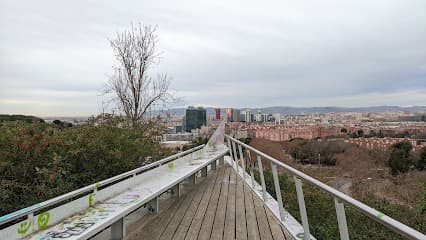
Then you look out, and the scale of the thing knocks the wind out of you. You aren't looking at the Sagrada Família or the Gothic Quarter from here—at least not primarily. You are looking at the Port de Barcelona, the massive, mechanical heart of the Mediterranean. From this height, the giant container ships look like Lego bricks, and the towering yellow cranes look like prehistoric birds picking through the cargo. You see the ferries heading to Mallorca, the cruise ships disgorging their thousands, and the endless movement of a city that never stops trading. It’s an industrial ballet, and from this vantage point, it’s hypnotic. It’s the best view in Barcelona because it doesn't try to hide the gears and the grease that make the city run.
As you stroll through the different levels, you’ll find a massive fountain designed by Carles Buïgas—the same guy who did the Magic Fountain further down the hill. This one is quieter, more contemplative. The water cascades down the stone steps, providing a white-noise soundtrack that drowns out the distant hum of the city below. It’s a place for perspective. You’ll see old men sitting on the stone benches, staring out at the sea with the kind of intensity that suggests they’re counting every wave. You’ll see couples hiding in the shadows of the palms. It’s a public space in the truest sense—no cover charge, no velvet ropes, just a place to exist.
Is it worth the trek? Absolutely. But don't expect a polished, Disney-fied experience. The stone is weathered, the wind can be biting, and the walk up from the Miramar hotel will make you regret that third plate of patatas bravas. But when you stand at the edge of the terrace, with the Mediterranean stretching out to the horizon and the entire machinery of Barcelona laid out at your feet, you’ll realize that this is the only place where the city’s past, present, and future actually make sense. It’s raw, it’s honest, and it’s exactly what you need to clear your head before diving back into the chaos below.
Type
Tourist attraction
Duration
45-60 minutes
Best Time
Late afternoon for the golden hour light over the port, or early morning to avoid the cable car crowds.
What People Say
perspective(2)strolling(2)
Features
Tourist attraction
Categories
ParkViewpointArchitecturePublic Art
Ticket Prices
Free Admission
No tickets required
Opening Hours
- MondayOpen 24 hours
- TuesdayOpen 24 hours
- WednesdayOpen 24 hours
- ThursdayOpen 24 hours
- FridayOpen 24 hours
- SaturdayOpen 24 hours
- SundayOpen 24 hours
Must-See Highlights
The Tharrats mosaic pavement
The ornamental waterfall fountain by Carles Buïgas
The panoramic view of the World Trade Center and cruise ship terminals
Visitor Tips
Bring a bottle of water; there are no shops directly at the viewpoint, though there are kiosks near the cable car station.
The wind can be much stronger here than in the city center, so bring a light jacket even in summer.
Combine this with a visit to the Montjuïc Castle, which is just a short walk further uphill.
Good For
PhotographersBudget travelersCouplesSolo travelers
Why Visit
Tharrats Mosaic Floor: A unique 3,000-square-meter pavement made from recycled glass, ceramics, and industrial parts.
Industrial Port Views: The best vantage point in the city to watch the massive logistics of the Mediterranean's busiest port.
Multi-Level Terracing: A series of distinct gardens and fountains that offer different angles and quiet spots away from crowds.
Nearby Landmarks
- 5-minute walk from Castell de Montjuïc
- 2-minute walk from Telefèric de Montjuïc (Mirador Station)
- 10-minute walk from Jardins de Joan Brossa
- 12-minute walk from Hotel Miramar
Accessibility
- Partial wheelchair access via ramps
- Multiple levels connected by stairs
- Paved pathways
Location
Sants-Montjuïc, Barcelona
Nearby Hotels
Nearby Restaurants
In Sants-Montjuïc
ATTRACTION
Bolets1
Sants-Montjuïc
A gritty, earthy temple to the Catalan obsession with wild mushrooms, where the dirt is real, the fungi are seasonal gold, and the air smells like the damp floor of a Pyrenean forest.
0.0(0)
Tourist attraction
ATTRACTION
Montjuic aparca
Sants-Montjuïc
The unglamorous base camp for your Montjuïc assault. A tactical slab of asphalt where the city's chaos fades into the pine-scented ghosts of the 1992 Olympics.
0.0(0)
Tourist attraction
ATTRACTION
Паркінг Барселона
Sants-Montjuïc
A sprawling slab of industrial reality in the Zona Franca. No Gaudí here—just hot asphalt, diesel fumes, and the honest utility of a secure place to park your rig.
0.0(0)
Park
Frequently Asked Questions
Is Mirador de Montjuïc worth visiting?
Yes, it offers the most honest perspective of Barcelona, combining a unique recycled mosaic floor with an incredible bird's-eye view of the industrial port and the Mediterranean sea.
How do I get to Mirador de l'Alcalde?
You can take the Montjuïc Cable Car (Telefèric) to the 'Mirador' stop, or take the 150 bus from Plaça d'Espanya. For those who don't mind a climb, it's a 15-minute uphill walk from the Miramar hotel.
Is there an entrance fee for the viewpoint?
No, the Mirador de l'Alcalde is a public park and viewpoint that is completely free to enter 24 hours a day.
Reviews
0 reviews for Mirador de Montjuïc,1
No reviews yet. Be the first to share your experience!