4.6
2,527 verified reviews
About
Montjuïc is a massive, brooding presence over Barcelona, a hill that has served as a fortress, a slaughterhouse, and a playground. Most tourists choke the entrance to the castle at the summit, but if you stop just short of the peak, you find the Mirador de l'Alcalde. This isn't some manicured, sterile observation deck designed by a committee to sell keychains. It’s a series of stone terraces carved into the hillside, a place where the city’s ego meets its industrial reality.
The first thing that hits you isn't the horizon; it’s the ground beneath your boots. In the late 1960s, the artist Joan Josep Tharrats was tasked with paving this place, and he did it with the soul of a scavenger. He took broken glass bottles, discarded machinery gears, paving stones, and ceramic shards, and he hammered them into a sprawling, 3,000-square-meter mosaic. It’s punk rock landscaping. You’re literally walking on the recycled guts of 20th-century Barcelona. It’s rough, textured, and infinitely more interesting than the polished marble you’ll find in the Eixample. It’s a reminder that this city was built on sweat and scrap metal before it was built on tourism.
Then you look up, and the view does the talking. While other viewpoints in Barcelona try to hide the industrial sprawl, the Mirador de l'Alcalde leans into it. You get a front-row seat to the Port of Barcelona. You see the massive container ships—beasts of burden painted in primary colors—being unloaded by cranes that look like prehistoric insects. You see the ferries departing for the Balearics and the cruise ships that look like floating hotels. Beyond that, the Mediterranean stretches out like hammered lead. To your left, the city unfolds: the Gothic Quarter’s spires, the jagged towers of the Sagrada Familia, and the silver needle of the Torre de Collserola in the distance. It’s the best views in Barcelona because it’s the most honest ones. You see the beauty and the machinery working in tandem.
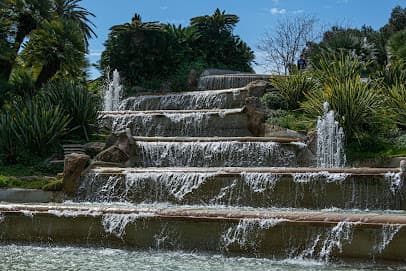
The terraces are connected by a series of cascading fountains designed by Carles Buïgas, the same man responsible for the Magic Fountain down the hill. But here, the water doesn't dance for a crowd; it tumbles quietly over stone lips, providing a white-noise soundtrack that drowns out the distant hum of the city. It’s a place for people who want to think, or for couples who want to hide in plain sight. You’ll see old men sitting on the stone benches, staring at the sea with the kind of intensity that suggests they’re counting every wave. You’ll see kids running across the mosaic, oblivious to the fact that they’re playing on a masterpiece of Catalan modernism.
Getting here is half the point. You can take the Montjuïc Cable Car and hop off at the 'Mirador' station, or you can sweat it out on the walk up from the Miramar gardens. If you’re feeling lazy or cheap, the 150 bus will drop you nearby. There is no admission fee, no turnstiles, and no one trying to sell you a selfie stick. It’s one of the few places left on the mountain that feels like it belongs to the people who live here.
Is it worth it? If you want the sanitized, high-altitude version of Barcelona, go to Tibidabo. But if you want to feel the salt air, see the city’s working heart, and walk on a floor made of history’s leftovers, this is the spot. It’s quiet, it’s slightly weathered, and it’s absolutely essential for anyone trying to understand what makes this city tick. Come at sunset when the light hits the port and turns the industrial cranes into silhouettes. It’s a moment of clarity in a city that’s often too loud for its own good.
Type
Observation deck, Tourist attraction
Duration
45-60 minutes
Best Time
Sunset for the best lighting over the port and city skyline.
What People Say
montjuïc(31)sea(28)gardens(24)cable car(16)bus(12)barcelona(11)castle(10)fountain(9)
Features
Observation deck
Tourist attraction
Categories
ParkArchitecturePhotography
Ticket Prices
Free Admission
No tickets required
Opening Hours
- MondayOpen 24 hours
- TuesdayOpen 24 hours
- WednesdayOpen 24 hours
- ThursdayOpen 24 hours
- FridayOpen 24 hours
- SaturdayOpen 24 hours
- SundayOpen 24 hours
Must-See Highlights
The Tharrats Mosaic pavement made of recycled glass and iron
The ornamental waterfall fountain by Carles Buïgas
The view of the W Hotel and the industrial shipping containers
The sundial located on the upper terrace
Visitor Tips
Bring a bottle of wine and some snacks; there are plenty of stone benches but few nearby shops.
Look closely at the ground—you can find old gears and bottle bottoms embedded in the art.
Combine this with a visit to the Mossèn Costa i Llobera cactus garden nearby for a full Montjuïc afternoon.
The 150 bus is a much cheaper way to reach the viewpoint than the cable car.
Good For
Budget travelersPhotographersCouplesFamiliesArchitecture enthusiasts
Why Visit
Recycled mosaic pavement by artist Joan Josep Tharrats
Unobstructed panoramic views of the industrial port and Mediterranean
Tiered garden terraces with ornamental fountains by Carles Buïgas
Nearby Landmarks
- 5-minute walk from Montjuïc Castle
- 2-minute walk from Montjuïc Cable Car (Mirador station)
- 10-minute walk from Joan Brossa Gardens
- 12-minute walk from Mossèn Costa i Llobera Garden
Accessibility
- Ramped access between some levels
- Paved paths
- Accessible by public bus (Line 150)
Location
Ctra. de Montjuïc, 43
Sants-Montjuïc, Barcelona
Nearby Hotels
Nearby Restaurants
In Sants-Montjuïc
ATTRACTION
Bolets1
Sants-Montjuïc
A gritty, earthy temple to the Catalan obsession with wild mushrooms, where the dirt is real, the fungi are seasonal gold, and the air smells like the damp floor of a Pyrenean forest.
0.0(0)
Tourist attraction
ATTRACTION
Montjuic aparca
Sants-Montjuïc
The unglamorous base camp for your Montjuïc assault. A tactical slab of asphalt where the city's chaos fades into the pine-scented ghosts of the 1992 Olympics.
0.0(0)
Tourist attraction
ATTRACTION
Паркінг Барселона
Sants-Montjuïc
A sprawling slab of industrial reality in the Zona Franca. No Gaudí here—just hot asphalt, diesel fumes, and the honest utility of a secure place to park your rig.
0.0(0)
Park
Frequently Asked Questions
Is Mirador de l'Alcalde worth visiting?
Absolutely. It offers some of the most expansive and honest views of Barcelona's port and coastline for free, without the crowds of the nearby castle.
How do I get to Mirador de l'Alcalde?
Take the 150 bus from Plaça d'Espanya or the Montjuïc Cable Car to the 'Mirador' stop. You can also walk up from the Miramar gardens if you're up for a climb.
Do I need tickets for Mirador de l'Alcalde?
No, it is a public park and admission is completely free. You only pay if you choose to arrive via the cable car.
What is the best time to visit?
Late afternoon or sunset is best. The light over the Mediterranean and the industrial port is spectacular, and the temperatures are cooler.
Reviews
0 reviews for Mirador de l'Alcalde
No reviews yet. Be the first to share your experience!