4.5
3,110 verified reviews
About
If you’re looking for the melting-clock whimsy of Gaudí or the Gothic Quarter’s damp, medieval shadows, you’re in the wrong place. The Mies van der Rohe Pavilion is a surgical strike of logic in a city often drunk on its own ornamentation. It is a building that shouldn't exist, a ghost that was torn down in 1930 and willed back into reality by architects who realized that the world had lost something essential. It’s the ultimate 'less is more' pilgrimage site, and even if you don't know a cantilever from a coat hanger, the sheer, cold-blooded elegance of the place will hit you in the gut.
Originally built as the German Pavilion for the 1929 Barcelona International Exposition, this wasn't meant to be a house or a museum. It was a statement. Ludwig Mies van der Rohe and Lilly Reich—who often gets unfairly edited out of the credits—designed it to show the world that Germany was modern, transparent, and done with the heavy, imperial bullshit of the past. They used glass, steel, and four distinct types of stone: Roman travertine, green Alpine marble, ancient green marble from Greece, and a massive, honey-colored slab of golden onyx from the Atlas Mountains. That onyx slab wasn't just a choice; it was a find. Mies saw it in a stone yard and redesigned the dimensions of the pavilion just to fit the size of the rock. That’s the kind of obsessive madness I can get behind.
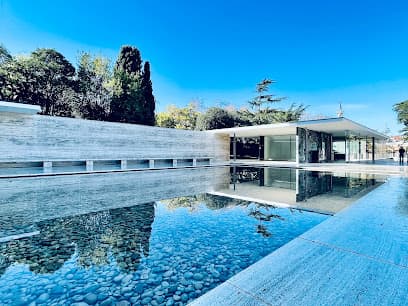
Walking through the pavilion is an exercise in silence. There are no doors to slam, no ornate ceilings to crane your neck at. The walls don't so much enclose space as they suggest it. You move between the reflecting pools—one large and expansive, the other small and tucked away—where the water acts as a mirror for the sky and the stone. In the smaller pool stands 'Alba' (Dawn), a bronze sculpture by Georg Kolbe. She’s a solitary figure, arms raised, trapped in a courtyard of green marble. It’s haunting, beautiful, and completely devoid of the usual tourist-trap sentimentality.
Then there’s the furniture. You’ve seen the Barcelona Chair in every high-end law firm and 'minimalist' bachelor pad on the planet, but this is where they were born. They were designed specifically for the King and Queen of Spain to sit on during the exposition. They are essentially modern thrones—white leather and chrome, looking as fresh today as they did nearly a century ago. It’s a reminder that truly good design doesn't age; it just waits for the rest of the world to catch up.
Is the Mies van der Rohe Pavilion worth it? If you want a 'feast for the senses' with churros and buskers, no. But if you want to see what happens when human beings stop trying to decorate and start trying to achieve perfection, then yes. It’s a palate cleanser for the soul. It’s quiet, it’s stark, and it’s arguably the most important building in Barcelona that doesn't have a single gargoyle on it. Come here when the sun is low, the shadows are long, and the crowds at the nearby Magic Fountain are somewhere else. Just stand there and breathe in the travertine. It’s as close to a religious experience as you’ll get in a building made of straight lines.
Type
Museum, Tourist attraction
Duration
45 minutes
Best Time
Late afternoon for the best light reflections on the marble and water.
Guided Tours
Available
What People Say
modern architecture(121)ludwig mies van der rohe(52)1929(52)minimalist(40)world fair(32)architecture and history(23)montjuic(18)gaudi(12)
Features
Museum
Tourist attraction
Categories
ArchitectureModernism
Ticket Prices
adult€8
childFree
senior€4
Opening Hours
- Monday4 to 6 PM
- Tuesday10 AM to 6 PM
- Wednesday10 AM to 6 PM
- Thursday10 AM to 6 PM
- Friday10 AM to 6 PM
- Saturday10 AM to 6 PM
- Sunday10 AM to 6 PM
Must-See Highlights
The golden onyx wall in the main hall
The Georg Kolbe 'Alba' statue in the small pool
The original-style Barcelona Chairs
The specialized architecture bookstore
Visitor Tips
Check the website for 'interventions'—temporary art installations that occasionally change the space.
The bookstore is one of the best in the city for design nerds.
Visit on the first Sunday of the month for free entry.
Good For
Architecture enthusiastsDesignersPhotography loversSolo travelers
Why Visit
The birthplace of the iconic Barcelona Chair
A rare reconstruction of a lost 1929 masterpiece
Exquisite use of rare golden onyx and Alpine marble
Nearby Landmarks
- 3-minute walk from the Magic Fountain of Montjuïc
- 5-minute walk from the Museu Nacional d'Art de Catalunya (MNAC)
- 5-minute walk from Poble Espanyol
Accessibility
- Fully accessible for wheelchairs via ramps
Location
Av. de Francesc Ferrer i Guàrdia, 7
Sants-Montjuïc, Barcelona
Nearby Hotels
Nearby Restaurants
In Sants-Montjuïc
ATTRACTION
Bolets1
Sants-Montjuïc
A gritty, earthy temple to the Catalan obsession with wild mushrooms, where the dirt is real, the fungi are seasonal gold, and the air smells like the damp floor of a Pyrenean forest.
0.0(0)
Tourist attraction
ATTRACTION
Montjuic aparca
Sants-Montjuïc
The unglamorous base camp for your Montjuïc assault. A tactical slab of asphalt where the city's chaos fades into the pine-scented ghosts of the 1992 Olympics.
0.0(0)
Tourist attraction
ATTRACTION
Паркінг Барселона
Sants-Montjuïc
A sprawling slab of industrial reality in the Zona Franca. No Gaudí here—just hot asphalt, diesel fumes, and the honest utility of a secure place to park your rig.
0.0(0)
Park
Frequently Asked Questions
Is the Mies van der Rohe Pavilion worth visiting?
Yes, if you have any interest in design or architecture. It is a masterclass in minimalism and provides a quiet, contemplative break from the more crowded, ornate sights of Barcelona.
How much are tickets for the Mies van der Rohe Pavilion?
General admission is €8, with reduced rates of €4 for students and seniors. Children under 16 enter for free.
How long do you need at the Barcelona Pavilion?
It is a small site. Most visitors spend 30 to 60 minutes exploring the structure, the pools, and the bookstore.
Can you take photos at the Mies van der Rohe Pavilion?
Yes, photography for personal use is allowed and highly encouraged given the stunning reflections and materials, but professional equipment may require a permit.
Reviews
0 reviews for Mies van der Rohe Pavilion
No reviews yet. Be the first to share your experience!