5.0
3 verified reviews
About
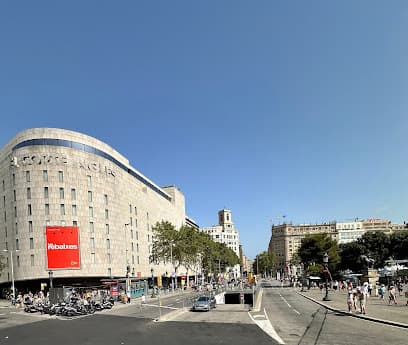
Stand at the intersection of Passeig de Gràcia and Avinguda Diagonal, and you’ll feel the tectonic plates of Barcelona shifting beneath your boots. This is the 'Cinc d'Oros,' the Five of Gold, a junction that has seen more history, more protests, and more exhaust fumes than almost anywhere else in the city. And right there, rising out of the pavement like a minimalist middle finger to the ornate Gaudí curves down the street, is the 'M.'
Formally known as the 'Homenatge a la Mutua Madrileña,' this 12-meter-high stainless steel sculpture by Valencian artist Andreu Alfaro is the kind of thing most tourists blow past on their way to a scheduled date with a gargoyle. That’s a mistake. In a city obsessed with the organic, the melting, and the medieval, the 'M' is a cold, hard reminder of the modern world. It’s industrial, it’s corporate, and it’s strangely beautiful when the Mediterranean sun hits those steel tubes, turning the whole thing into a blinding beacon of light.
To understand the 'M,' you have to understand the ground it stands on. This site has been a tug-of-war for Spanish identity for a century. For decades, a massive stone pillar known as 'The Pencil' stood here, topped with a statue of Victory to celebrate the end of the Civil War. Before that, it was a tribute to the Republic. The 'M' arrived in the late 90s as part of the city's ongoing effort to scrub away the ghosts of the past with something abstract—something that doesn't take sides in the old blood-soaked arguments of the 20th century. Alfaro’s work consists of fourteen stainless steel tubes that fan out with mathematical precision, creating a sense of dynamic movement and rhythm that shifts as you walk around it.
The name 'Cinc d'Oros' itself is a piece of local lore, referring to the five ornate lampposts that once occupied the space, arranged like the five of gold in a deck of Spanish playing cards. Today, it’s a crossroads of commerce and culture. To your south, you have the world-class shopping of Passeig de Gràcia, where people drop a month's rent on a leather handbag without blinking. To your north, the Jardinets de Gràcia lead you into a neighborhood that still feels like a fiercely independent village, where people actually live, argue in the plazas, and drink vermouth at noon.
The 'M' sits at the foot of the Jardinets de Gràcia, officially the Jardins de Salvador Espriu. It acts as a silent, silver anchor in the middle of the urban chaos. Barcelona isn't just a museum of the 19th century; it's a living, breathing entity that occasionally needs a sharp, metallic edge to keep things honest. Grab a coffee from a nearby cafe, find a spot on a stone bench, and watch the relentless flow of the Diagonal swirl around this minimalist monument. It’s the perfect place to watch the city transition from its polished, bourgeois exterior to its gritty, poetic heart.
Type
Park
Features
Park
Location
Pg. de Gràcia
Eixample, Barcelona
In Eixample
ATTRACTION
Mural Margalef
Eixample
A towering splash of Mediterranean blue breaking the rigid geometry of Eixample, Joan Margalef’s mural is a visceral reminder that Barcelona’s soul isn't just in its museums.
0.0(0)
Tourist attraction
ATTRACTION
Mural Margalef
Eixample
A geometric middle finger to urban decay, this massive kinetic mural by Eduard Margalef turns a drab Eixample blind wall into a rhythmic, shifting explosion of optical art.
0.0(0)
Tourist attraction
ATTRACTION
Happy Foodies
Eixample
Forget the plastic-wrapped tourist traps; this is a deep dive into the grease, garlic, and soul of Catalan cooking where you actually learn to handle a knife and a porrón.
0.0(0)
Sightseeing tour agencyTour agency
Reviews
0 reviews for M
No reviews yet. Be the first to share your experience!