3.7
89 verified reviews
About
Look, if you’re coming to Barcelona to tick boxes off a list written by some glossy magazine, you’re in the wrong place. Sant Andreu doesn’t care about your itinerary. It’s a neighborhood that smells like laundry detergent, toasted sandwiches, and honest work, not overpriced sangria and tourist desperation. Tucked away on Carrer de Garcilaso is a place called the Jardins de Virginia Woolf. It’s an 'interior d’illa'—one of those clever Barcelona tricks where they reclaim the hollowed-out guts of a residential block and turn it into a public lung.
There’s a certain irony in naming this place after Woolf. The woman famously argued for a room of one’s own, a private sanctuary for the mind. Instead, she got a communal backyard where the primary soundtrack is the rhythmic thwack of a football against a fence and the high-pitched negotiations of toddlers over a shared plastic shovel. But maybe she’d appreciate it. It’s a space for the people who actually live here, a reprieve from the relentless stone and asphalt of the city outside.
The walk from the Congrés metro station is a lesson in urban transition. You leave behind the roar of Avinguda Meridiana—a river of steel and exhaust—and slip into the side streets where the pace slows to a crawl. This is the heart of the Congrés i els Indians neighborhood, a place where the architecture tells stories of mid-century expansion and the stubborn survival of community. When you finally step through the entrance of the Jardins, the silence hits you first. It’s not a total silence, but a filtered one. The surrounding apartment blocks act as a sound barrier, turning the city’s cacophony into a distant hum.
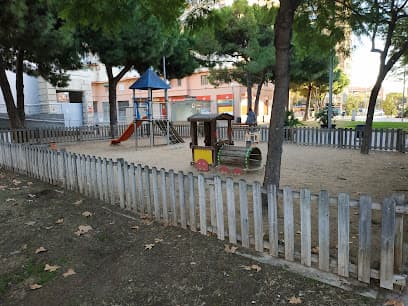
Before it was a park, this was the site of the Talleres Garcilaso, an industrial workshop. You can still feel that ghost of utility in the layout. It’s not a sprawling meadow; it’s a functional, paved, and planted square of sanity. The design is typical of the city’s push to ensure every resident has a green space within 200 meters of their front door. It’s got the standard-issue Barcelona benches—those sturdy, wooden slats that have hosted a million arguments and just as many afternoon naps—and a playground that serves as the social headquarters for the local parents.
Look closely at the greenery. It’s not the manicured perfection of Versailles. It’s hardy, Mediterranean flora designed to survive the trampling of feet and the occasional stray ball. There are poplars and shrubs that provide just enough shade to make a July afternoon bearable. You’ll see the 'avis'—the grandfathers—sitting in rows, their canes leaning against the benches, debating the state of the world or the local football scores with a gravity usually reserved for UN summits. This is their living room. In a city increasingly sold off to the highest bidder, these interior gardens are a defiant stand for the right to exist without buying a ticket.
Coming here isn't about 'sightseeing' in the traditional sense. There are no grand monuments, no t-shirt shops, and nobody is going to try to sell you a selfie stick. You come here to see the city with its guard down. You watch the elderly residents reclaim their morning sun, the teenagers brooding on the edges of the play area, and the light filtering through the trees in a way that makes the surrounding apartment blocks look almost poetic. It’s a reminder that a city isn't just its cathedrals and museums; it’s the small, quiet gaps in between where life actually happens.
Is it worth the trek? If you’re staying in the center and only have forty-eight hours, probably not. But if you’re the kind of traveler who finds beauty in the mundane, who wants to understand the rhythm of a real Barcelona barrio, then grab a coffee from a nearby bar, find a spot in the shade, and just sit. It’s a room of one’s own, shared with several hundred neighbors. Woolf might have found that funny.
Type
Park
Duration
30-60 minutes
Best Time
Late afternoon when the neighborhood comes alive with families and the sun hits the interior courtyard.
What People Say
kids(8)bank(2)strolling(2)space(2)
Features
Park
Categories
PlaygroundUrban GardenLocal Life
Ticket Prices
Free Admission
No tickets required
Opening Hours
- MondayOpen 24 hours
- TuesdayOpen 24 hours
- WednesdayOpen 24 hours
- ThursdayOpen 24 hours
- FridayOpen 24 hours
- SaturdayOpen 24 hours
- SundayOpen 24 hours
Must-See Highlights
The children's play area which is the heart of the park
The industrial-era layout reflecting its past as a workshop site
The quiet residential architecture surrounding the garden
Visitor Tips
Pick up a pastry at a local bakery on Carrer de Garcilaso before heading in.
Don't expect a 'park' in the forest sense; this is an urban plaza with greenery.
Respect the neighbors; sound echoes loudly in these interior courtyards.
Good For
Families with young childrenSlow travelersArchitecture enthusiastsBudget travelers
Why Visit
Authentic 'Interior d'Illa' experience inside a residential block
Named after Virginia Woolf as part of a city-wide feminist naming initiative
A peaceful, car-free sanctuary in the heart of the Sant Andreu district
Nearby Landmarks
- 5-minute walk from Canòdrom - Creative Research Park
- 3-minute walk from Plaça del Congrés Eucarístic
- 10-minute walk from Fabra i Coats: Centre d'Art Contemporani
Accessibility
- Flat paved surfaces
- Wheelchair accessible entrance
- Accessible seating
Location
Carrer de Garcilaso, 85
Sant Andreu, Barcelona
Nearby Hotels
Nearby Restaurants
In Sant Andreu
ATTRACTION
Camsbio,S.L
Sant Andreu
Not a park for picnics, but the workshop where Barcelona’s green future is built. Camsbio is the grit behind the city's vertical gardens and bio-construction.
0.0(0)
Park
ATTRACTION
Multan los Domingos
Sant Andreu
A defiant slice of Sant Andreu where industrial ruins meet community gardens. It’s the anti-tourist Barcelona: raw, brick-heavy, and smelling of vermut and rebellion.
0.0(0)
Garden
ATTRACTION
Plaça d'Albert Badia i Mur
Sant Andreu
A gritty, honest slice of Sant Andreu where the 'Cases Barates' history meets modern life. No Gaudí here—just real people, a playground, and the unvarnished soul of Bon Pastor.
0.0(0)
Park
Frequently Asked Questions
Is Jardins de Virginia Woolf worth visiting?
It's not a major tourist attraction. Visit only if you are exploring the Sant Andreu neighborhood or need a quiet, local spot for kids to play away from traffic.
What is there to do at Jardins de Virginia Woolf?
The park features a children's playground, several benches for sitting, and a small green area. It is primarily a space for relaxation and local neighborhood life.
How do I get to Jardins de Virginia Woolf?
The easiest way is via Metro Line 5 (Blue Line), getting off at the Congrés station. From there, it's a short 5-minute walk down Carrer de Garcilaso.
Are there any entrance fees?
No, admission is completely free as it is a public municipal park managed by the Barcelona City Council.
Reviews
0 reviews for Jardins de Virginia Woolf
No reviews yet. Be the first to share your experience!