4.5
2,522 verified reviews
About
Most people come to Montjuïc for the big, loud stuff. They want the Magic Fountain’s neon water show or the hulking authority of the MNAC museum. But if you have any sense, or if the humidity is starting to feel like a wet wool blanket, you turn away from the crowds and slip into the Jardins de Laribal. This isn’t the Barcelona of Gaudí’s fever dreams; it’s something older, cooler, and infinitely more disciplined. It’s a Mediterranean masterclass in how to handle the sun.
Designed for the 1929 International Exposition by Jean-Claude Nicolas Forestier and Nicolau Maria Rubió i Tudurí, these gardens were built to prove that Barcelona could do elegance without the histrionics. Forestier wasn’t looking at the industrial north for inspiration; he was looking south, toward the Alhambra in Granada. He understood that in a city this hot, water shouldn't just be looked at—it should be heard. He built the Escalera del Generalife, a series of stairs where water flows down the banisters in tiled channels. You can walk up the middle of it, the sound of the stream flanking you, cutting through the heavy afternoon air like a cold blade.
As you climb the terraces, the city starts to disappear. The noise of the traffic on Avinguda de l'Estadi is swallowed by thick groves of cypress, orange trees, and ivy. You’ll stumble across the Font del Gat, a fountain and a building that’s been a local legend for a century. There’s a famous Catalan song about a chef and a maid meeting here, but forget the folklore—the reality is a quiet, stone-carved cat’s head trickling water into a basin. It was once the clubhouse for the 'Colla de l'Arròs,' a group of local bigwigs who came up here to eat rice and escape their responsibilities. You can still feel that ghost of leisure hanging in the air.
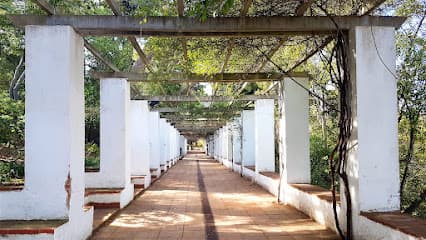
This is one of the best gardens in Barcelona because it doesn't try too hard. It’s a place of geometry and shade. The pergolas are heavy with wisteria, and the brickwork is worn smooth by decades of people looking for a place to hide. There are small, secluded squares with benches where you can sit and watch the light filter through the leaves, hitting the blue and white 'azulejo' tiles that define the park’s aesthetic. It’s tactile, earthy, and smells of wet stone and pine needles.
Is it perfect? No. The stairs will punish your knees, and if you’re looking for a manicured, plastic-wrapped tourist experience, you’ll be disappointed. Some of the corners are overgrown, and the signage is indifferent at best. But that’s the point. It’s a real place, a lung for the city that hasn't been completely sterilized for the Instagram hordes. It’s where you go when you’re tired of being a tourist and just want to be a human being again, sitting in the shade, listening to the water, and waiting for the sun to drop behind the hill. If you're looking for things to do on Montjuïc that don't involve standing in a line, this is your sanctuary. It’s free, it’s quiet, and it’s honest. In a city that’s increasingly sold by the slice, Laribal is a rare, whole thing.
Type
Garden, Tourist attraction
Duration
1-2 hours
Best Time
Late afternoon when the sun is lower and the shadows stretch across the terraces, or spring when the roses are in full bloom.
What People Say
montjuic(73)peaceful(27)strolling(25)stairs(24)fountain(20)museum(14)waterfalls(13)shadow(13)
Features
Garden
Tourist attraction
Categories
Landscape ArchitectureBotanical GardenHistoric Site
Ticket Prices
Free Admission
No tickets required
Opening Hours
- Monday10 AM to 9 PM
- Tuesday10 AM to 9 PM
- Wednesday10 AM to 9 PM
- Thursday10 AM to 9 PM
- Friday10 AM to 9 PM
- Saturday10 AM to 9 PM
- Sunday10 AM to 9 PM
Must-See Highlights
The water channels running down the handrails of the Generalife stairs
The stone cat fountain at Font del Gat
The view of the city framed by cypress trees from the upper terraces
The tiled benches in the secluded 'patios'
Visitor Tips
Wear shoes with good grip; the stone stairs can be slippery when damp.
Bring water, as there are few places to buy drinks once you are deep inside the garden terraces.
Combine this with a visit to the nearby Teatre Grec for a full afternoon of quiet exploration.
Good For
CouplesPhotography enthusiastsSolitude seekersBudget travelers
Why Visit
Escalera del Generalife: A stunning water-staircase inspired by the Alhambra in Granada.
Font del Gat: A historic 19th-century fountain and building tied to local Catalan folklore.
The Rose Garden: Home to the 'Colla de l'Arròs' rose garden, the first public rose garden in the city.
Nearby Landmarks
- 5-minute walk from Fundació Joan Miró
- 8-minute walk from Museu Nacional d'Art de Catalunya (MNAC)
- 3-minute walk from Teatre Grec
- 10-minute walk from Olympic Stadium
Accessibility
- Limited accessibility due to steep terrain
- Many stairs and uneven stone paths
- Accessible entry points available at the top near Avinguda de l'Estadi
Location
Passeig de Santa Madrona, 2
Sants-Montjuïc, Barcelona
Nearby Hotels
Nearby Restaurants
In Sants-Montjuïc
ATTRACTION
Bolets1
Sants-Montjuïc
A gritty, earthy temple to the Catalan obsession with wild mushrooms, where the dirt is real, the fungi are seasonal gold, and the air smells like the damp floor of a Pyrenean forest.
0.0(0)
Tourist attraction
ATTRACTION
Montjuic aparca
Sants-Montjuïc
The unglamorous base camp for your Montjuïc assault. A tactical slab of asphalt where the city's chaos fades into the pine-scented ghosts of the 1992 Olympics.
0.0(0)
Tourist attraction
ATTRACTION
Паркінг Барселона
Sants-Montjuïc
A sprawling slab of industrial reality in the Zona Franca. No Gaudí here—just hot asphalt, diesel fumes, and the honest utility of a secure place to park your rig.
0.0(0)
Park
Frequently Asked Questions
Is Jardins de Laribal worth visiting?
Absolutely, especially if you want to escape the crowds. It offers some of the most peaceful, shaded terraces in Barcelona with beautiful Moorish-inspired water features and zero entry cost.
How do I get to Jardins de Laribal?
Take the Funicular de Montjuïc from Paral·lel metro station, then it's a short walk from the top station. Alternatively, take the 150 or 55 bus which stops right near the entrance on Avinguda de l'Estadi.
Is there an entrance fee for the gardens?
No, admission to the Jardins de Laribal is completely free, making it one of the best budget-friendly attractions on Montjuïc hill.
Is the garden accessible for people with limited mobility?
It is challenging. The garden is built on a steep hillside with many stairs, including the famous Escalera del Generalife. While some upper sections are flatter, the core experience involves significant climbing.
Reviews
0 reviews for Jardins de Laribal
No reviews yet. Be the first to share your experience!