3.7
195 verified reviews
About
The Eixample is a beautiful, relentless machine. It’s a grid of octagonal blocks designed by Ildefons Cerdà to be a utopian vision of light and air, but in the century since, it’s mostly become a high-rent canyon of traffic and exhaust. If you want to see where the machine breaks down—where the people who actually live here find a moment to breathe without a Vespa buzzing in their ear—you have to look behind the facades. You have to find the 'interiors d’illa.'
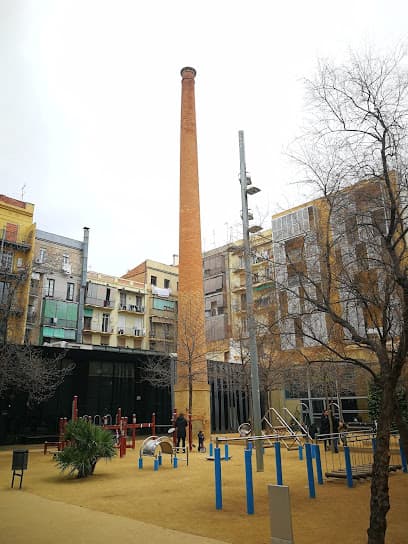
Jardins de Càndida Pérez is one of these reclaimed spaces, a concrete and gravel sanctuary carved out of the center of a block in the Sant Antoni neighborhood. It’s not 'pretty' in the way a travel brochure wants things to be. There are no manicured rose bushes or marble fountains here. Instead, you get the raw, functional reality of Barcelona neighborhood life. It’s a space shared by the Biblioteca Sant Antoni - Joan Oliver, a striking piece of modern architecture that straddles the entrance like a glass-and-steel gateway, and the locals who treat this place like their collective backyard.
Walk through the passage under the library and the decibel level drops instantly. The air feels different—cooler, stiller, smelling faintly of damp earth and old paper. This is one of the best parks in Eixample for witnessing the city's generational hand-off. On one side, you’ve got the petanque courts. This is the domain of the neighborhood elders, men who have lived through transitions of power and fashion, now focused entirely on the trajectory of a metal ball across the dirt. They don’t care about your Instagram feed. They care about the score.
On the other side, it’s pure chaos. The playground is a magnet for the local kids who spill out of the surrounding apartments. It’s a cacophony of Catalan and Spanish, the sound of childhood in a city where private garden space is a luxury for the few. If you're hunting for things to do in Sant Antoni, Barcelona that don't involve twenty-euro gin and tonics, sitting on a bench here to watch the world go by is a solid start.
The gardens are named after Càndida Pérez, a famous cupletista and composer who once filled the theaters of the nearby Paral·lel with her voice. There’s a certain poetic justice in naming this quiet retreat after a woman who lived her life in the spotlight. It’s a reminder that even in a city as loud and performative as Barcelona, there is a desperate need for the wings—the places where you can step off-stage and just exist.
Is it worth visiting? If you’re a tourist looking for Gaudí-esque whimsy, probably not. You’ll find the concrete walls and the proximity of the surrounding apartment balconies too intrusive. But if you want to understand the 'interior d’illa' concept—the lungs of the Eixample—this is a textbook example. It’s an honest place. It’s where people read books they borrowed from the library next door, where dogs sniff the few patches of green, and where the city’s frantic energy finally hits a wall. It’s a slice of the real Barcelona, tucked away behind the laundry lines and the limestone, and it doesn't owe you a thing.
Type
Park
Duration
30-60 minutes
Best Time
Late afternoon when the library is active and the neighborhood comes alive with families and petanque players.
What People Say
for children(25)library(9)games(9)bank(4)petanque(2)slide(2)swings(2)
Features
Park
Categories
Urban GardenPlaygroundArchitectureLocal Culture
Ticket Prices
Free Admission
No tickets required
Opening Hours
- Monday9 AM to 9 PM
- Tuesday9 AM to 9 PM
- Wednesday9 AM to 9 PM
- Thursday9 AM to 9 PM
- Friday9 AM to 9 PM
- Saturday9 AM to 9 PM
- Sunday9 AM to 9 PM
Must-See Highlights
The glass architecture of the Joan Oliver Library
The petanque courts at the rear of the garden
The 'interior d'illa' perspective looking up at the surrounding apartment balconies
Visitor Tips
Enter through the library passage for the most dramatic architectural experience.
Check the library hours if you plan to use their facilities or restrooms.
It can get very crowded with school children around 4:30 PM on weekdays.
Good For
Families with childrenBudget travelersArchitecture enthusiastsSolo travelers looking for a quiet spot
Why Visit
Integrated Library Access: The garden is physically connected to the Biblioteca Sant Antoni - Joan Oliver, making it a perfect spot for outdoor reading.
Authentic 'Interior d'Illa': One of the best examples of Ildefons Cerdà’s original vision for green spaces inside Eixample blocks.
Local Petanque Culture: A genuine hub for neighborhood elders playing traditional boules, offering a glimpse into local social life.
Nearby Landmarks
- Mercat de Sant Antoni (5-minute walk)
- Avinguda del Paral·lel (4-minute walk)
- Manso Health Center (2-minute walk)
- Plaça de la Universitat (12-minute walk)
Accessibility
- Wheelchair accessible entrance
- Flat paved pathways
- Accessible from the library
Location
Rda. de Sant Pau, 67X
Eixample, Barcelona
Nearby Hotels
Nearby Restaurants
In Eixample
ATTRACTION
Mural Margalef
Eixample
A towering splash of Mediterranean blue breaking the rigid geometry of Eixample, Joan Margalef’s mural is a visceral reminder that Barcelona’s soul isn't just in its museums.
0.0(0)
Tourist attraction
ATTRACTION
Mural Margalef
Eixample
A geometric middle finger to urban decay, this massive kinetic mural by Eduard Margalef turns a drab Eixample blind wall into a rhythmic, shifting explosion of optical art.
0.0(0)
Tourist attraction
ATTRACTION
Happy Foodies
Eixample
Forget the plastic-wrapped tourist traps; this is a deep dive into the grease, garlic, and soul of Catalan cooking where you actually learn to handle a knife and a porrón.
0.0(0)
Sightseeing tour agencyTour agency
Frequently Asked Questions
Is Jardins de Càndida Pérez worth visiting?
It is worth it if you want to see a genuine neighborhood space away from the tourist crowds. It's a functional community garden, not a scenic landmark, perfect for a quiet break or seeing how locals live.
How do I get to Jardins de Càndida Pérez?
The easiest way is via the Sant Antoni Metro station (L2). The entrance is located on Ronda de Sant Pau, often accessed through the passage under the Joan Oliver Library.
What is there to do at Jardins de Càndida Pérez?
You can visit the adjacent public library, use the children's playground, watch locals play petanque, or simply enjoy a quiet place to read on one of the many benches.
Is there an entrance fee for the gardens?
No, entry to the Jardins de Càndida Pérez is completely free as it is a public municipal space.
Reviews
0 reviews for Jardins de Càndida Pérez
No reviews yet. Be the first to share your experience!