4.6
196 verified reviews
About
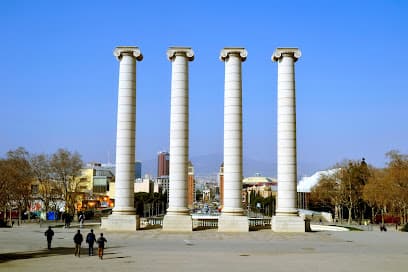
In 1928, a man named Miguel Primo de Rivera—a dictator with a thin skin and a deep-seated hatred for anything that smelled of Catalan autonomy—ordered these columns to be ground into dust. He didn’t just want them gone; he wanted the memory of what they represented erased from the map. They were four Ionic columns, designed by the legendary Josep Puig i Cadafalch in 1919, meant to represent the four red stripes of the Senyera, the Catalan flag. To the regime, they were a provocation. So, they tore them down a year before the 1929 International Exposition, hoping the world wouldn’t notice the gap in the skyline.
But Barcelona has a long memory and a stubborn streak that borders on the pathological. For over eighty years, there was a void here, right in front of where the Magic Fountain now sits dry and silent, a victim of the city's ongoing drought protocols. It wasn’t until 2010 that the city finally put them back. Standing there today, Les Quatre Columnes (The Four Columns) aren’t just architectural flourishes; they are a resurrected ghost, a quiet but firm 'we are still here' directed at anyone who ever tried to say otherwise.
When you walk up from Plaça d'Espanya, past the twin Venetian towers that look like they were lifted straight from St. Mark’s Square, the scale of the place hits you. This is the grand entrance to Montjuïc, a hill that has seen more blood, sweat, and Olympic glory than most cities see in a millennium. The columns stand twenty meters high, made of stone that looks a little too clean, a little too 'new' compared to the weathered Palau Nacional sitting behind them. That’s the thing about reconstructions—they lack the physical scars of the original, but they carry a different kind of weight. They represent a choice to remember.
Standing between the pillars, you get one of the best views in Sants-Montjuïc. To your back is the Museu Nacional d'Art de Catalunya (MNAC), a massive neo-Baroque palace that houses a thousand years of art. In front of you, the ground drops away toward the Font Màgica. If you’re here during the day, it’s a stark, shadowless expanse filled with people trying to find the right angle for a selfie. It’s loud, it’s bright, and it’s undeniably a tourist hub. But if you come here at dusk, when the light turns that bruised purple color and the city lights begin to bleed into the horizon, the columns take on a different character. They become silhouettes, framing the city below like a stage set.
Is it worth visiting? If you’re just looking for a pretty photo, sure, it’s got that. But if you care about the soul of this city, you need to understand that these aren’t just rocks. They are a testament to the fact that you can destroy a building, but you can’t kill an idea. The columns are a reminder that Barcelona is a city built on layers of resistance. It’s a place that was bombed, occupied, and suppressed, yet it keeps rebuilding itself, stone by stubborn stone.
Don’t just breeze past them on your way to the Palau Nacional. Stop for a second. Look at the way they frame the horizon. Think about the guys who had to haul the original stones away in the middle of the night because a general was scared of four stripes. It’s a lesson in the futility of trying to bury culture. In the end, the columns are back, and the dictator is a footnote. That’s a win in my book.
Type
Sculpture, Tourist attraction
Duration
15-30 minutes
Best Time
At sunset, when the light hits the stone and the city lights begin to flicker on below, offering the best silhouette of the pillars.
What People Say
fountains(12)symbol(9)dictatorship(8)history(8)1919(5)1928(4)miguel primo de rivera(3)barcelona(3)
Features
Sculpture
Tourist attraction
Categories
HistorySculptureCatalan CultureArchitecture
Ticket Prices
Free Admission
No tickets required
Opening Hours
- MondayOpen 24 hours
- TuesdayOpen 24 hours
- WednesdayOpen 24 hours
- ThursdayOpen 24 hours
- FridayOpen 24 hours
- SaturdayOpen 24 hours
- SundayOpen 24 hours
Must-See Highlights
The Ionic capitals at the top of the 20-meter pillars
The view looking down Avinguda de la Reina Maria Cristina
The commemorative plaque explaining the demolition and reconstruction
Visitor Tips
Combine this with a visit to the MNAC museum for a full afternoon of culture.
Avoid the mid-day heat as there is very little shade in the plaza.
Note that the Magic Fountain is currently deactivated due to drought protocols; check for updates, but visit for the architecture and the view regardless.
Good For
History buffsPhotographersBudget travelersArchitecture enthusiasts
Why Visit
Symbol of Political Resistance: Rebuilt in 2010 as a direct correction of a 1928 act of fascist censorship.
Architectural Pedigree: Designed by Josep Puig i Cadafalch, one of the 'big three' architects of Catalan Modernism.
Prime Vantage Point: Offers a perfectly framed view of the Magic Fountain and the Venetian Towers leading to the city center.
Nearby Landmarks
- Magic Fountain of Montjuïc (2-minute walk)
- Museu Nacional d'Art de Catalunya - MNAC (5-minute walk)
- Mies van der Rohe Pavilion (5-minute walk)
- Poble Espanyol (10-minute walk)
- Plaça d'Espanya (8-minute walk)
Accessibility
- Wheelchair accessible plaza
- Outdoor public space
- Elevators and escalators available nearby to reach different levels of Montjuïc
Location
Pl. de Carles Buïgas, 7-11
Sants-Montjuïc, Barcelona
Nearby Hotels
Nearby Restaurants
In Sants-Montjuïc
ATTRACTION
Bolets1
Sants-Montjuïc
A gritty, earthy temple to the Catalan obsession with wild mushrooms, where the dirt is real, the fungi are seasonal gold, and the air smells like the damp floor of a Pyrenean forest.
0.0(0)
Tourist attraction
ATTRACTION
Montjuic aparca
Sants-Montjuïc
The unglamorous base camp for your Montjuïc assault. A tactical slab of asphalt where the city's chaos fades into the pine-scented ghosts of the 1992 Olympics.
0.0(0)
Tourist attraction
ATTRACTION
Паркінг Барселона
Sants-Montjuïc
A sprawling slab of industrial reality in the Zona Franca. No Gaudí here—just hot asphalt, diesel fumes, and the honest utility of a secure place to park your rig.
0.0(0)
Park
Frequently Asked Questions
Is Four Columns worth visiting?
Yes, especially for the historical significance and the panoramic views of Plaça d'Espanya. It is a powerful symbol of Catalan identity that was destroyed by a dictatorship and later rebuilt.
What do the Four Columns represent?
The four columns represent the four red stripes of the 'Senyera,' the national flag of Catalonia. They were designed to symbolize Catalanism at the entrance of the 1929 International Exposition.
How do I get to the Four Columns?
Take the Metro (L1 or L3) to Espanya station. From there, it is a 5-10 minute walk up Avinguda de la Reina Maria Cristina toward the National Museum (MNAC).
Do I need tickets for the Four Columns?
No, the monument is located in a public plaza and is completely free to visit at any time of day.
Reviews
0 reviews for Four Columns
No reviews yet. Be the first to share your experience!