4.3
140 verified reviews
About
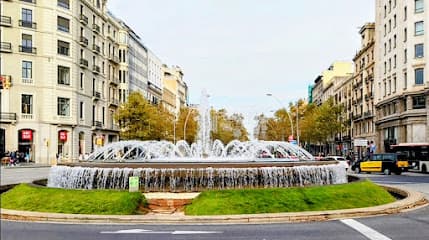
Barcelona is a city that breathes through its stone, and nowhere is the breath more labored or more beautiful than at the intersection of Gran Via and Passeig de Gràcia. This isn't a place for the faint of heart or the sensitive of lung. You are standing at the epicenter of the Eixample, a grid of ambition and exhaust fumes, where the Font Monumental del Passeig de Gràcia sits like a stubborn, regal island in a sea of yellow-and-black taxis and screaming Vespas.
If you’re looking for a quiet park bench and a moment of Zen, keep walking. This is the best of Barcelona’s urban theater—raw, loud, and unapologetically monumental. Designed in 1927 by Josep Maria Jujol, the man who was often the secret sauce in Antoni Gaudí’s most famous recipes, this fountain was built for the 1929 International Exposition. While the world was looking at the flashy pavilions on Montjuïc, Jujol was here, anchoring the city's most prestigious crossroads with a circular basin and a central stone pylon.
Look past the blur of traffic and you’ll see what he was doing. This isn't the sprawling allegory of his other works; it's a more restrained, muscular piece of urban furniture. The fountain is defined by its four bronze lampposts and the heavy, rhythmic flow of water into its stone basins. It’s a reminder that before this city was a playground for luxury brands and brunch spots, it was a place of civic pride and rugged, monumental ambition.
Jujol was a genius of the discarded and the visceral. While Gaudí got the headlines, Jujol was the one getting his hands dirty with the trencadís and the wrought iron. Here, he worked with a more classical vocabulary, but the energy is still there. The way the water hits the basins, competing with the roar of the Gran Via, feels like a constant argument between the 19th-century dream of a grand European capital and the 21st-century reality of a city that never shuts up.
Is it worth visiting? If you’re already walking down Passeig de Gràcia to gawk at Casa Batlló or drop a month’s rent at Loewe, you’d be a fool not to stop for five minutes. Most people treat it as a glorified traffic circle, a blur in the window of a tour bus. Don’t be that person. Cross the street, stand on the corner, and feel the spray of the water mixing with the heat of the asphalt. It’s a necessary stop if you want to understand the scale of Barcelona’s ego.
At night, the fountain transforms. The lighting—which reviewers often mention as 'magical'—softens the brutalist edges of the surrounding architecture and turns the water into something ethereal. It’s the only time the traffic seems to fade into the background, replaced by a sense of old-world grandeur. You realize that this fountain isn't just a decoration; it’s a landmark, a compass point for anyone trying to navigate the beautiful madness of the Eixample.
Don't expect a gift shop. Don't expect a tour guide. Just bring your eyes and maybe a little patience for the crowds. It’s a public monument in the truest sense—free, exposed, and enduring. It’s a testament to a time when we built things to last, even when we knew they’d eventually be surrounded by the chaos of modern life. It’s Barcelona in a nutshell: high art, heavy traffic, and a stubborn refusal to be ignored.
Type
Tourist attraction
Duration
15-30 minutes
Best Time
Nighttime for the lighting effects
What People Say
classical music(2)lighting(2)traffic(2)magical(2)clothes(2)
Features
Tourist attraction
Categories
ArchitectureSculpturePublic ArtHistory
Ticket Prices
Free Admission
No tickets required
Opening Hours
- MondayOpen 24 hours
- TuesdayOpen 24 hours
- WednesdayOpen 24 hours
- ThursdayOpen 24 hours
- FridayOpen 24 hours
- SaturdayOpen 24 hours
- SundayOpen 24 hours
Must-See Highlights
The four bronze lampposts surrounding the basin
The central stone pylon and decorative carvings
The night-time lighting display
Visitor Tips
Watch out for heavy traffic when trying to get a good photo angle
Combine this with a visit to the nearby 'Block of Discord' (Manzana de la Discordia)
It's a great meeting point if you're lost in Eixample
Good For
Architecture buffsHistory loversPhotographersBudget travelers
Why Visit
Designed by Josep Maria Jujol, Gaudí's most important collaborator
Features four iconic bronze lampposts and a central stone pylon characteristic of Jujol’s style
A rare 1920s monumental survivor in the heart of the modern luxury district
Nearby Landmarks
- Casa Batlló (5-minute walk)
- Casa Amatller (5-minute walk)
- El Nacional (3-minute walk)
- Plaça de Catalunya (7-minute walk)
Accessibility
- Wheelchair accessible (public sidewalk)
- Outdoor viewing
Location
Gran Via de les Corts Catalanes, 638
Eixample, Barcelona
Nearby Hotels
Nearby Restaurants
In Eixample
ATTRACTION
Mural Margalef
Eixample
A towering splash of Mediterranean blue breaking the rigid geometry of Eixample, Joan Margalef’s mural is a visceral reminder that Barcelona’s soul isn't just in its museums.
0.0(0)
Tourist attraction
ATTRACTION
Mural Margalef
Eixample
A geometric middle finger to urban decay, this massive kinetic mural by Eduard Margalef turns a drab Eixample blind wall into a rhythmic, shifting explosion of optical art.
0.0(0)
Tourist attraction
ATTRACTION
Happy Foodies
Eixample
Forget the plastic-wrapped tourist traps; this is a deep dive into the grease, garlic, and soul of Catalan cooking where you actually learn to handle a knife and a porrón.
0.0(0)
Sightseeing tour agencyTour agency
Frequently Asked Questions
Is Font Monumental del Passeig de Gràcia worth visiting?
Yes, especially for fans of architecture and history. It is a free, monumental work by Josep Maria Jujol that serves as a grand anchor for the city's most famous shopping district.
What is the best time to see the fountain?
Evening is best. The fountain is beautifully illuminated at night, which creates a 'magical' atmosphere that contrasts with the heavy daytime traffic of the Eixample.
How do I get to the Font Monumental?
It is located at the intersection of Passeig de Gràcia and Gran Via. The easiest way is to take the Metro (L2, L3, or L4) to the Passeig de Gràcia station; the fountain is just steps away from the main exits.
Reviews
0 reviews for Font Monumental del Passeig de Gràcia
No reviews yet. Be the first to share your experience!